Table of Contents
South Korea's rapid production of AI-assisted books has raised two practical questions: who checks the writing before publication, and which titles should be accepted through the country's library deposit system? Reports about one prolific publisher and a disputed translation of The Odyssey brought both issues into focus in 2026.
Why readers questioned the books
A Korean edition of The Odyssey drew criticism for modern slang that some readers found out of place in the ancient story. The publisher said the wording was intentional and that people had reviewed the AI-assisted translation. The dispute illustrates a real editorial choice: even when a machine drafts a translation, a named editor needs to assess tone, meaning, consistency, and the intended audience. A stylistic change should be explained to readers rather than assumed to be faithful to every source passage.
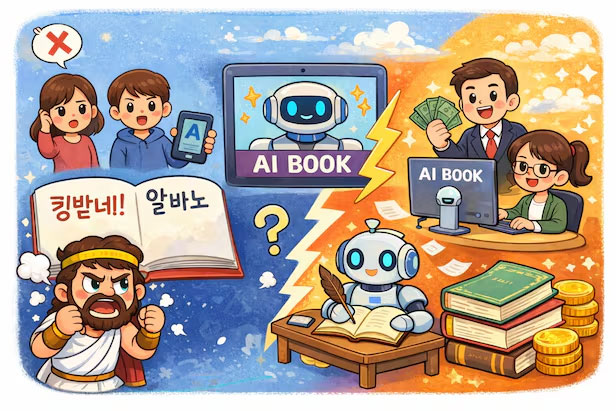
Separately, The Korea Times reported that Seoul-based Luminary Books produced roughly 9,000 titles in a year using AI-assisted production. Volume alone does not prove every title is poor, but it makes basic checks—accurate facts, readable prose, clear attribution, and disclosure of AI involvement—especially consequential.
What is the legal deposit dispute?
Under the National Library of Korea's legal-deposit guidance, publishers submit qualifying material so it can be preserved in the national collection. Korean reporting said the library declined 395 Luminary Books e-books submitted for deposit in 2025. The publisher disputed claims that it had obtained deposit compensation and said it submitted only a portion of its catalog.

In March 2026, South Korea's culture minister said the government was pursuing a clearer basis for excluding books mass-generated by AI from legal deposit, according to Seoul Economic Daily. That was a policy proposal and monitoring effort, not proof that every AI-assisted book had already been prohibited. The distinction between AI-assisted editing and a minimally reviewed, automatically generated title matters to publishers and libraries alike.
What should a buyer or publisher check?
For a translated classic, compare a sample with an established edition, inspect the translator and editor credits, and look for a note explaining whether AI was used. For nonfiction, spot-check references, dates, and claims before relying on the book. Publishers can reduce preventable errors by keeping a human review trail and stating the tool's role honestly. TipsMake's AI translation tools overview discusses where machine translation needs checking, while the prompt-chaining guide gives an example of separating translation from proofreading.
Related Articles
 South Korea Achieved a New Breakthrough with Nuclear Fusion Experiments5 minutes read
 Lenovo's AI Assistant Advertisement Sparks Controversy for Making Humans Feel Like 'Superfluous'6 minutes read
 South Korea: the Capital Seoul Witnessed the First Cherry Blossoms Blooming5 minutes read
 South Korean Crypto Firms Prepping to Meet the FATF Travel Rule5 minutes read
 South Korea Uses Technology to Combat Covid-19: a Quarantine6 minutes read
 South Korea Has a Similar Pattern of Deaths Due to Covid-194 minutes read
Reader Comments 0
Sign in with email or Google to join the discussion.