Table of Contents
This guide explains 8 tips when using quick look in os x with practical context and clear actions. Use the points below to avoid common mistakes and make better decisions.
TipsMake - Quick Look of OS X allows users to view the contents of a file by selecting it in the Finder and then pressing the spacebar.Users no longer have to wait for hco until the file is opened in the app - it appears immediately.So you can see the number or date or simply view the file you want. Besides, you can also read text files, RFT files, Word, Excel and PowerPoint files; Play video files in various formats or even listen to music. However, these still don't tell the power of Quick Look, it even does more.
1. View Multiple Files with Quick Look
If you've just selected a file in the Finder and viewed it with Quick Look, you can also easily view other files in the same folder. Just press the arrow key to be. If you are using, display List View or Column view , press the up arrow or the down arrow to view another file. If you are in the Icon View Display, use the up or down arrows and use the right or left arrows to view the items in the other column. Using this method, users can go through a folder by selecting the first file, pressing the spacebar and then using the arrow keys to view other items.
2. View Multiple Pages in the Text
When opening a multi-page file with Quick Look, users can scroll through a single view to see all the data. For example, if you select a PDF file and press the spacebar, the first page appears with thumbnails of other pages in the sidebar on the right. To read these pages, the user has two ways: to use the mouse or trackpad to select it, or press the Page Up or Page Down button To move through them. (If you are using a laptop, you will have to use the arrow Fn-Up Arrow And Fn-Down Arrow To perform). This also applies to data created by Apple's Pages, Numbers and Keynote apps as well as Microsoft Word, Excel, and PowerPoint data.
 When viewing multi-page data with Quick Look, select the thumbnail to the right to see different pages.
3. Copy and Paste Quick Look Content
By default, users can only view the content of the data in Quick Look, but a recent suggestion by Macworld shows how to enable the hidden feature, allowing you to copy text from the open data. Just a simple command is enough.
To select text in Quick Look, users only need to enable hidden Finder settings. Select and copy the code below, open Terminal (/ Apps / Utilities), paste the code into the command and press Return:
Defaults write com. Apple. Finder QLEnableTextSelection -bool TRUE; killall Finder
After a second or two, Finder will restart. After booting, you can select the text in Quick Look and copy it to Clipboard for later use.
If you do not want to select text in Quick Look anymore, use the following command to disable this feature:
Defaults delete com. Apple. Finder QLEnableTextSelection; killall Finder
4. Preview the Attachments in Mail
If you receive an email message with a Mail attachment (OS X can read the attachment), you can select the Quick Look button in the top right corner of the message to view it.
 Select the Quick Look button in Mail to see the attachment.
If there are multiple attachments, the arrow appears in the top left corner of the Quick Look window; select one of them to see the next or previous attachment. You will also see the Open With App Name button, allowing users to open the currently viewed file with an app. (With OS X Lion, you'll see this option in most cases when using Quick Look. )
When you have finished viewing the attachment, press the spacebar or select the close button to exit the Quick Look window.
5. See Spotlight Results
If you use Sportlight to search for files on your Mac, you can access Quick Look's options when searching for results. Move the mouse over a search result to see the contents of the file. For example, scroll through a web page to see how it is, move the mouse over the video or music file, then move the cursor over the display and select the arrow to run it, move the cursor over Word data. To see its content.
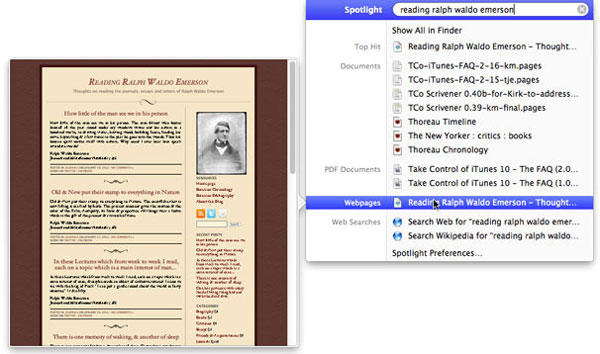 Scroll through the Sportlight results to see Quick Look display of a web page in a web browser.
6. View News Items in iTunes
Although it is not possible to use Quick Look in iTunes - choose a song and press the spacebar to run it - there is a way to access Quick Look-like features right inside the software. Using Have a Quick Look Apple Doug Adams script, you can view PDF and music files without leaving what is running. Besides, users can watch videos. Just select a news item in iTunes and access the script from the Script menu.
7. Check the File Twice in Terminal
Wouldn't it be great to be sure that you have the right files before doing something with a script? Although you may not have thought about this before, it would be great to enable Quick Look from within Terminal, the OS X command line interface. Users can do this using qlmanage command.
8. See What's in the Trash
You put a few files in Trash, but now you're wondering if you will miss something important. OS X does not allow opening files in Trash, so will you have to copy everything to a folder to check them out? Not required to do so. Just select the file and press the spacebar to view it with Quick Look.
FAQ
How should I compare the options in this list?
Compare compatibility, essential features, ease of use, support, and total cost rather than choosing by popularity alone.
Are free options enough for most users?
Free options may cover basic needs, but advanced features, fewer limitations, and better support can make a paid option worthwhile.
What feature matters most when choosing?
Prioritize the feature that solves your main need reliably on the device or platform you use.
Related Articles
 Life Will Become Easier with 9 Quick Calculation Tips Learned7 minutes read
 Quick and Accurate Mental Arithmetic Tips Make You Surprised2 minutes read
 How to Bring Mac Quick Look to Windows3 minutes read
 Quick Shortcut for Coc Coc Web Browser2 minutes read
 How to Use Quick Parts to Quickly Insert a Word Text Block5 minutes read
 Quick Action Tips on Windows3 minutes read
Reader Comments 0
Sign in with email or Google to join the discussion.