Table of Contents
This guide explains Keyword Difficulty, why it matters, how it works, and how to evaluate or use it in practical situations.
What is Keyword Difficulty?
Even if your longest and most information-rich content is perfectly optimized for the right keywords, it's not always enough to earn top search rankings.
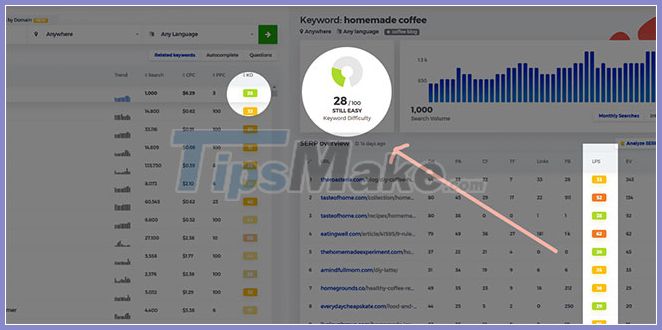
So, before you decide which keywords to target, take a look at the competitors ranking at the top on the search results page for a particular phrase. Pay attention to the strength of the domains and the pages where that particular piece of content is published.
If your competitor's domains (and pages) are much stronger than yours, then it is unlikely that you will overtake them, especially if you are new to the market.
That is a fact about modern SEO. Multiple SEO factors combine to determine daily search results, and Domain Authority is a very strong ranking signal.
Fortunately, keyword difficulty scores ease the difficulty of manually checking hundreds of keywords in your search. This metric is especially useful when you're working on super long keyword lists and need to evaluate keywords at a glance.
Keyword difficulty or keyword difficulty, as its name suggests, reflects how difficult it is to get to the top of the search results for a particular keyword. A better understanding of this metric will help you quickly identify which keywords to use in your strategy and give you an idea of where you'll be ranked.
How do I test keyword difficulty?
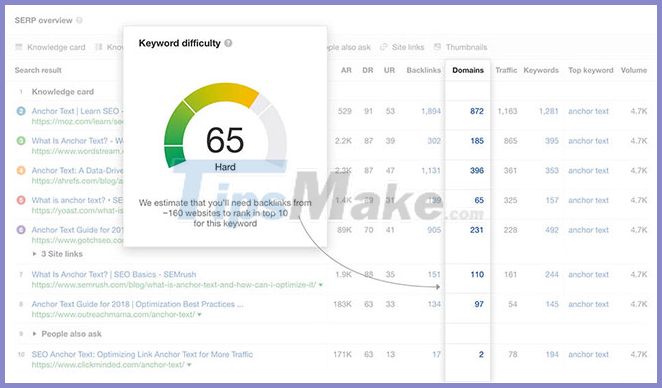
The keyword difficulty calculation is entirely based on your link profile, which is estimated by Page Authority and Domain Authority metrics respectively. Both are continuously evolving.
In the past, you could literally call keyword difficulty literally the PA median of the top 10 search results for a given term.
These days, the calculation is more advanced and is based on the average Page Authority weighted CTR on the first page of results, between 0 and 100, with 100 being the hardest ranking.
Determining the keyword difficulty also requires an explanation of the meaning of Page Authority and Domain Authority.
Domain Authority
In short, Domain Authority is one of the most important metrics in modern SEO, measured on a 100-point scale, where 100 is the maximum authority. The better the DA, the stronger the entire domain and the easier it is to reach the top positions in the search engine results page.
Domain Authority is built from many factors. However, the strongest factor is the website's affiliate profile. Specifically, how many backlinks the site has and how trustworthy those links are.
You can easily check your Domain Authority and Page Authority for free here.
Page Authority
Page Authority predicts how a particular website is likely to be ranked in a search engine's results page. Similar to the DA, this score is based on a 100 logarithmic scale, where 100 is the strongest.
If you want to improve the credibility of a domain and a particular page, you need to work with the overall SEO strategy, which calculates metrics based on completely different SEO factors.
But most importantly, you should focus on your affiliate profile, disavow poor quality backlinks, and at the same time try to achieve reliable backlinks.
FAQ
What should I know about Keyword Difficulty?
Focus on the key features, requirements, limitations, and practical use cases explained in this guide.
How do I get the best results with Keyword Difficulty?
Follow the recommended steps, use current software or information, confirm compatibility, and review settings before major changes.
Are there any risks or limitations?
Potential limitations depend on compatibility, data quality, cost, privacy, support, and how the product or method is used.
Related Articles
 12 Free Keyword Analysis Tools Replace Google Keyword Tool6 minutes read
 How to Use Google Keyword Planner19 minutes read
 12 Top Keyword Analysis Tools: Top Picks and Buying Guide10 minutes read
 Google Keyword Tool: What You Need to Know13 minutes read
 How to Do Keyword Research for SEO: Clear Instructions34 minutes read
 6 Most Effective Keyword Research (Keyword Research)8 minutes read
Reader Comments 0
Sign in with email or Google to join the discussion.