Table of Contents
What are real numbers? What are real numbers? This article will provide you with everything you need to know about real numbers.
Real numbers are continuous quantities that can represent a distance on a straight line, because real numbers include both rational and irrational numbers. Rational numbers occupy points at a finite distance, and irrational numbers fill the spaces between them, forming a real straight line. In other words, real numbers are numbers that can be represented on a real straight line.
Real numbers include rational numbers, which are positive integers, negative integers, fractions, and irrational numbers. Basically, any number we can think of is a real number.
Examples of rational numbers are 2, 3.5, 6/7, √5, 0.35, -67,
π
, e, etc.
In this article, we will discuss real numbers in detail, including their properties, representation on the number line and decimal expansion, and check whether 0 is a real number.
1. What are real numbers?
- Real numbers are the set of rational and irrational numbers.
- A set
is the notation for the set of real numbers, which consists of real numbers.
- A rational number is a number that can be written as a fraction
(a, b ∈ Z, b ≠ 0). For example.
- The set of rational numbers is denoted by
- Irrational numbers are infinite, non-repeating decimal numbers. For example:
- The set of irrational numbers is denoted by


The set of real numbers 
For example: 
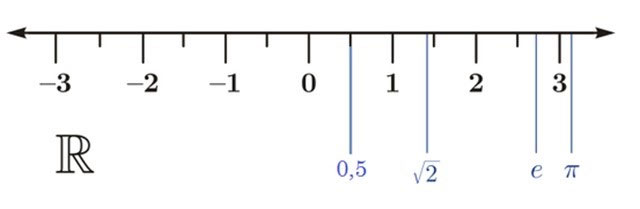
2. The real number line
Each real number is represented by a point on the number line.
- Conversely, each point on the number line represents a real number.
- Only the set of real numbers can fill the number line.
3. Comparing real numbers
Method
- For any two real numbers x and y, we always have x = y, or x < y, or x > y.
- Real numbers greater than 0 are called positive real numbers, and real numbers less than 1 are called negative real numbers. Zero is neither a positive nor a negative real number.
- Comparing positive real numbers is done similarly to comparing rational numbers.
- With a and b being two positive real numbers, if a > b then
.
Example: Fill in the square with an appropriate digit:
| a) -7.5(.)8 > -7.513 | b) -3.02 < -3,(.)1 |
| c) -0.4(.)854 < -0.49826 | d) -1,(.)0765 < -1,892 |
Solution guide
a) -7.5(0)8 > -7.513
b) -3.02 < -3.(0)1
c) -0.4(9)854 < -0.49826
d) -1,(9)0765 < -1,892
Example: Sort the real numbers: 
Solution guide
Arrange the real numbers in ascending order: 
Example: Prove that:
For a and b being two positive real numbers, if a > b then 
Solution guide
If a > b then 
Since a and b are two positive real numbers, a + b > 0.
If a > b then a – b > 0
Analysis
%20(a%20%E2%80%93%20b))
%20%2B%20b(a%20%E2%80%93%20b))


Therefore 
(a%20%E2%80%93%20b)%20%3E%200)
=> a 2 > b 2 => QED
3. Properties of the set of real numbers
In the set of rational numbers 
In the set of real numbers, the operations with respect to multiplication have the following properties:
- For all
attributes
:
- Adding zero:
- Commutative property:
;
- Associative properties:
- Commutative property: a. b = b. a
- Associative property: (a. b). c = a. (b. c)
- Properties of multiplication by 1:
- Distributive property of multiplication over addition: a. (b + c) = a. b + a. c
- For every real number a ≠ 0, there exists an inverse
such that

%20%2B%20c%20%3D%20a%20%2B%20(b%20%2B%20c))


- This means that the above operations 
The relationship between sets of numbers

Example: Perform the calculation: %3A%5Cleft(%204%5Cfrac%7B2%7D%7B3%7D%20%2B%200%2C15%0A%5Cright))
Solution guide

Example: Find x, knowing that: 
Solution guide

4. Absolute value of a real number
Definition: The distance from point a to point 0 on the number line is the absolute value of a number a (a is a real number). The absolute value of a non-negative number is itself, and the absolute value of a negative number is its opposite.
Overview:
- If
- If
- If
- If


Nature
- The absolute value of every number is non-negative.
- In general:
for every a ∈ R
Specifically:


Some properties
- If two numbers are equal or opposite, then they have the same absolute value, and conversely, if two numbers have the same absolute value, then they are either equal or opposite.
Overview: 
- Every number is greater than or equal to the opposite of its absolute value and at the same time less than or equal to its absolute value.
In general: 

- Of two negative numbers, the smaller one has a larger absolute value.
In general: If 
- Of two positive numbers, the smaller one has a smaller absolute value.
In general: If 
- The absolute value of a product is equal to the product of its absolute values.
Overview: 
- The absolute value of a quotient is equal to the quotient of the two absolute values.
Overview: 
5. Example exercises on real numbers
Example 1: Fill in the appropriate sign ∈, ∉, or ⊂ in the blank (…):
3…. Q ; 3…. R ; 3… I ; -2.53…Q;
0.2(35) …. I ; N…. Z ; I …. R.
Instruct
a) 3 ∈ Q ; 3 ∈ R ; 3 ∉ I ; -2.53 ∈ Q
b) 0.2(35) ∉ I ; N ∈ Z ; I ⊂ R
Example 2: Find the sets
a) Q ∩ I ;
b) R ∩ I.
Instruct
a) Q ∩ I = Ø ;
b) R ∩ I = I.
Example 3: Fill in the appropriate digit in (…)
a) – 3.02 < – 3, … 1
b) – 7.5 … 8 > – 7.513
c) – 0.4 … 854 < – 0.49826
d) -1, … 0765 < – 1,892
Instruct
a) – 3.02 < – 301
b) – 7,508 > – 7,513 ;
c) – 0.49854 < – 0.49826 ;
d) -1.90765 < – 1.892.
Example 4: Find x, knowing that:
3.2x + (-1.2x) + 2.7 = -4.9;
Instruct
3.2. x + (-1,2).x + 2,7 = -4,9
[3,2 + (-1,2)].x + 2,7 = -4,9.
2.x + 2.7 = – 4.9.
2.x = – 4.9 – 2.7
2.x = – 7.6
x = -7.6 : 2
x = -3.8
Besides real numbers, you can learn more about other definitions in mathematics such as perfect squares , irrational numbers, rational numbers , prime numbers , natural numbers , etc.
Related Articles
 How Will Viettel Network Customers Be Supported to Transfer 11 Numbers to 10 Numbers?4 minutes read
 These Scary Numbers Are Haunting All over the World7 minutes read
 How to Block Spam Phone Numbers on iPhone5 minutes read
 Guide to Look up Phone Numbers with Google and Facebook9 minutes read
 How to Use Formulas and Functions in Numbers on Mac4 minutes read
 Draw the Guy Wearing a Cowboy Hat with Numbers from 1 - 10 Exciting2 minutes read
Reader Comments 0
Sign in with email or Google to join the discussion.