Table of Contents
Every PowerPoint presentation consists of a series of slides. To begin creating a slideshow, you need to know the basics of working with slides. You'll need to master tasks such as inserting new slides, changing slide layouts, rearranging existing slides, changing slide views, and adding notes to slides.
Learn about slides and slide layouts.
When you insert a new slide, there will usually be placeholders showing you where to place your content. Each slide will have different layouts for placeholders, depending on the type of information you want to include. Whenever you create a new slide, you will need to choose a slide layout that suits your content.
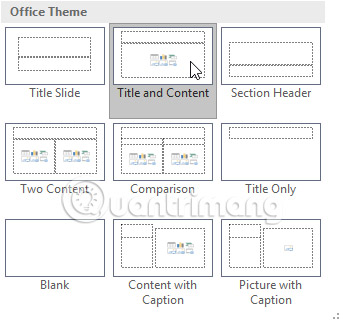
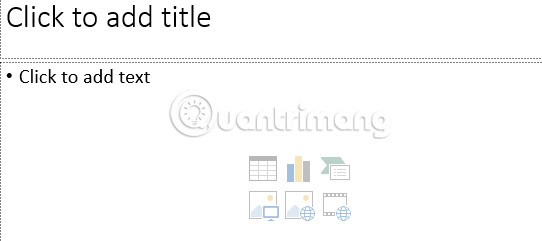
Placeholders can contain different types of content, including text, images, and videos. Many placeholders have thumbnail icons. You can click on them to add specific types of content. In the example below, the slide has placeholders for the title and content.
How to insert a new slide
Whenever you start a new presentation, you'll see a slide with a Title Slide layout. You can insert as many slides as you like with various layouts.
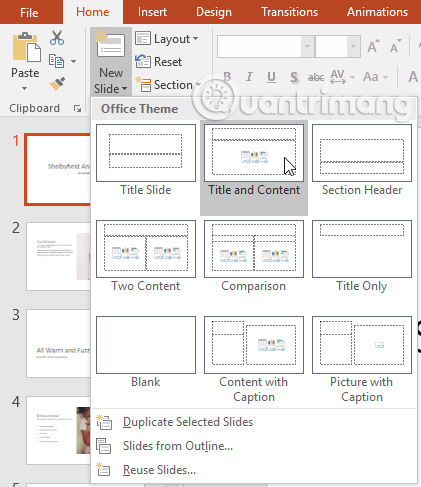
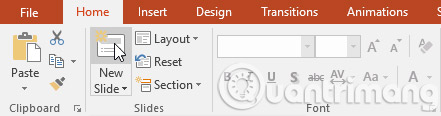
1. From the Home tab, click the bottom half of the New Slide command.

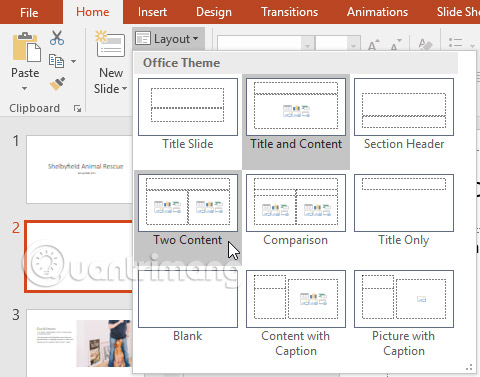
2. Select your desired slide layout from the menu that appears.
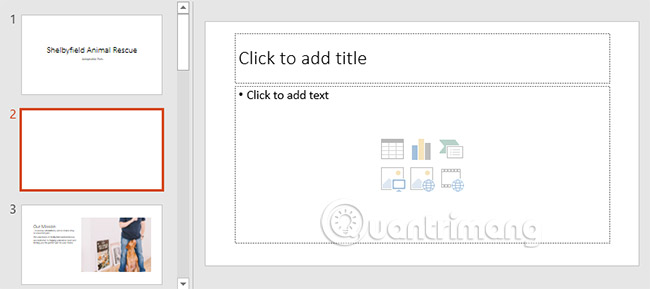
3. A new slide will appear. Click on any placeholder and start typing to add text. You can also click on any icon to add other types of content, such as images or charts.
To change the layout of an existing slide, click the Layout command, and then select your desired layout.
To quickly add a new slide using the same layout as the selected slide, click the top half of the New Slide command.
Arrange the slides
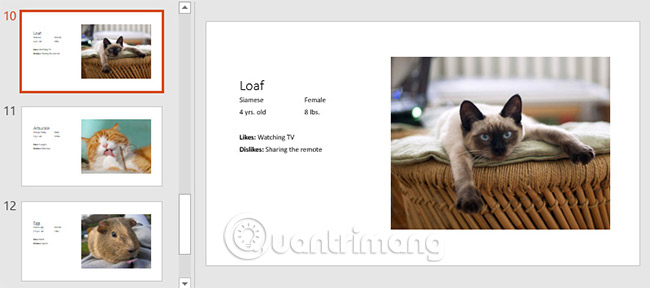
PowerPoint presentations can contain as many slides as needed. The Slide Navigation panel on the left side of the screen makes it easy to organize your slides. From there, you can copy, rearrange, and delete slides in your presentation.
Working with slides
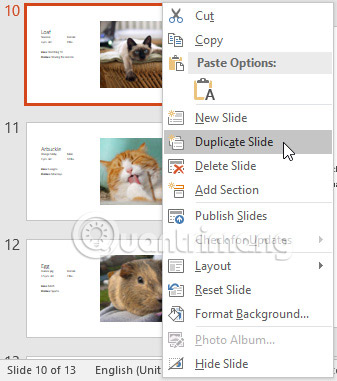
- Duplicate slides: If you want to quickly copy and paste slides, you can duplicate them. To duplicate a slide, select the slide you want, right-click, and choose "Duplicate slide" from the menu that appears. You can also duplicate multiple slides at once by selecting them first.
- Move slides: It's easy to change the order of your slides. Simply click and drag the desired slide in the Slide Navigation panel to the desired position.
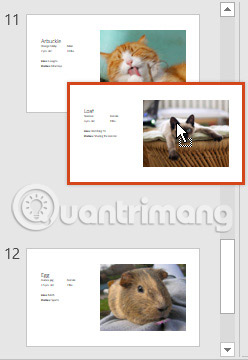
- Delete slides: If you want to delete a slide from your presentation, simply select the slide you want to delete, then press the Delete or Backspace key on your keyboard.
How to copy and paste slides
If you want to create several slides with the same layout, you might find it easier to copy and paste the slides you've already created than to start with a blank slide.
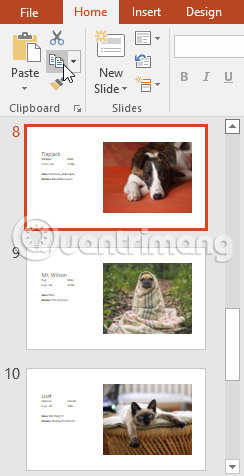
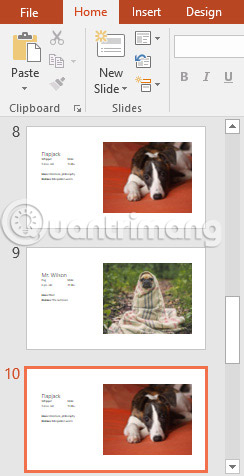
1. Select the slide you want to copy in Slide Navigation, then click the Copy command on the Home tab. Alternatively, you can press Ctrl + C on your keyboard to perform the same task.
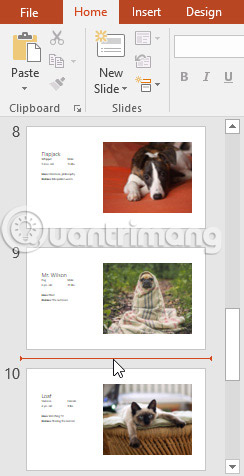
2. In Slide Navigation, click just below the slide (or between two slides) to select the insertion point. A horizontal insertion point will appear.
3. Click the Paste command on the Home tab. Alternatively, you can also press Ctrl + V on your keyboard.
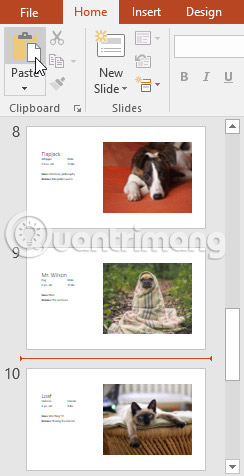
4. The slide will appear at the selected location.
Customize slide layout
Sometimes you might find that the slide layout isn't quite right for your needs. For example, the layout might have too many or too few placeholders. You might also want to change how placeholders are arranged on the slide. Fortunately, PowerPoint makes it easy to adjust slide layouts when needed.
Adjust the placeholders
To select a placeholder : Hover your mouse over the edge of the placeholder and click (you may need to click on the text within the placeholder first to see the border). A selected placeholder will have a solid line instead of a dotted line.

To move a placeholder : Select the placeholder, then click and drag it to the desired location.

Resizing a placeholder : Select the placeholder you want to resize. Resizing handles will appear. Click and drag these handles until the placeholder is the desired size. You can use the handles at the corners to adjust both the height and width of the placeholder simultaneously.

To delete a placeholder : Select the placeholder you want to delete, then press the Delete or Backspace key on your keyboard.
How to add a text box
Text can be inserted into both placeholders and text boxes. You can add text boxes to your slide layout if you wish. Unlike placeholders, text boxes remain in a fixed position, even when you change themes.
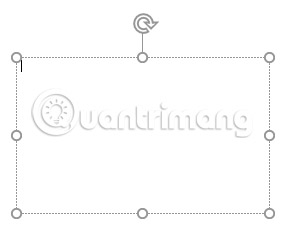
1. From the Insert tab, select the Text Box command.

2. Click and drag to draw a text box on the slide.

3. A text box will appear. To add text, simply click on the text box and start typing.
Use blank slides.
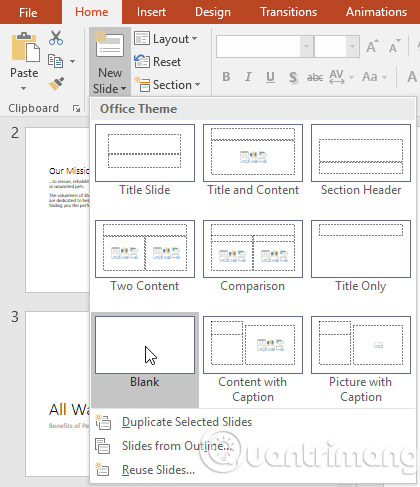
If you want more control over your content, you might prefer using blank slides (without placeholders). Blank slides can be customized by adding your own text boxes, images, charts, and more.
To insert a blank slide, click the bottom half of the New Slide command, then select Blank from the menu that appears.
While blank slides offer more flexibility, keep in mind that you won't be able to take advantage of the pre-designed layouts included in each theme.
How to project a presentation
Once you've finished arranging your slides, the next step is to deliver the presentation. This is how you'll introduce your presentation to your audience.
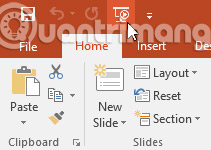
1. Click the Start From Beginning command on the Quick Access Toolbar to view your presentation.
2. The presentation will appear in full-screen mode.
3. You can move to the next slide by clicking the mouse or pressing the spacebar on your keyboard. Alternatively, you can use the arrow keys on your keyboard to navigate to the previous and next slides in the presentation.
4. Press the Esc key to exit presentation mode.
You can also press the F5 key at the top of your keyboard to start the presentation.
Customize the slides
How to resize a slide
By default, all slides in PowerPoint 2013 use a 16:9 aspect ratio, or widescreen. You may already know that widescreen TVs also use a 16:9 aspect ratio . Widescreen slides will work best with monitors and projectors. However, if you need your presentation to fit a 4:3 screen, it's easy to resize the slides accordingly.
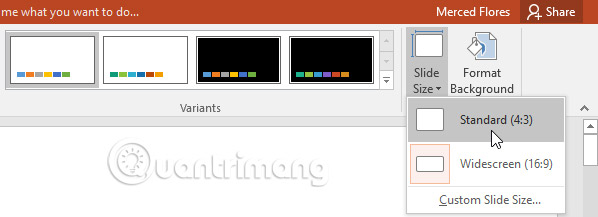
To change the slide size, select the Design tab, then click the Slide Size command. Choose your desired slide size from the menu that appears, or click Custom Slide Size for more options.
Background slide format
By default, all slides in your presentation use a white background. It's easy to change the background style for some or all of your slides. Backgrounds can be Solid, Gradient, Pattern, or Picture fill.
1. Select the Design tab, then click the Format Background command.

2. The Format Background panel will appear on the right. Select the option you want. In this example, we will use Solid fill with a light yellow color.
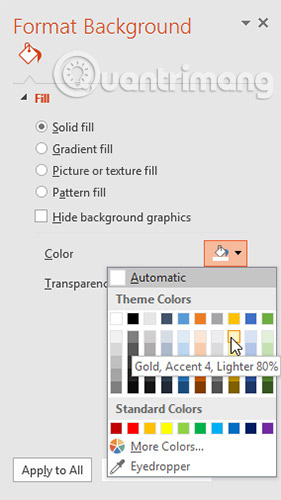
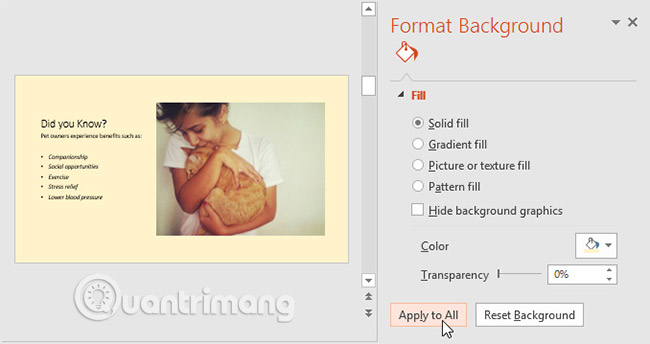
3. The background style selected for the slide will be updated.
4. If you wish, you can click Apply to All to apply the same background style to all slides in your presentation.
Apply a theme
A theme is a predefined combination of colors, fonts, and effects that can quickly change the look and feel of an entire slideshow. Different themes also use different slide layouts, which can alter the arrangement of your existing placeholders. This will be discussed in more detail in the article: Applying Themes in PowerPoint 2016.
1. Select the Design tab on the Ribbon, then click the More dropdown arrow to see all available themes.

2. Choose your desired theme.
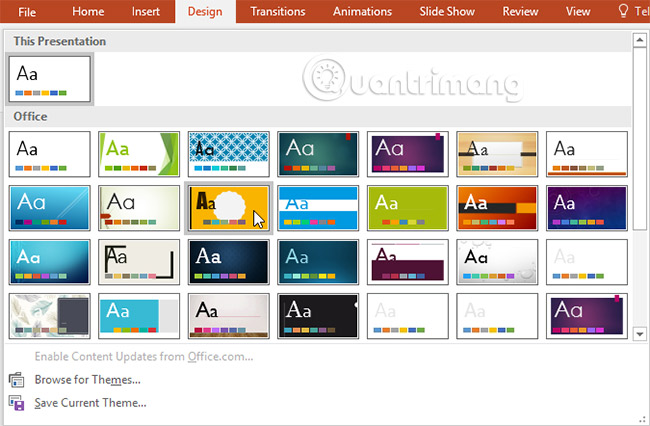
3. The theme will be applied to your entire presentation.
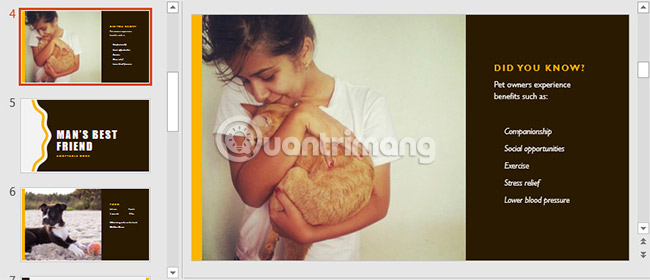
Try applying a few different themes to your presentation. Some themes will be more effective than others, depending on your content.
Practice!
1. Open the sample presentation .
2. Change the theme of the presentation.
3. Delete slide 7. This slide must be blank.
4. Add a new slide with the Title and Content layout to the end of the presentation.
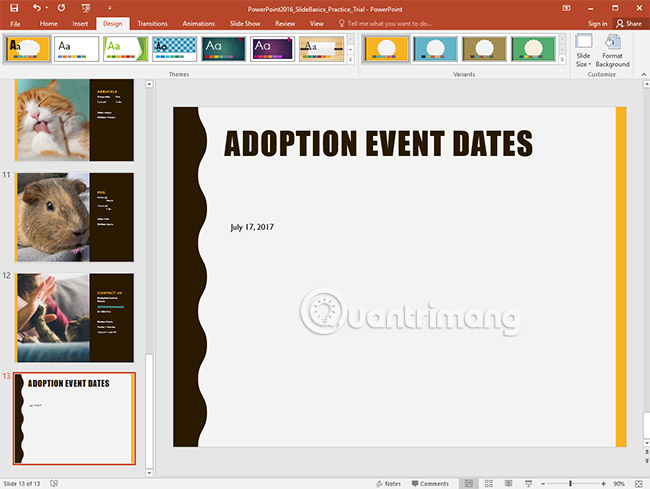
5. In the Title placeholder, type Adoption Event Dates.
6. Select the placeholder Content and delete it.
7. Insert a text box and type July 17, 2017 inside it.
8. Change the slide size to Standard (4:3). A dialog box will appear asking if you want to select Maximize or Ensure Fit. Choose Ensure Fit.
9. When you're finished, your presentation will look like this:
See more:
- Creating and opening presentations in PowerPoint 2016
- How to save a presentation in PowerPoint 2016
- Create beautiful slides for your PowerPoint presentation with these 8 tips.
Related Articles
 Basic Information About Slides in PowerPoint 201611 minutes read
 PowerPoint 2019 (Part 4): Basic Slide Concepts: Explained11 minutes read
 Why People Use Google Slides More Than PowerPoint7 minutes read
 PowerPoint 2019 (Part 21): Tables: Explained7 minutes read
 How to Convert Google Slides to Powerpoint3 minutes read
 How to Reduce the Size of PowerPoint Files Effectively6 minutes read
Reader Comments 0
Sign in with email or Google to join the discussion.