Table of Contents
Winning as a Hider in MECCHA CHAMELEON is not about finding the darkest corner. You need to paint your white character so it looks like part of the stage, choose a pose that breaks up the human outline, and avoid movement that gives the disguise away.
A slightly imperfect paint job in a believable cluster of scenery can survive longer than a perfect color match in an empty space. Treat hiding as a combination of placement, paint, pattern, pose, and patience.
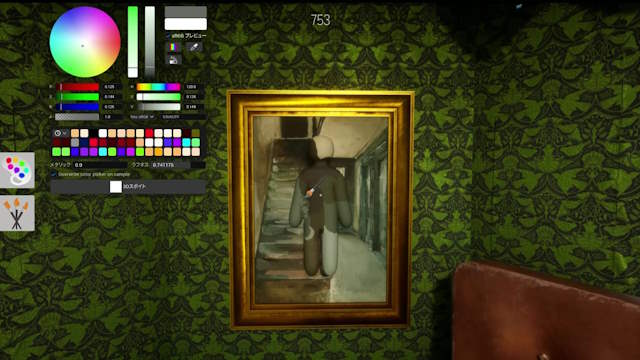
1. Choose the hiding spot before painting
The preparation window disappears quickly. Spend the opening moments scanning for two or three viable spots, commit to one, and use the remaining time to paint and pose. Wandering until the final seconds usually leaves a bright patch or unfinished limb that Seekers can identify immediately.
Look for areas where your shape makes visual sense:
- clusters of boxes, signs, furniture, pipes, or decorations;
- corners where part of the body can overlap existing geometry;
- surfaces with several colors or irregular details;
- areas that can be reached without crossing an exposed route once the hunt begins.
A smooth, empty wall is unforgiving because every edge is visible. Use it only when you can align the pose and paint closely. Clutter is more tolerant of small mistakes.
2. Match the dominant tone and contrast
Do not chase one tiny highlight. First match the broad color family of the surface behind you. Then compare how light or dark your body appears against the surrounding area. A correct hue that is much brighter than the background still stands out.

Check the disguise from the direction a Seeker is likely to enter. Lighting and nearby objects can change the apparent shade, so a color that looked correct while painting may create obvious contrast from the doorway.
3. Reproduce large patterns, not every detail
Stripes, tiles, panels, and strong color boundaries are more important than tiny texture marks. If a line continues across the background, carry that line across the visible part of the character and align it from the expected viewing angle.
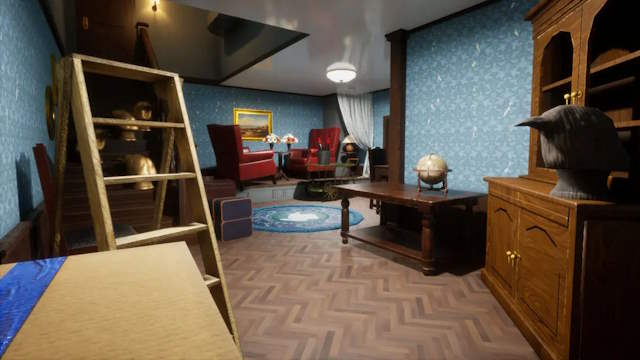
Use a simple order:
- Apply the main background color.
- Add the largest contrasting block or stripe.
- Align the boundary while holding the final pose.
- Spend any remaining time correcting the most visible edges.
Overpainting can be as harmful as underpainting. A busy design that does not match the stage looks like a player trying to hide.
4. Break up the character silhouette
Seekers often notice a head, shoulders, hands, or feet before they notice a slight color error. Choose a pose that makes the outline resemble nearby scenery. Crouching can work among low props; a stretched or wall-aligned pose may suit pipes, shelving, or vertical decorations.
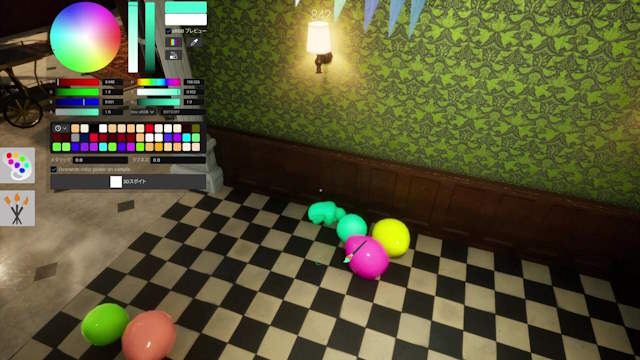
A believable position matters. A perfectly painted figure floating beside a wall or blocking a walkway still looks suspicious. Test the pose before finalizing the pattern, because changing posture can move painted sections out of alignment.
5. Hide from the Seeker's route, not your camera
Rotate the view and inspect the spot from common entrances. Ask three questions:
- Which edge of the body is visible first?
- Does the pattern line up from that angle?
- Is there an unexplained shape where no stage object belongs?
The best-looking angle from close range is not always the angle the Seeker sees during a fast scan. Prioritize the doorway, corridor, or elevation most likely to reveal you.
6. Stop adjusting once the hunt begins
Movement is one of the clearest signals a Seeker can receive. After settling into the final pose, avoid unnecessary camera, body, or position changes that affect the character. Use the game's rotation-lock or pose controls where appropriate, and check the current on-screen prompts if your controls were remapped.
Do not turn repeatedly just to watch a nearby Seeker. Trust the preparation and listen for activity. A weak disguise can sometimes survive a quick scan; a moving disguise rarely does.
7. Use visual noise without crowding teammates
Busy scenery gives the eye more information to process, but several Hiders packed into one corner can make the entire area suspicious. Leave enough space that another player's poor camouflage or movement does not expose you.
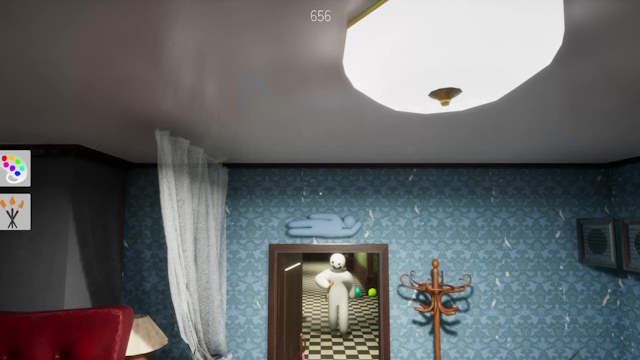
If a Seeker focuses on a nearby target, staying still is usually safer than fleeing. Move only when the Seeker's attention and sight line are clearly elsewhere.
8. Plan one escape, then use it sparingly
Before the hunt begins, identify a nearby obstacle, corner, or second hiding area. An escape route is useful when the Seeker has already committed to checking your exact position. It is not a reason to roam whenever someone enters the room.
When moving:
- wait until the Seeker turns away or leaves the direct sight line;
- move toward a specific destination rather than running randomly;
- avoid crossing the center of the room;
- do not lead the Seeker toward teammates;
- accept that remaining still may be the better gamble when discovery is uncertain.
Common Hider mistakes
| Mistake | Why it fails | Better choice |
|---|---|---|
| Painting before choosing a spot | The final background does not match | Commit to a location first |
| Using one flat color everywhere | Limbs and lighting create obvious contrast | Match the main tone, then add the largest shade or pattern change |
| Copying tiny details | Preparation time is wasted | Prioritize silhouette and large boundaries |
| Choosing an empty wall | The body outline is easy to scan | Blend into a believable prop cluster |
| Changing pose late | Paint alignment breaks | Select the final pose before finishing the pattern |
| Watching the Seeker constantly | Visible motion reveals the disguise | Lock in and move only for a clear escape |
A fast preparation routine
- Scan the room and select a plausible prop cluster.
- Test the final pose and expected Seeker angle.
- Paint the dominant background tone.
- Add one or two major light, dark, or patterned areas.
- Correct the head, hands, feet, and outer edges.
- Identify an escape route, then stop moving.
The official MECCHA CHAMELEON Steam page summarizes the core loop: hiding spot, pose, and painting all matter. Practice one element at a time and review how Seekers found you after each round. That feedback is more useful than trying to create a perfect disguise all at once.
Related Articles
 Meccha Chameleon Hide-and-Seek Game Tips for Beginners - Meccha Chameleon Tips7 minutes read
 MECCHA CHAMELEON Beginner's Guide: How to Win14 minutes read
 Meccha Chameleon Seeker Guide: How to Find Hiders8 minutes read
 MECCHA CHAMELEON: PC Control and Shortcut Guide6 minutes read
 The Best Hiding Places in Meccha Chameleon4 minutes read
 MECCHA CHAMELEON: A guide to color combinations and paint4 minutes read
Reader Comments 0
Sign in with email or Google to join the discussion.