Table of Contents
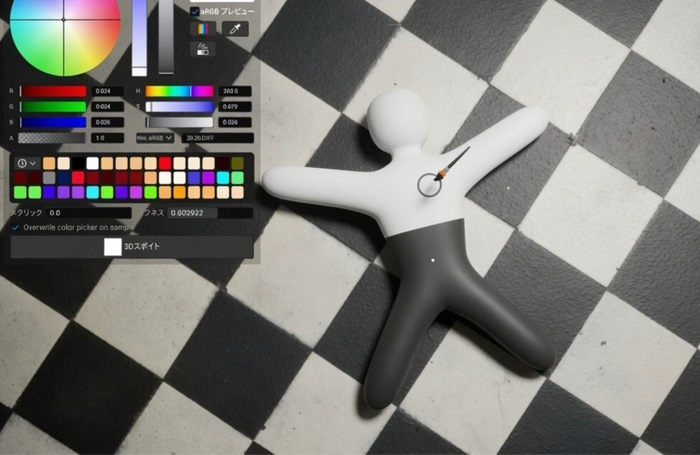
Meccha Chameleon is a hide-and-seek game in which Hiders paint and pose their white character models to blend into the map. Hiders win by remaining unnoticed until time expires; the Seeker wins by finding every disguised player.

How a round works
A round has a preparation phase and a hunting phase. During preparation, Hiders choose positions, sample colors, adjust materials, and lock a pose while the Seeker waits. During the hunt, the Seeker searches the map and Hiders depend on their camouflage.
| Role | Objective | Main tools | Win condition |
|---|---|---|---|
| Hider | Blend into the environment and avoid detection | Color picker, HSV controls, roughness and metallic settings, poses | At least one Hider remains when the timer ends |
| Seeker | Identify shapes that do not belong in the scene | Visual inspection, map movement, and the available marking or attack action | Every Hider is found before time expires |
How to play as a Hider
Choose the hiding place before painting
Pick the surface first, then sample its colors. Moving to a different wall after painting often produces a mismatch. Beginners should start with a broad, simple surface in partial shadow rather than a detailed poster, patterned tile, or brightly lit open area.
Match brightness and material
Color alone is not enough. Notice which side of the room is lit and which side falls into shadow. Make the corresponding sides of the character lighter or darker so the body does not look like a flat sticker.
Check roughness and metallic controls as well. A glossy character will stand out against matte paint, concrete, or fabric even when the hue is close.
Break up the human silhouette
The Seeker is looking for a person-shaped outline. Choose a pose that follows the surrounding geometry: compact beside low furniture, horizontal near the floor, or flattened against a large surface. Avoid a normal upright pose against an empty wall.
Inspect from likely approach angles
Rotate the camera around the character before the preparation timer ends. Look for white joints, gaps between limbs, a bright edge, a floating shadow, or a body part extending beyond the object being copied.
Stay still during the hunt
Movement attracts attention faster than a small color mismatch. Do not make unnecessary position or pose changes when the Seeker is nearby. If camera movement affects the character in the current control scheme, keep it minimal.
How to play as the Seeker
Search in a fixed pattern
Do not run randomly between rooms. Divide each area into a repeatable sequence:
- Doorways, corners, and wall edges.
- Large objects and the space directly around them.
- Shelves, beams, ceilings, and other high positions.
- Floors, shadows, and low furniture.
- Exits and routes a missed player could use.
A systematic sweep reduces backtracking and makes it easier to notice what changed.
Look for physical inconsistencies
- A human outline where the background should be flat.
- A shadow that points in the wrong direction.
- Gloss or reflection that differs from the nearby material.
- An object placed at an unnatural height or angle.
- Edges that are cleaner, blurrier, or more heavily painted than the background.
- A tiny movement when the rest of the scene is still.
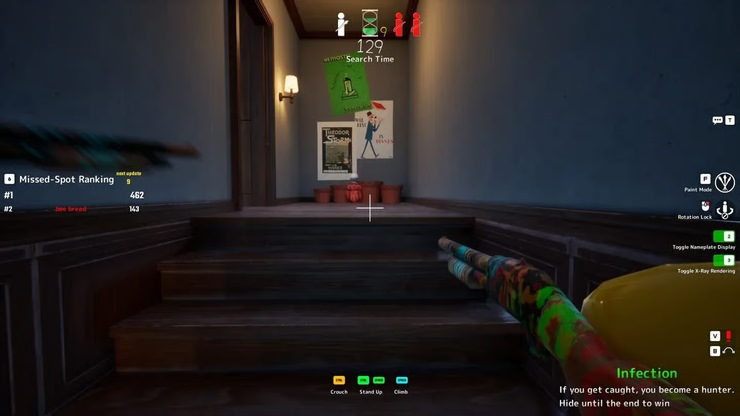
Change viewing angle
A disguise that works from the front may fail from the side. Approach suspicious surfaces diagonally, crouch or look upward where the game allows, and compare the suspected shape with repeated objects elsewhere in the room.
Common Hider mistakes
- Matching only one color: lighting, texture, and silhouette still reveal the character.
- Using an open location: bright empty areas provide no edges or shadows to hide transitions.
- Choosing a complex pattern too early: a simple accurate disguise is stronger than a rushed detailed one.
- Ignoring the back and sides: the Seeker rarely approaches from exactly the preview angle.
- Adjusting after the hunt begins: visible movement can expose otherwise effective camouflage.
A simple practice routine
Use early rounds to practice one skill at a time. First learn accurate color sampling, then material matching, then poses, and finally more ambitious locations. As Seeker, follow the same room-by-room sweep every round and note which disguises fooled you; those locations and techniques will improve your next Hider round.
Related Articles
 Meccha Chameleon Hide-and-Seek Game Tips for Beginners - Meccha Chameleon Tips7 minutes read
 MECCHA CHAMELEON: PC Control and Shortcut Guide6 minutes read
 How to Play Meccha Chameleon With Friends10 minutes read
 Meccha Chameleon Custom Maps: Create, Upload & Play15 minutes read
 The Best Hiding Places in Meccha Chameleon4 minutes read
 The best hiding spots on the Minecraft map in Meccha4 minutes read
Reader Comments 0
Sign in with email or Google to join the discussion.