Table of Contents
This practical guide explains how to use cpu heatsink with clear steps and useful context. It also covers common requirements, potential problems, and the details that can help you get better results.
Common Heat Sinks
Usually when buying a CPU or a cooler (fan) for a CPU, a heatsink will be included. This substance is usually contained in a small package, cylinder tube or has been pre-coated on the CPU contact surface of the cooler.
 Heat sink
If there is a heat sink on the heatsink, you just need to attach it to the Mainboard. However, in case the heatsink is provided separately, you need to use this heatsink before attaching the heatsink to the Mainboard.
How to Use CPU Heatsink
Assemble the CPU into the slot on the mainboard first. (See How to assemble the CPU into the Mainboard)
 Assemble the CPU into the slot on the mainboard (Mainboard)
Cut off one end of the package containing the radiator or remove the cylinder head cover.
 Cut off the end of the radiator pack
  Remove the cap on the radiator cylinder
Put the heatsink on the back of the CPU.
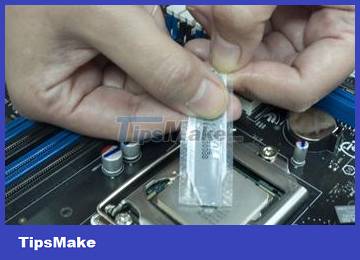 Put the heatsink on the center of the back of the CPU
 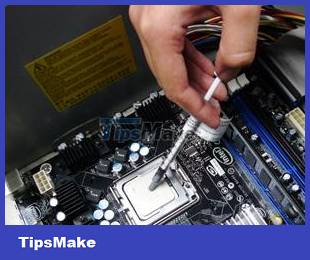 Put the heatsink on the center of the back of the CPU
There's no need to use up all the heatsink in the package (or cylinder) but just put a small amount of heatsink in the center of the CPU and there's no need to spread it all around. The heat sink will be evenly squeezed out when the heatsink is attached. 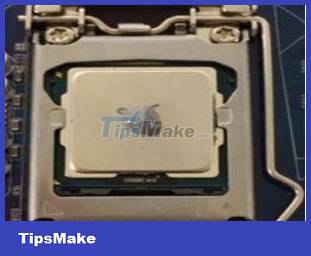 Put a small amount of heatsink in the center of the CPU
Attach the cooling fan unit to the Mainboard.
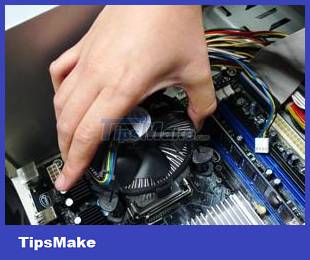 Install the cooling fan unit on the Mainboard
Notes on Using CPU Coolers
- The contact surface of the CPU and the cooling fan must be cleaned before applying the heatsink.
- Do not reuse old heatsinks, but clean them with a paper towel or dry cloth before using a new heatsink.
- Different heat sinks can affect the efficiency of heat exchange. However, in normal use conditions, without overclocking to increase CPU speed, ordinary heatsinks can be used.
- The heat sink after a period of use may dry out, making the heat dissipation no longer effective.
Conclusion
Understanding CPU makes it easier to compare options, avoid common mistakes, and apply the information in this guide more effectively. Review the relevant requirements before making changes or choosing a solution.
FAQ
How do you use cpu heatsink?
Follow the steps in this guide in order, confirm the required settings or tools, and verify the result before making additional changes.
Is it safe to use cpu heatsink?
It is generally safe when you follow the recommended instructions, use trusted tools, and avoid changing settings you do not understand.
What should you do if the process does not work?
Recheck the requirements, restart the device or application when appropriate, and review each step for missed settings or compatibility issues.
Related Articles
 Decode the Super Exclusive Cooling Fan Design from the World4 minutes read
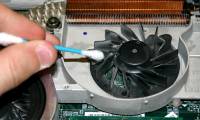 How to Clean the Laptop Heatsink Fan5 minutes read
 You Have to Use Thermal Paste Properly?11 minutes read
 What CPU Coolers Are There? Which Type Is Best?11 minutes read
 What Is a Laptop Cooling Pad? How to Choose a Heat Sink14 minutes read
 Steps to Recheck Thermal Paste for Computer CPU10 minutes read
Reader Comments 0
Sign in with email or Google to join the discussion.