Table of Contents
This article provides a clear overview of Fujifilm X100V Close-up: 26.1MP X-Trans BSI CMOS Sensor 4th, with the main facts, useful context, and practical details organized for easy reading.
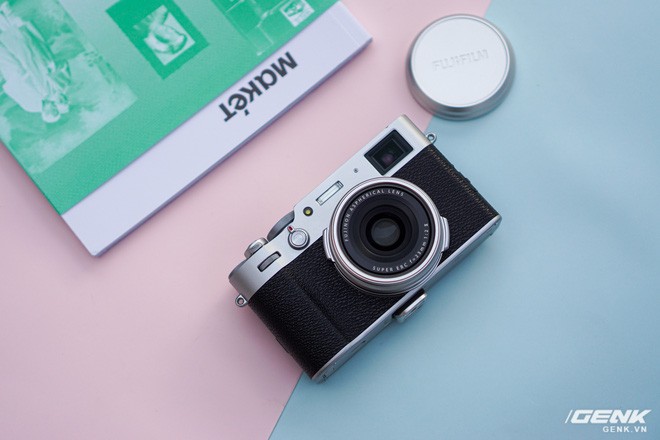
The exterior design of the X100V has not changed much, the overview is still very familiar to Fujifilm users so far: the compact body, continuous lens, viewfinder deviate to the left corner of the application.
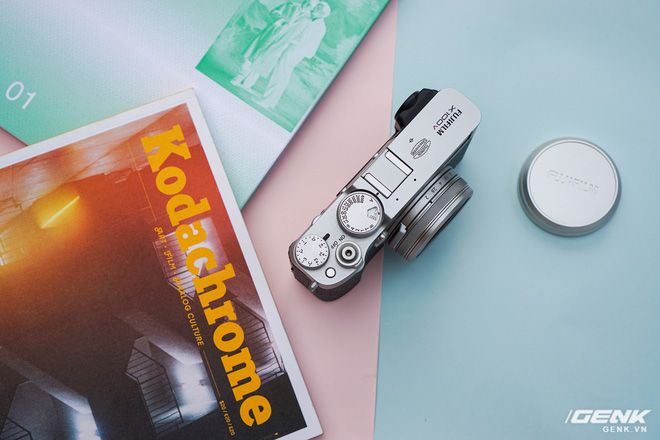
However, if you pay close attention, you will see the corners are sharper and not rounded like the previous version.
The most noticeable upgrade point on this machine is that the screen has been able to flip 2-way (up and down) for users to have easier viewing angles and layouts. Besides, touch to focus or take photos has also been added on this model, although maybe not everyone needs it, especially for those who like to take photos on the street. was mistakenly touched on the screen. The screen size remains the same at 3 inches, but the screen resolution has increased from 1.04 million to 1.62 million pixels.


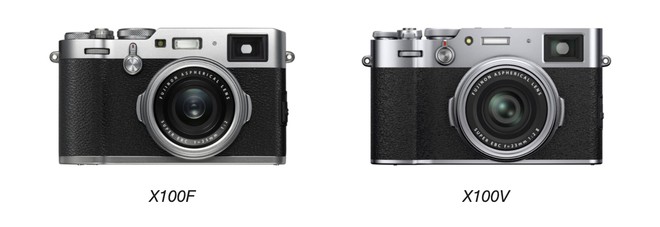
Besides, the application is also about 1mm thicker, and weighs nearly 10gr, which is not significant because this machine is still compact and can be used for long periods. The grip is improved, a little deeper than the top so the grip is also more solid.

The top of the X100V is the same as the previous model, with 2 parameters of the wheel adjustment parameters on the right half. We have big wheel dials for changing ISO and shutter speed, while smaller wheels for EV changes. If the X100F previously had to lift, hold the wheel to rotate the ISO value change, now on the new version you do not need to hold anymore, just pick up and change the ISO only.


The electronic viewfinder is now also bigger (0.5 inches vs. 0.48 inches) and higher resolution (3.69 million pixels compared to 2.36 million pixels) with refresh rates up to 100fps.

Change the view mechanism of EVF (electronic viewfinder) and OVF (optical viewfinder).

With OVF you can see what is going on outside the viewfinder, while EVF is more convenient when you do not want to be distracted and can see the color filter applied.
After 4 editions, nothing changed, Fujifilm finally gave this 5th edition a new lens system. Still 23mm (35mm equivalent of full frame) and F / 2.0 but inside has been redesigned, adding an aspherical glass inside to increase border definition and focus better.

Other upgrades include a 26.1MP X-Trans BSI CMOS sensor (4th generation), 117 phase-detection focus points covering 99% of the sensor area, and these can be subdivided into 425 combined focus points. Fujifilm also said the new algorithm also helps the X100V to identify eyes and faces better.

The NP-W126S battery is the same as the previous model, but Fujifilm said when used on the X100V will be able to take 350 images when using EVF or 420 images when using OVF.
The X100V can shoot burst shots at 11 frames per second (mechanical shutter) or 20 frames (electronic shutter). Finally, the X100V can also record 4K / 30p and 1080 / 120p movies, output 10-bit, 4: 2: 2 signals via HDMI.


FAQ
What is the main focus of Fujifilm X100V Close-up: 26.1MP X-Trans BSI CMOS Sensor 4th?
The article explains the most important facts, context, and practical details related to Fujifilm X100V Close-up: 26.1MP X-Trans BSI CMOS Sensor 4th.
Who may find this information useful?
It is useful for readers who want a clear overview, practical context, and a better understanding of the subject.
What should readers verify before taking action?
Check current product versions, official requirements, regional availability, and any details that may have changed since the original publication.
Related Articles
 Share the Solution When Facebook Cannot Rotate the Screen: What to Know7 minutes read
 How to Fix the Error of the Computer Screen Being Turned3 minutes read
 4 Extremely Simple Ways to Rotate the Computer Screen to Your Liking: Expert9 minutes read
 How to Rotate Windows 10, 8, 7 Computer Screen Quickly3 minutes read
 Click: How to Use the Rotate Tool in Sketchup3 minutes read
 How to Rotate the Computer Screen, Laptop on Windows 10, Windows 72 minutes read
Reader Comments 0
Sign in with email or Google to join the discussion.