Table of Contents
In the digital age, cyberattacks are becoming increasingly sophisticated and unpredictable, directly threatening data, systems, and business operations. From phishing, ransomware, and DDoS attacks to SQL Injection and malware, each type of cyberattack has different exploitation methods and levels of danger.
So what are the common types of cyberattacks today and how can we prevent them? In this article, let's explore common types of cyberattacks , how they work, and effective security strategies to help individuals and businesses minimize the risk of becoming victims of cyber threats.
DoS and DDoS attacks
Denial-of-Service (DoS) attacks are designed to overload a system's resources to the point where it cannot respond to legitimate service requests. Distributed Denial-of-Service (DDoS) attacks also aim to exhaust system resources.
However, DDoS attacks are carried out from a large number of servers that have been infected with malware and are under the control of the attacker. These attacks are called 'denial of service' because the victim's website cannot provide services to those who want to access it.
In a DoS attack, the target website is flooded with invalid requests. Because the website has to respond to each request, system resources are quickly consumed by these responses. This prevents the website from serving users normally and often leads to a complete shutdown.
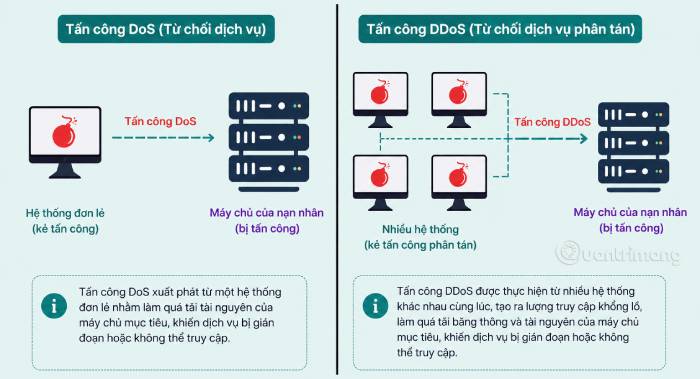
DoS and DDoS attacks differ from other types of cyberattacks, which allow hackers to infiltrate systems or increase the access they already have. With those types of attacks, the attacker directly benefits from their actions.
Conversely, the goal of DoS and DDoS cyberattacks is simply to disrupt the target system's ability to provide services. If the attacker is hired by a business competitor, they may gain financial benefit from the action.
DoS attacks can also create vulnerabilities for other types of attacks. After a successful DoS or DDoS attack, the system is often forced to shut down, leaving it vulnerable to other attacks.
A common way to prevent DoS attacks is to use firewalls that can detect whether requests sent to a website are valid. Fraudulent requests can then be dropped, allowing normal traffic to continue uninterrupted.
Furthermore, understanding how different network architectures handle traffic resilience, such as SD-WAN and MPLS, can help design more robust defense mechanisms against high-traffic attacks. An example of this type of large-scale internet attack occurred in February 2020 targeting Amazon Web Services (AWS).
MITM attack
A Man-in-the-Middle (MITM) attack is a type of cybersecurity breach that allows an attacker to eavesdrop on data exchanged between two people, two networks, or two computers. It's called 'Man-in-the-Middle' because the attacker is positioned 'in the middle,' or in between two parties attempting to communicate. Essentially, the attacker is monitoring the interaction between the two parties.
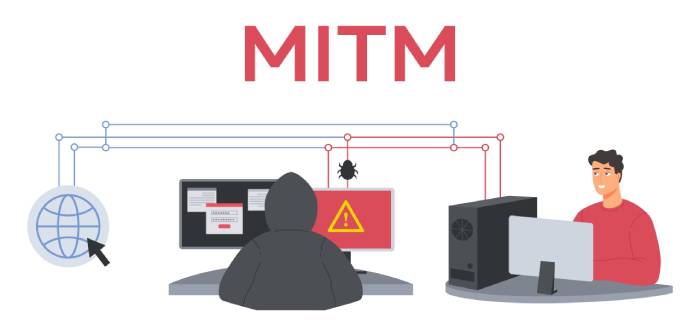
In a MITM attack, both parties believe they are communicating normally. What they don't know is that the attacker can secretly modify or access the message before it reaches its destination. Some ways to protect individuals and organizations from MITM include using strong encryption at access points or using a virtual private network (VPN).
Phishing attacks
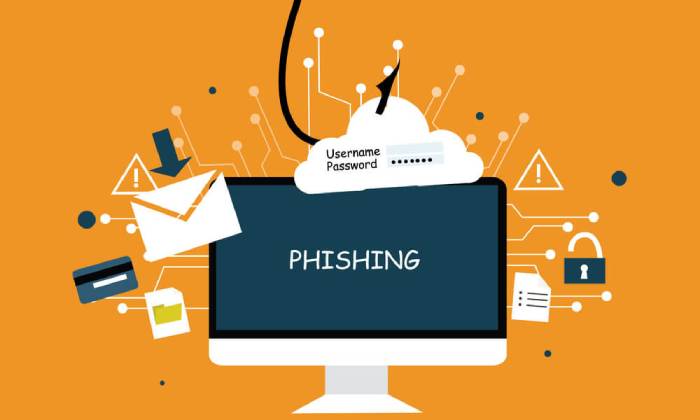
Phishing attacks occur when malicious actors send emails that appear to come from trustworthy and legitimate sources in order to collect sensitive information from their targets. Phishing combines social engineering and technology. The name comes from the fact that attackers are like 'fishing' to gain access to a restricted area using a seemingly trustworthy sender as 'bait'.
To carry out the attack, attackers can send a link leading users to a fake website, then trick them into downloading malware such as viruses or providing personal information. In many cases, victims may not realize they have been compromised, allowing attackers to continue targeting others within the same organization without suspicion.
You can prevent phishing by being cautious about which emails you open and the links you click on. Pay close attention to the email header and avoid clicking on anything that seems suspicious. Check the 'Reply-to' and 'Return-path' parameters. They should link to the same domain displayed in the email.
Whale Phishing Attack
Whale phishing is so named because it targets the "big fish" or "whales" within an organization, often senior leaders in the C-suite or those responsible for running the organization. These individuals typically possess information valuable to the attacker, such as proprietary business or operational information.
If a targeted 'whale' downloads ransomware, they are more likely to pay the ransom to prevent information about the successful attack from being disseminated, damaging their personal or organizational reputation. Whale phishing can be prevented using similar measures to regular phishing, such as carefully checking emails, attachments, and links, and paying attention to suspicious addresses or parameters.
Spear Phishing Attack
Spear phishing is a type of targeted phishing attack. The attacker spends time researching the target and then composes messages that are likely directly relevant to the recipient. This type of attack is called 'spear' phishing because the attacker focuses precisely on a specific target. The messages often appear legitimate, making spear phishing difficult to detect.
Spear phishing typically employs email spoofing techniques, where the 'From' field is falsified to make the email appear to be from a different sender. This could be someone the victim trusts, such as a member of their network, a close friend, or a business partner.
Attackers can also use website cloning techniques to make communications appear legitimate. With website cloning, attackers copy a legitimate website to create a sense of security for the victim. Believing the website to be real, the target will feel comfortable entering personal information.
Similar to regular phishing, spear phishing can be prevented by carefully checking the information in all fields of an email and ensuring users do not click on any links until they have verified that the destination is legitimate.
Ransomware
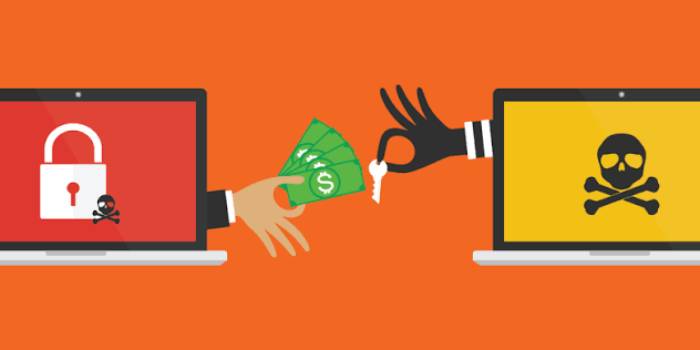
With ransomware, the victim's system is held 'hostage' until they agree to pay a ransom to the attacker. After receiving the money, the attacker provides instructions for the victim to regain control of the computer. The name 'ransomware' comes from the fact that this type of malware demands a ransom from the victim.
In a ransomware attack, the target may download malware from a website or via an email attachment. The malware is designed to exploit vulnerabilities not addressed by the system manufacturer or IT team. The ransomware then encrypts the victim's workstation.
Sometimes ransomware can be used to attack multiple targets by preventing access to numerous computers or a central server critical to business operations.
Affecting multiple computers is often achieved by delaying the encryption process for days or even weeks after the initial malware infection. The malware can send AUTORUN files from one system to another via a local network or USB drives connected to multiple computers. Then, when the attacker triggers the encryption process, all infected systems can be encrypted simultaneously.
In some cases, ransomware authors design malware to evade traditional antivirus software. Therefore, users need to be vigilant about the websites they visit and the links they click on. You can also prevent many ransomware attacks by using next-generation firewalls (NGFWs) that can perform deep packet scanning using artificial intelligence (AI) to look for ransomware characteristics.
Password attacks
Passwords are the most common method of authentication for most people. Therefore, finding a target's password is always an attractive option for hackers. There are many different ways to do this.
Typically, people keep copies of their passwords on paper or sticky notes placed around their desks. An attacker could either find the password themselves or pay someone inside the organization to obtain this information.
Attackers may also attempt to intercept data transmitted over the network to obtain unencrypted passwords. They may also employ social engineering techniques, persuading victims to enter passwords to resolve a seemingly 'important' issue. In other cases, attackers may simply guess a user's password, especially if it's a default or easily remembered password like '1234567'.
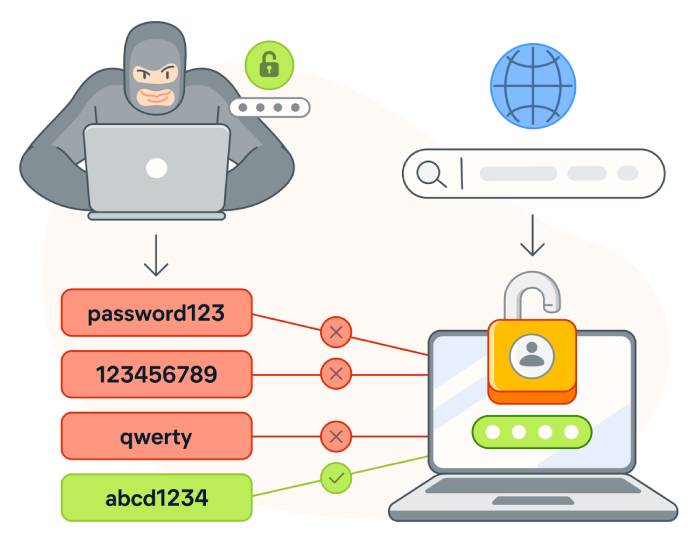
Hackers also frequently use brute-force methods to guess passwords. This type of attack uses basic information about an individual's personal or professional background to try and guess their password. For example, names, birth dates, anniversaries, or other easily accessible personal information can be combined in various ways to decrypt a password.
Information users post on social media can also be exploited. Hobbies, hobbies, pet names, or children's names are sometimes used to create passwords, making them relatively easy to guess for brute-force attackers.
Hackers can also use dictionary attacks to find passwords. This technique uses common words and phrases, such as those found in dictionaries, to try and guess the target's password.
An effective way to prevent brute-force and dictionary attacks is to implement an account lockout policy. This policy will automatically lock access to a device, website, or application after a certain number of failed login attempts. This leaves the attacker with only a limited number of attempts before being blocked.
If your account is locked due to too many failed login attempts, you should change your password.
If attackers repeatedly use brute-force or dictionary attacks to guess passwords, they may memorize passwords they've tried unsuccessfully. For example, if your password is your last name + year of birth and the hacker last tried year of birth + last name, they might try that variation again next time and guess correctly.
SQL Injection Attack
SQL Injection (Structured Query Language Injection) is a common method used to exploit websites that rely on databases to provide services to users. The client is the computer that receives information from the server, while the SQL attack uses an SQL query sent from the client to the database on the server.
Malicious commands are injected into a data area instead of the content that would normally be there, such as passwords or login information. The server containing the database then executes the command, and the system is compromised.
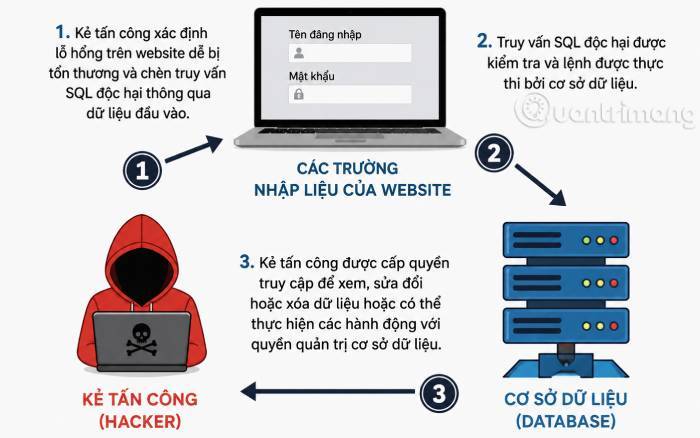
If SQL injection is successful, many consequences can occur, including the exposure of sensitive data or the modification and deletion of critical data. The attacker can also perform administrative actions such as shutting down the server, disrupting database operations.
To protect against SQL Injection, implement a least privilege model. With this architecture, only those who truly need to access the critical database are granted permission.
Even if a user has power or a high position within the organization, they may still be denied access to certain areas of the network if their job doesn't require it.
For example, a CEO might have restricted access to certain network areas even though they have the right to know the information inside. A minimum privilege policy not only prevents malicious actors from accessing sensitive areas but also limits the risk of legitimate users inadvertently revealing login credentials or leaving workstations running while they are away from their computers.
URL-free attacks
With URL interpretation, attackers modify or create specific URLs to gain access to the target's personal and work data. This type of attack is also known as URL poisoning.
The term 'URL Interpretation' comes from the fact that attackers know the order in which a website's URL information needs to be entered. They then 'interpret' this syntax to gain access to areas that are not authorized.
To carry out a URL interpretation attack, hackers can guess URLs, allowing them to gain administrative privileges on a website or access the backend to compromise user accounts. Once they access the desired page, they can manipulate the website or steal sensitive user information.
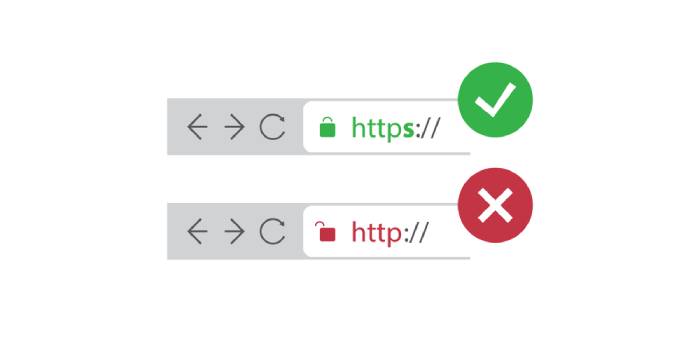
For example, if a hacker wants to access a website's admin area, they might try adding '/admin' to the end of the URL to find the admin login page. In some cases, the default admin username and password can be very easy to guess. The attacker may also already know or have narrowed down the admin password to several possibilities, then try each password until successful.
To prevent URL interpretation, use a secure authentication method for all sensitive areas of your website. This could include multi-factor authentication (MFA) or using strong passwords that include seemingly random characters.
DNS Spoofing
With DNS spoofing, hackers alter DNS records to redirect traffic to a fake website. When accessing the fraudulent website, victims may enter sensitive information that the hackers can use or sell.
Hackers can also create a low-quality website containing offensive or controversial content to damage the image of a competitor company.
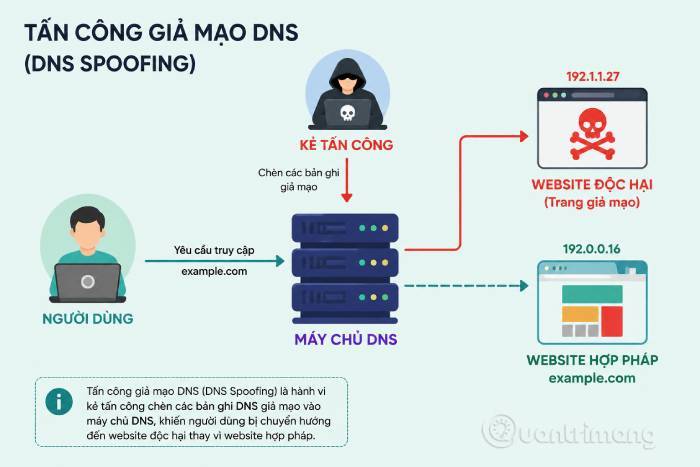
In a DNS spoofing attack, the attacker exploits the user's belief that the website they are visiting is legitimate. This allows the attacker to commit illegal acts under the guise of an innocent company, at least from the visitor's perspective.
To prevent DNS spoofing, ensure your DNS servers are always up-to-date. Attackers often try to exploit vulnerabilities in DNS servers, while the latest software versions usually contain patches that fix known vulnerabilities.
Related Articles
 What Is a Firewall? Overview of Firewall7 minutes read
 How to Check Where Google AI Overview Gets the Information5 minutes read
 Things You Can Do to Protect Yourself from Cyberattacks7 minutes read
 What Is Hosting? Hosting Used to Do? Features, Uses, and Key6 minutes read
 The New Algorithm Can Prevent Cyber-Attacks on GPS Devices4 minutes read
 What Is Adobe AIR? Overview of Adobe AIR5 minutes read
Reader Comments 0
Sign in with email or Google to join the discussion.