Table of Contents
MySQL is a relational database management system: server software that stores structured data and lets applications or users query and change it. A website might use MySQL to keep customer accounts, product records, orders, or article content in related tables.
MySQL, a database, and SQL are different things
- MySQL Server is the software that manages access, runs queries, and handles database storage.
- A database is an organized collection of objects and data managed by the server.
- SQL is the language used to define tables and work with data.
- A client, such as MySQL Workbench, the mysql command-line program, or an application connector, sends requests to the server.
Installing Workbench alone is not the same as installing and starting MySQL Server. A client can connect to a server on the same computer or to a remote server when the network and account permissions allow it.
How relational data is organized
A table contains rows and columns. In an online shop, a customers table might hold one row per customer, while an orders table records purchases. A customer identifier connects the two so a query can retrieve the orders belonging to one customer.
Keys and constraints help define identity and relationships. Indexes can speed up suitable lookups, but database design and query structure still matter; simply using MySQL does not make every application fast.
Where does MySQL keep the data?
For ordinary persistent tables, MySQL keeps data on the server's storage, such as an SSD, and uses RAM for caches, sorting, and other processing. The server might be a local computer, a hosted machine, or part of a managed database service.
It is incorrect to say MySQL cannot store table data in RAM. Its specialized MEMORY storage engine does that, but the contents do not persist through a server restart. This differs from the InnoDB buffer pool, which caches persistent table data for access.
Storage behavior depends on the engine and configuration. Persistent storage is also not a backup: accidental changes, damaged storage, or a failed migration can still require recovery from a tested backup.
What people use MySQL for
MySQL is used in web applications, content-management systems, business software, and other services needing structured records and queries. Whether it suits a particular project depends on transactions, data relationships, workload, operations, and the team's experience.
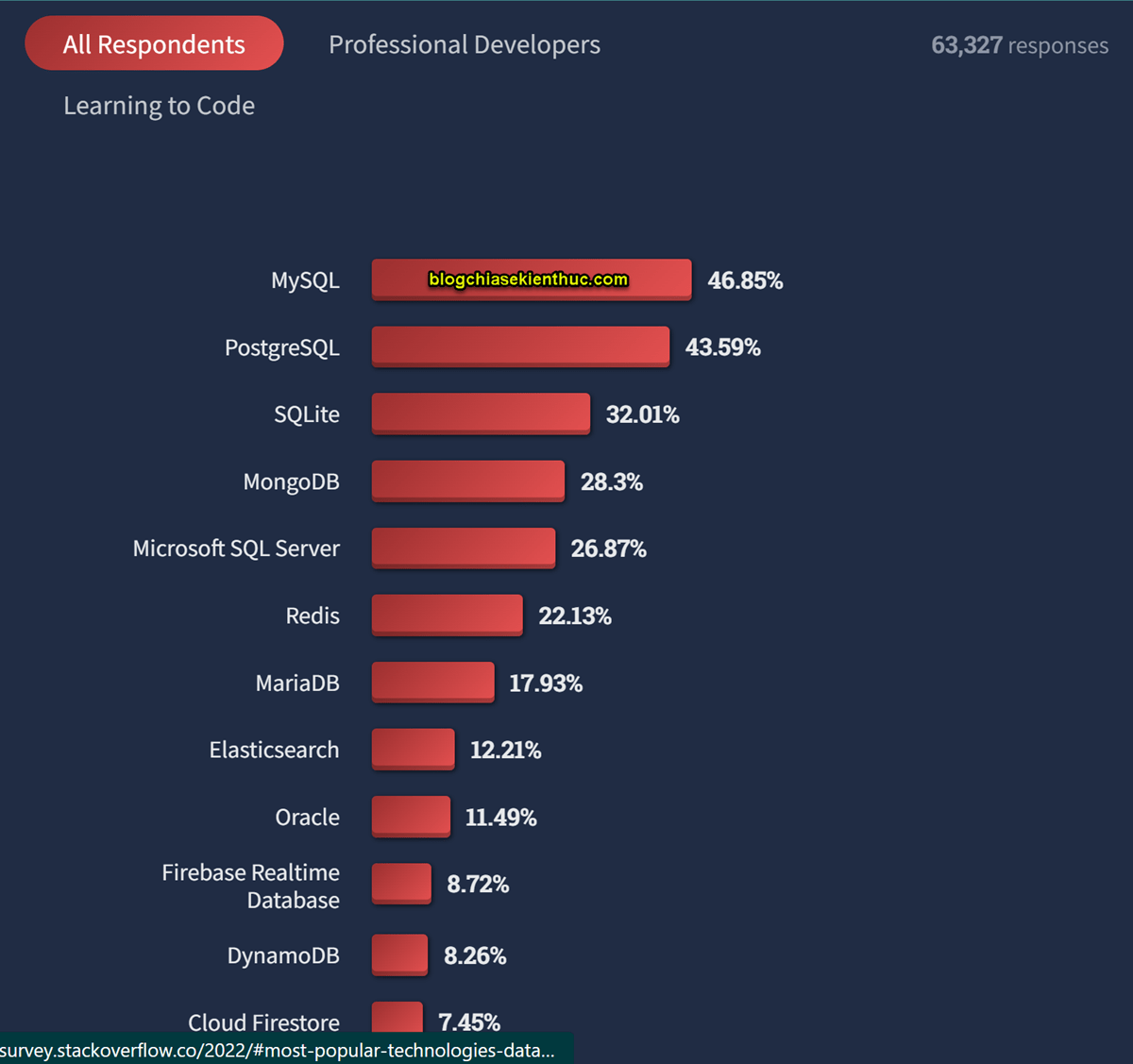
Historical survey illustration retained from the original article. It should not be read as a current popularity ranking.
A popularity chart can suggest ecosystem familiarity, but it does not establish which database is best for your workload. Avoid choosing solely on an old ranking or a list of companies said to use it.
Is MySQL free?
MySQL Community Edition is available under an open-source license. Commercial editions, support, hosting, and some distribution arrangements have different terms. Check the applicable license rather than assuming every MySQL-related service is free.
How to start learning
- Use a local or disposable test server, or an authorized learning environment.
- Connect with a client and create a small practice database.
- Learn tables, data types, primary keys, and
SELECTbefore moving to joins and data changes. - Practice permissions and backup restoration before managing important data.
Try the MySQL Workbench setup guide for a desktop client, or phpMyAdmin database management if your learning environment already provides that interface.




Reader Comments 0
Sign in with email or Google to join the discussion.