Table of Contents
An IP54 enclosure is dust-protected and resistant to splashing water from any direction. It is suitable for dust, light rain, sweat, and ordinary splashes under the manufacturer's stated conditions, but it is not rated for immersion or water jets.

How to read an IP54 rating
IP codes are defined by IEC 60529, which classifies how an enclosure protects people and equipment from contact, solid objects, dust, and water. The two numerals measure different things:
| Part | Meaning in IP54 |
|---|---|
| IP | Ingress Protection code |
| 5 | Dust-protected: some dust may enter, but not enough to interfere with safe operation. |
| 4 | Protected against splashing water from any direction when tested as specified. |
The rating describes the enclosure in a standardized test. It does not mean the product is completely sealed, waterproof in every situation, or suitable for all outdoor environments.
What the “5” means for dust
Level 5 is not the highest solid-particle rating. It permits limited dust ingress as long as the amount does not interfere with satisfactory operation or safety. By comparison, the first numeral 6 indicates a dust-tight enclosure under the relevant test conditions.
IP54 may therefore be appropriate for a workshop, warehouse, construction-adjacent area, or dusty commute if the manufacturer designed the product for that use. Fine conductive dust, corrosive particles, or unusually heavy exposure may require a more specialized enclosure.
What the “4” means for water
Level 4 covers splashing water from any direction. It is not the same as IPX5 or IPX6 water-jet protection, and it does not cover temporary immersion like IPX7.
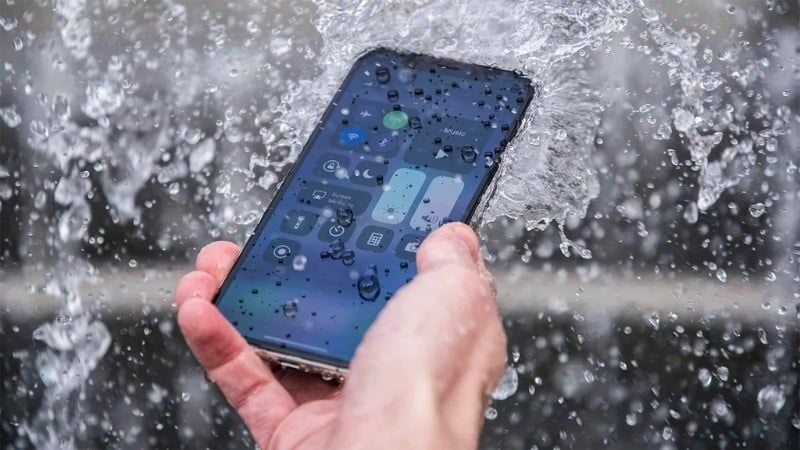
Normally within the rating's scope
- light rain;
- incidental splashes near a sink or work area;
- sweat on a wearable product, if the maker also approves that use;
- routine exposure to airborne dust that does not exceed product guidance.
Situations to avoid
- dropping the device into a bath, pool, sink, or puddle;
- rinsing it under a tap or hose;
- pressure washers, strong jets, and high-speed water impact;
- steam, saunas, hot water, saltwater, soap, solvents, and corrosive liquids;
- charging while the connector or cable is wet.
A rain shower and a pressurized hose are not equivalent. IP54 addresses the former type of exposure more closely than the latter.
IP54 compared with other common ratings
| Rating | Solids protection | Water protection | Key difference from IP54 |
|---|---|---|---|
| IPX4 | Not specified | Splashing water | Same water numeral, but no declared solids rating. |
| IP53 | Dust-protected | Water spray up to the specified angle | Lower water-protection level. |
| IP54 | Dust-protected | Splashing water | No jet or immersion claim. |
| IP55 | Dust-protected | Water jets | Higher water-protection level. |
| IP67 | Dust-tight | Temporary immersion under specified conditions | Higher dust and water ratings. |
| IP68 | Dust-tight | Continuous immersion under conditions agreed by maker and user | Exact immersion conditions must be supplied by the manufacturer. |
Higher is not automatically better for every purchase. An indoor speaker may need splash protection but not immersion resistance, while industrial equipment may require protection from jets, dust, impact, chemicals, or explosive atmospheres that an ordinary consumer IP code does not address. TipsMake's broader IP rating guide explains the other numerals.
What an IP rating does not tell you
An IP54 mark alone does not specify:
- drop or impact resistance;
- saltwater, chlorine, oil, or chemical resistance;
- operation in steam, condensation, extreme temperatures, or corrosive environments;
- whether ports must be closed or covers installed during exposure;
- whether liquid damage is covered by warranty.
Read the product manual for orientation, exposure time, port-cover requirements, cleaning instructions, and warranty exclusions. A rating on the enclosure may not apply when a door is open, a gasket is missing, or an accessory is attached.
Does IP54 protection wear out?
The original laboratory rating does not automatically change, but real devices can lose protection through drops, bent frames, aged adhesive, damaged seals, repairs, or missing covers. Manufacturers commonly warn that water resistance is not permanent.
After a hard impact or repair, do not assume the enclosure still performs like a new test sample. Replace damaged gaskets or have critical equipment inspected according to the maker's maintenance procedure.
Bottom line
IP54 means useful everyday protection from dust and splashing water—not complete dust sealing, water jets, or submersion. It is adequate when accidental splashes are the main risk, but swimming, washing, and pressurized exposure require a different product and rating.
Related Articles
 What Is the IP Water Resistance Standard?7 minutes read
 IP Indicator for Water and Dust on Smartphone Everyone Needs to6 minutes read
 Giant Dust Storms Are Taking Away Water on Mars3 minutes read
 Close-up of the Water and Impact Resistance Test for Apple's3 minutes read
 What Is Fine Dust? the Harmful Effects of Inhaling Ultra-fine7 minutes read
 PM2.5 Ultrafine Dust Is the Most Dangerous Type of Dust in the World7 minutes read
Reader Comments 0
Sign in with email or Google to join the discussion.