Table of Contents
Impaling is a trident-only enchantment that adds 2.5 damage (1.25 hearts) per level, up to 12.5 extra damage at Impaling V. Its target rules differ by edition: Java Edition applies the bonus to aquatic mobs, while Bedrock Edition applies it to mobs and players that are touching water or exposed to rain.
What does Impaling do?
Impaling increases both melee and thrown-trident damage when the target qualifies. It does not improve durability, loyalty, travel speed, or the chance of a lightning strike; those functions belong to other trident enchantments.
| Level | Bonus damage | Total melee damage | Total thrown damage |
|---|---|---|---|
| I | +2.5 | 11.5 | 10.5 |
| II | +5 | 14 | 13 |
| III | +7.5 | 16.5 | 15.5 |
| IV | +10 | 19 | 18 |
| V | +12.5 | 21.5 | 20.5 |
The totals above use the normal trident base values of 9 melee damage and 8 thrown damage before armor, difficulty, critical-hit rules, other effects, or version-specific combat changes.
Java Edition and Bedrock Edition differences
Java Edition
In Java Edition, the damage bonus applies to aquatic mobs—creatures classified by the game as naturally associated with water. Guardians and elder guardians are the most important combat targets. Fish, squid, dolphins, and turtles also qualify, although most are not enemies.
Being wet is not enough in Java Edition. A zombie, skeleton, creeper, or player standing in water does not become an aquatic mob, and rain does not extend Impaling to ordinary targets. Drowned are classified as undead rather than aquatic for this enchantment.
Bedrock Edition
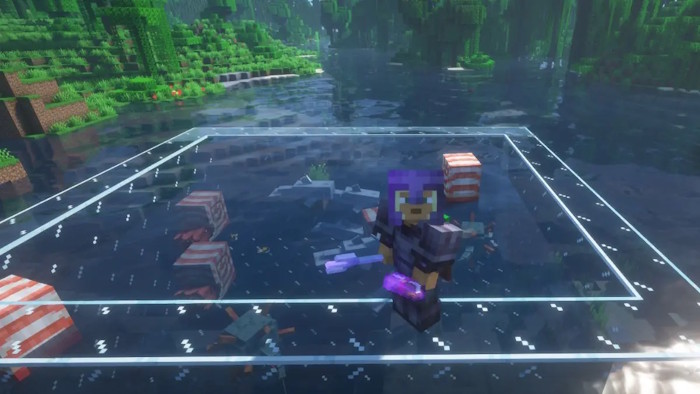
In Bedrock Edition, Impaling applies to a much broader set of targets: any mob or player in contact with water, including rain. This makes the enchantment useful beyond ocean monuments. Luring a hostile mob into shallow water can activate the bonus, and outdoor combat during rain can do the same.
The target must meet the wet condition at the moment of the hit. A mob that has just left the water may no longer receive the bonus.
How to get Impaling
You first need a trident, which is obtained from eligible drowned drops rather than crafted. Once you have one, use an enchanting table or apply an Impaling book with an anvil.
Method 1: Enchant a trident at an enchanting table
- Repair the trident if necessary so the final item is worth investing in.
- Place the trident in the enchanting table.
- Add lapis lazuli.
- Review the available options and select the level you want.
Fifteen correctly placed bookshelves unlock the table's highest offer, but Impaling is still random. If it does not appear, enchant a different inexpensive item or book to refresh the offers, then check the trident again. Do not repeatedly remove and replace the same item expecting the choices to change.
Method 2: Apply an enchanted book
Impaling books can come from enchantment tables, fishing, librarian trades, and eligible generated chests. A librarian is the most controllable long-term source because a desirable trade can be reused, subject to the trading rules of your game version.
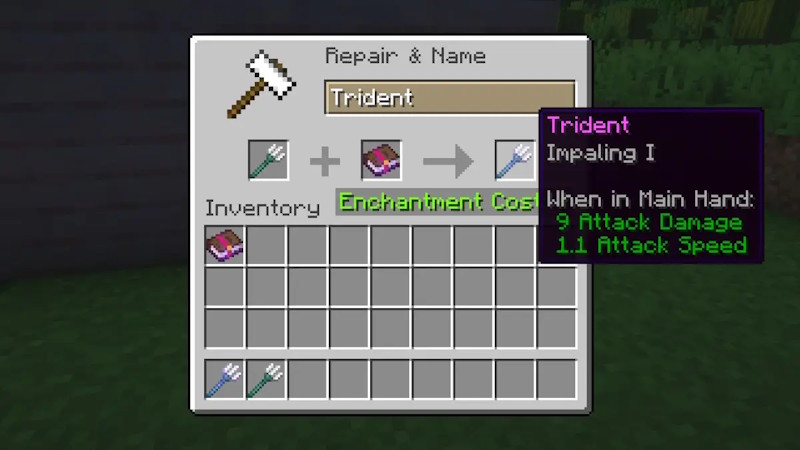
- Place the trident in the first slot of an anvil.
- Place the Impaling book in the second slot.
- Check the experience cost and resulting enchantments.
- Take the finished trident from the output slot.
Two books or enchanted tridents of the same level can also be combined to reach the next level, up to Impaling V. Anvil operations become more expensive as an item accumulates prior work, so combine books efficiently before applying them to a prized trident.
Commands for Creative mode or testing
With cheats enabled, hold a trident and use an enchant command supported by your edition. For Java Edition, the standard form is:
/enchant @s minecraft:impaling 5The command works only when the held item accepts the enchantment and the requested level is valid. Server permission settings may block it.
Which trident enchantments work with Impaling?
Impaling itself can be combined with the main trident enchantments, including Loyalty, Channeling, Riptide, Unbreaking, and Mending. However, the other enchantments have conflicts with one another:
- Riptide cannot normally be combined with Loyalty or Channeling.
- Loyalty returns a thrown trident to the player.
- Channeling summons lightning under its required thunderstorm and sky-access conditions.
- Unbreaking and Mending help preserve a trident, which is valuable because tridents are not craftable.
A practical combat build is Impaling V, Loyalty III, Unbreaking III, and Mending, with Channeling added when compatible. Use a separate Riptide trident for travel if you want both play styles.
When is Impaling worth using?
- Ocean monuments: the damage bonus is reliable against guardians and elder guardians in both editions.
- Underwater exploration: thrown attacks let you fight at a safer distance, especially when combined with Loyalty.
- Bedrock rain combat: ordinary mobs and players can qualify while exposed to rain.
- Bedrock water traps: shallow water can enable the bonus against targets that are not normally aquatic.
Impaling V is the strongest level, but a lower level is still useful when it appears on an otherwise good trident. Prioritize Mending and Unbreaking as well so the rare weapon lasts.
Common misconceptions
- Impaling does not increase fishing luck or fishing-rod damage.
- Rain activates the broader effect in Bedrock Edition, not Java Edition.
- Drowned do not receive Java's aquatic-mob bonus merely because they spawn in water.
- The enchantment affects thrown and melee trident hits, not only one attack type.
- Impaling does not conflict directly with Riptide; Riptide's conflicts are with Loyalty and Channeling.
Related Articles
 Top Most Worthwhile Buildings to Construct in Minecraft11 minutes read
 minutes read
 How to Creating Your Own Minecraft Mods to Play Games in Your Style12 minutes read
 Minecraft Potion Making Guide4 minutes read
 Minecraft for PC - Minecraft for PC Download and6 minutes read
 The Most Complete Command of Minecraft, Minecraft Cheat Code10 minutes read
Reader Comments 0
Sign in with email or Google to join the discussion.