Table of Contents
An HD-SDI camera sends high-definition digital video over a compatible coaxial cable link to an HD-SDI recorder or other receiver. HD-SDI refers to a serial digital video interface, commonly associated with the SMPTE 292M standard. It can be useful when an existing coaxial installation is being considered for an upgrade, but cameras, cabling, connectors, and recorder inputs must all be compatible.

How HD-SDI camera systems work
The camera converts its image to an HD-SDI signal and sends it over coax to a compatible DVR or monitor. The recorder can then store or display the video. Unlike IP video, this camera link does not use an Ethernet network for the signal path, although a DVR may still connect to a network for remote viewing and management.
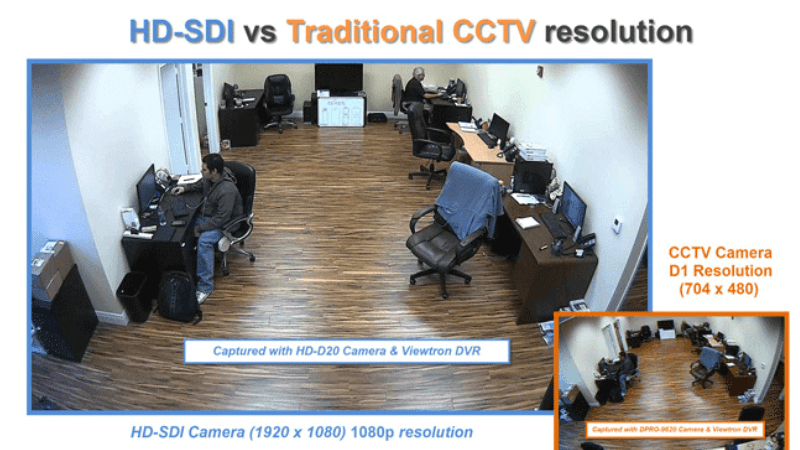
HD-SDI can carry uncompressed digital video with low transport delay in a suitable system. Resolution and format depend on the camera and recorder; HD-SDI does not mean every camera is 1080p. Use the specifications for the exact equipment.
Potential advantages
- Reuse of coaxial cable: Existing cabling may be reusable if its condition, connectors, and signal quality are adequate.
- Direct video connection: The camera-to-recorder link can operate without relying on the local IP network.
- Low-delay video: A direct SDI path can have low transport delay, though the camera, recorder, and display also affect end-to-end latency.
- Digital HD picture: HD-SDI carries digital video rather than the older analog composite signal.
These are system-dependent advantages, not guarantees that HD-SDI will be more reliable or easier to install than IP cameras. IP systems can offer different features, including flexible network routing and device management.
Limits and buying checks
- HD-SDI cameras require a compatible HD-SDI recorder or receiver. They do not automatically interoperate with analog, HD-TVI, HDCVI, or IP equipment.
- Usable cable distance depends on cable type, signal format, connectors, and installation quality. As a reference, Extron describes approximately 100 m for full-bandwidth HD-SDI over standard RG6 coax; verify the camera and recorder specifications for the actual run.
- Check each device’s supported resolution, frame rate, and video standard before mixing equipment.
- Compare the complete system cost, including cameras, recorder, power, storage, cabling, and installation.
Before replacing an older surveillance system, identify the existing cable type and recorder model, then confirm compatibility with the new camera. Extron’s HD-SDI overview explains the interface and why cable distance depends on the transmission medium.
Related Articles
 Advantages and disadvantages of dual boot (dual boot)
 What is VPN? Advantages and disadvantages of VPN virtual private network
 What is AMD CPU? Advantages and disadvantages of AMD CPU
 Top best selling Xiaomi travel cameras 2020
 Advantages and disadvantages of the Internet
 5 best wireless security cameras for the house
Reader Comments 0
Sign in with email or Google to join the discussion.