Table of Contents
France did use a white flag during the Bourbon Restoration, but the popular claim that it was the only country ever to use a white national flag is too broad. The white banner was a royalist symbol and replaced the revolutionary tricolor during the restorations of 1814–1815 and 1815–1830. It should not be confused with the white flag used internationally to request negotiation or surrender.

Why did the restored monarchy choose white?
White had long been associated with the French monarchy, particularly the House of Bourbon. Before the Revolution, French royal and naval banners appeared in several forms: some were plain white, while others displayed gold fleurs-de-lis or the royal arms. There was not one standardized national flag in the modern sense throughout the entire Ancien Régime.
When Louis XVIII returned after Napoleon's defeat in 1814, the Bourbon monarchy rejected the tricolor because of its association with the Revolution and the Napoleonic era. An ordinance restored the white ensign. Napoleon's return during the Hundred Days briefly interrupted the restoration in 1815; after his final defeat, the Bourbons again ruled under the white royal flag until 1830.
How the French tricolor developed
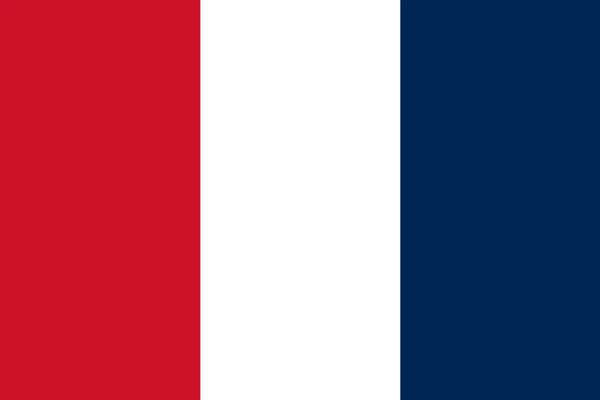
The colors blue and red were associated with Paris, while white was a longstanding color of France and the monarchy. During the Revolution, these colors were combined in a cockade and then a flag. An early vertical tricolor used red, white, and blue; in 1794, the National Convention established the blue-white-red arrangement familiar today.
It is common to say that the central white stripe placed the king between the people of Paris, but the flag's symbolism evolved and was never limited to one simple explanation. The official account from the French presidency describes white as the color of the king and blue and red as the colors of Paris; readers can consult the Élysée's history of the French flag.
Why the white flag disappeared in 1830
The July Revolution of 1830 overthrew Charles X and ended the senior Bourbon line's rule. Louis-Philippe restored the tricolor, which better represented the political legacy of the Revolution. The blue-white-red flag has remained France's national emblem since then, apart from a brief dispute over the flag during the upheaval of 1848.
Was France really unique?
No defensible historical survey supports the absolute claim that France was the only country ever to use a white national flag. Flag status is especially difficult to compare across eras because royal standards, military colors, naval ensigns, civil flags, and modern national flags are not equivalent. Afghanistan, for example, also used predominantly white flags during periods of Taliban rule, although designs and political recognition changed.
The accurate conclusion is narrower: the restored Bourbon monarchy replaced the French tricolor with a white royal flag from 1814 to 1830, with an interruption during the Hundred Days in 1815. The banner signaled dynastic restoration, not battlefield surrender.
Timeline
| Period | Flag development |
|---|---|
| 1789–1790 | Revolutionary cockades combine Parisian blue and red with white. |
| 1790 | An early vertical tricolor is adopted with red nearest the hoist. |
| 1794 | The blue-white-red vertical arrangement is established. |
| 1814–1815 | The Bourbon Restoration revives the white royal flag, interrupted by Napoleon's Hundred Days. |
| 1815–1830 | The restored Bourbon monarchy again uses the white flag. |
| 1830 onward | The July Revolution restores the tricolor; a brief 1848 dispute does not produce a lasting replacement. |
Flags are compressed versions of political history, so their meanings are best read in context rather than reduced to universal color symbolism. For more visual geography, see these unusual maps of the world and the smallest countries by area.
Related Articles
 We Almost Don't See Which Country Has the Purple Flag, Why Is It3 minutes read
 China Is the First Country to Plant a Flag on the Dark Side3 minutes read
 Guidance on National Flagging on Facebook Profile Picture4 minutes read
 Storm Took Advantage of the Us National Flag to Spread1 minutes read
 Instructions to Make a Representative Picture of Facebook5 minutes read
 Endangered White Dolphin in Mexico4 minutes read
Reader Comments 0
Sign in with email or Google to join the discussion.