Table of Contents
This guide provides a clear overview of malicious apps, including the main concepts, practical steps, and common questions. Use it to understand the topic, compare the available options, and make a more informed decision.
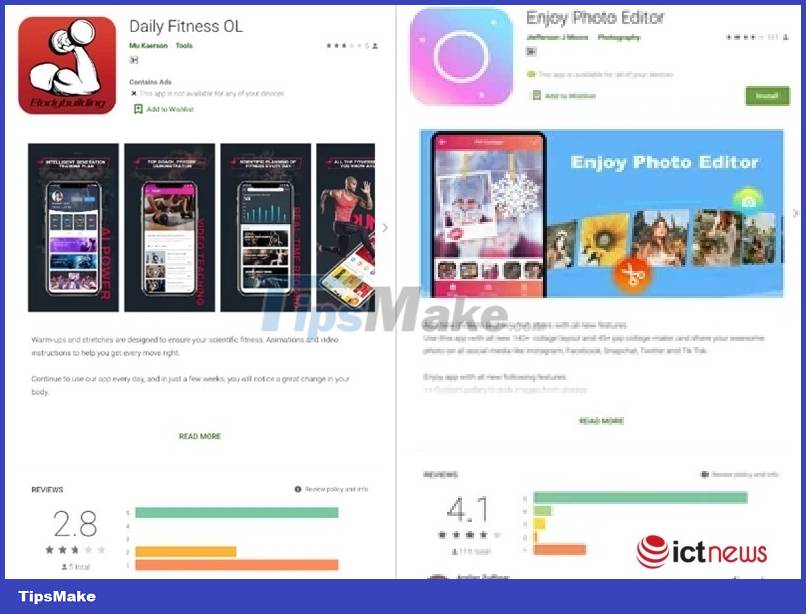
Some apps you should remove immediately include: Daily Fitness OL, Enjoy Photo Editor, Panorama Camera, Photo Gaming Puzzle, Swarm Photo, Business Meta Manager, Cryptomining Farm Your Own Coin.
They all carry the spyware (spyware) Facestealer, discovered since July 2021. Facestealer steals Facebook information from users through malicious apps on Google Play, then uses it to infiltrate Facebook accounts, serving purposes such as scams, fake posts, advertising bots. Similar to the Joker malware, Facestealer changes its code frequently and has many variations.
Since being denounced until now, they have continuously appeared on Google Play under different guises. TrendMicro's database records more than 200 variations of Facestealer's applications. For example, Daily Fitness OL is ostensibly a fitness app, but its goal is to steal Facebook information. Once the application is launched, it sends a request to hxxps://sufen168[.]space/config to download the encryption configuration. When the user logs into Facebook, the application opens a WebView browser to load the URL from the downloaded profile. Next, a piece of JavaScript code is embedded in the web page to get the login data. After the user is successfully logged into the account, the application collects the cookie, then encrypts all the personally identifiable information (PII) and sends it to the remote server.
The 7 apps were all removed from Google Play by Google shortly after receiving TrendMicro's notification about their real purpose and potential for data theft. However, for those who have installed one of the above applications, what to do now is to quickly change the password of Facebook or other accounts and services.
In addition, TrendMicro also detected more than 40 fake cryptocurrency mining applications, which are variations of previous malicious applications. They trick users into buying paid services or clicking on ads with offers of generous amounts of cryptocurrency.
To avoid encountering malicious applications, users should carefully read reviews from people who have downloaded them before. However, this is also not the optimal solution because many applications will hire highly appreciated services, for example, Photo Gaming Puzzle is rated 4.5 stars, and Enjoy Photo Editor 4.1 stars. Enjoy Photo Editor surpassed 100,000 downloads before being removed.
Conclusion
Understanding Malicious Apps makes it easier to compare options, avoid common mistakes, and apply the information in this guide more effectively. Review the relevant requirements before making changes or choosing a solution.
FAQ
What is Malicious Apps?
For example, Daily Fitness OL is ostensibly a fitness app, but its goal is to steal Facebook information.
Why is Malicious Apps important?
Understanding Malicious Apps helps you evaluate features, compatibility, performance, and potential limitations before you choose a product or follow a procedure.
What should you consider when using or choosing Malicious Apps?
Consider your specific goal, compatibility requirements, available features, cost, security, and the practical recommendations described in this guide.
Related Articles
 9 Apps That Scam and Steal Users' Facebook Accounts3 minutes read
 23 Malicious Apps That Steal Facebook and Instagram Accounts3 minutes read
 Instructions to Retrieve Facebook Password4 minutes read
 Instructions to Change Facebook Password on Computer4 minutes read
 4 Ways to Hack Facebook You Should Know to Protect Your Facebook12 minutes read
 Botnet: Complete Guide4 minutes read
Reader Comments 0
Sign in with email or Google to join the discussion.