Table of Contents
A physicist at Cornell University has calculated that the universe may be nearing the midpoint of its approximately 33-billion-year lifespan. Using newly released data from the Large Dark Energy Observatory, he concluded that the universe will continue to expand for another 11 billion years before reaching its maximum size. After that, it will begin to contract, eventually collapsing to a single point, like a stretched rubber band that springs back.
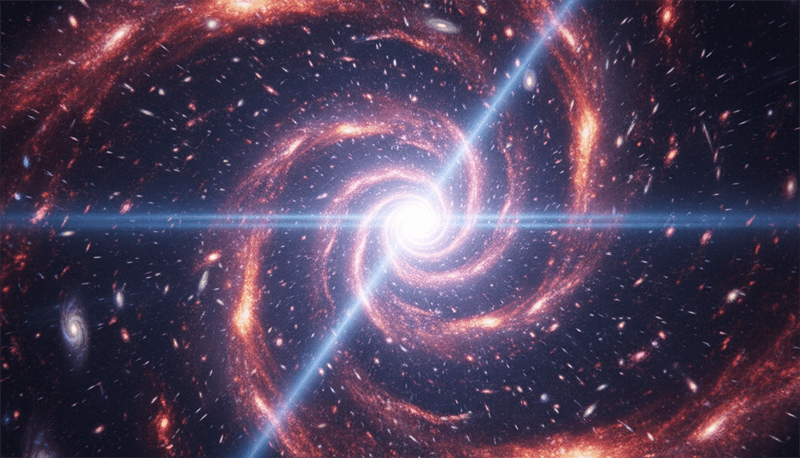
Henry Tye, Horace White Professor Emeritus of Physics at the University of Arts and Sciences , reached this conclusion by updating the long-standing model built around the "cosmological constant ." This concept was first introduced by Albert Einstein more than a century ago and is central to modern predictions about how the universe will evolve.
"For the past 20 years, everyone believed that the cosmological constant was positive and that the universe would expand forever," Professor Tye said. "New data seems to indicate that the cosmological constant has a negative value, and the universe will end in a Big Contraction."
Big Crunch is the opposite of Permanent Expansion.
The universe is currently 13.8 billion years old and is still expanding. Standard cosmology outlines two distinct possibilities. If the cosmological constant is positive, the expansion will continue indefinitely. If it is negative, the universe will eventually stop growing, reach its maximum size, and then reverse course, contracting until everything collapses to zero.
Tye's updated model supports the second scenario. Based on his calculations, that collapse would occur in about 20 billion years.
Dark Energy data from DES and DESI
Key evidence comes from new findings published this year by the Dark Energy Survey (DES) in Chile and the Dark Energy Spectroscopic Instrument (DESI) in Arizona. Professor Tye notes that the results from these two observatories, located in opposite hemispheres, are closely consistent with each other.
Both projects aim to better understand dark energy —the component that makes up about 68% of the mass and energy in the universe. Their goal is to examine whether dark energy is simply a constant property of space itself, or something more complex. Data suggests that the universe appears to be governed not solely by a pure cosmological constant; there is an additional factor influencing how dark energy operates.
To explain this, Tye and colleagues proposed a hypothetical particle with extremely low mass. In the early stages of cosmic history, this particle behaved like a cosmological constant, but over time, its effect changed. This adjustment matches the latest observations and pushes the latent cosmological constant toward a negative value.
Ongoing observations and future experiments
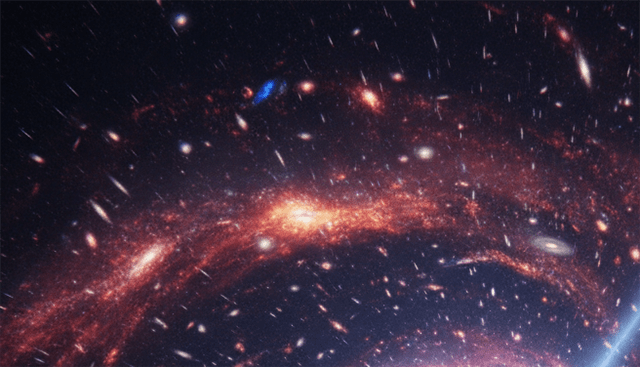
Experimental data is still being collected. Hundreds of researchers are studying millions of galaxies to refine estimates of dark energy. The DESI project will continue collecting data for another year. Other additional projects are also contributing or preparing to begin, including the Zwicky Transit Facility (San Diego), the Euclid Space Telescope (Europe), the SPHEREx mission (NASA), and the Vera C. Rubin Observatory.
Understanding the Beginning and the End
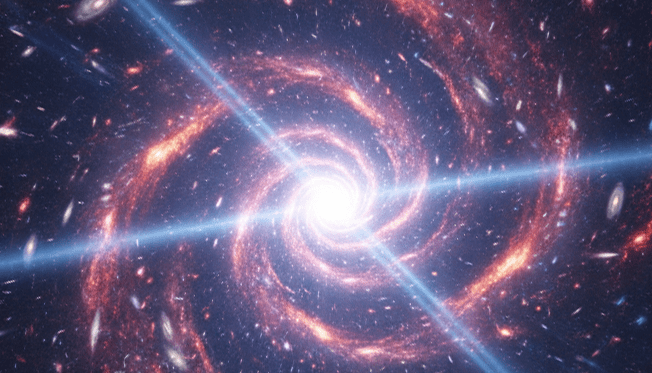
Professor Tye believes that the fact scientists are able to calculate the total lifespan of the universe in measurable terms is an encouraging sign. Identifying both the beginning and the end helps cosmologists better understand the entire story of astronomical history.
"For any life form, you always want to know how it begins and ends. The same is true for our universe," he said. "In the 1960s, we knew the universe had a beginning. The next question was: 'Does it end?' For many years, many people thought it would last forever. It's good to know that, if this data is correct, the universe will have an end point."
Related Articles
 9 Amazing Facts About the Universe Amaze You7 minutes read
 Water in the Universe May Have Formed Closer to the Big Bang Than Previously6 minutes read
 PSR B1620-26b - Whats the Oldest Planet on the Top of the Elders'3 minutes read
 How Many Planets Are There in the Universe: Key Facts4 minutes read
 America Discovered the First Milky Way of the Universe?4 minutes read
 Ways the Earth Was Completely Different 2 Billion Years Ago8 minutes read
Reader Comments 0
Sign in with email or Google to join the discussion.