Table of Contents
This article examines ProjectDR Allows Doctors to 'See Through' the Patient's Body. It presents the main facts, practical implications, and key points in a clearer, easier-to-follow format.
Understanding ProjectDR Allows Doctors to 'See Through' the Patient's Body
Imagine if the doctors could see through the patient's skin, everything would be like. Yes, that's what scientists at the University of Alberta have developed. It is still in beta, and is called ProjectDR.
Technology does not really make the skin transparent, nor does it provide real-time images inside the patient's body. Instead, it projected the previous three-dimensional CT or MRI images obtained on the skin, then arranged the corresponding parts of the patient.
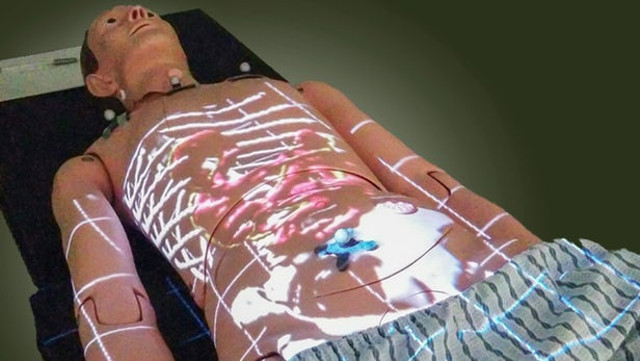
This system incorporates a projector, infrared camera, and markers placed in strategic positions on the patient's body. The cameras monitor the markers, allowing the system to know the direction of the body, so that images are projected on the skin accurately and clearly.
The system can also segment images, such as showing lung images or pointing out blood vessels, depending on what the situation requires.
Ian Watts, a computer science student, created a system with graduate student Michael Fiest, saying: "There are many applications for this technology, including teaching medicine and objects. therapy, endoscopic surgery and even surgery planning '.
- Google AI can diagnose a patient's cardiovascular condition by scanning the retina image.
- NeoMano - robotic gloves for paralyzed patients.
- Robot equipment to improve balance and walking for Parkinson patients.
FAQ
What is the main point of ProjectDR Allows Doctors to 'See Through' the Patient's Body?
Imagine if the doctors could see through the patient's skin, everything would be like. Yes, that's what scientists at the University of Alberta have developed.
Why is ProjectDR Allows Doctors to 'See Through' the Patient's Body important?
ProjectDR Allows Doctors to 'See Through' the Patient's Body matters because it can affect how readers understand, choose, use, or respond to the subject discussed in the article.
What should readers verify about ProjectDR Allows Doctors to 'See Through' the Patient's Body?
Check the date, product or software version, compatibility, and any current guidance before acting, especially when technology, security, health, or pricing is involved.
Related Articles
 Wuhan Team: 3-10% of Covid-19 Patients After Discharge Were6 minutes read
 Foods to Supplement for Dengue4 minutes read
 After Donating, How Will Your Body Be Processed: Body After Death3 minutes read
 20 Types of Strange Objects Discovered in the Human Body Make You9 minutes read
 No Need for Blockade, Korea Still Controlled Covid-1915 minutes read
 What Is Body Shaming?2 minutes read
Reader Comments 0
Sign in with email or Google to join the discussion.