Table of Contents
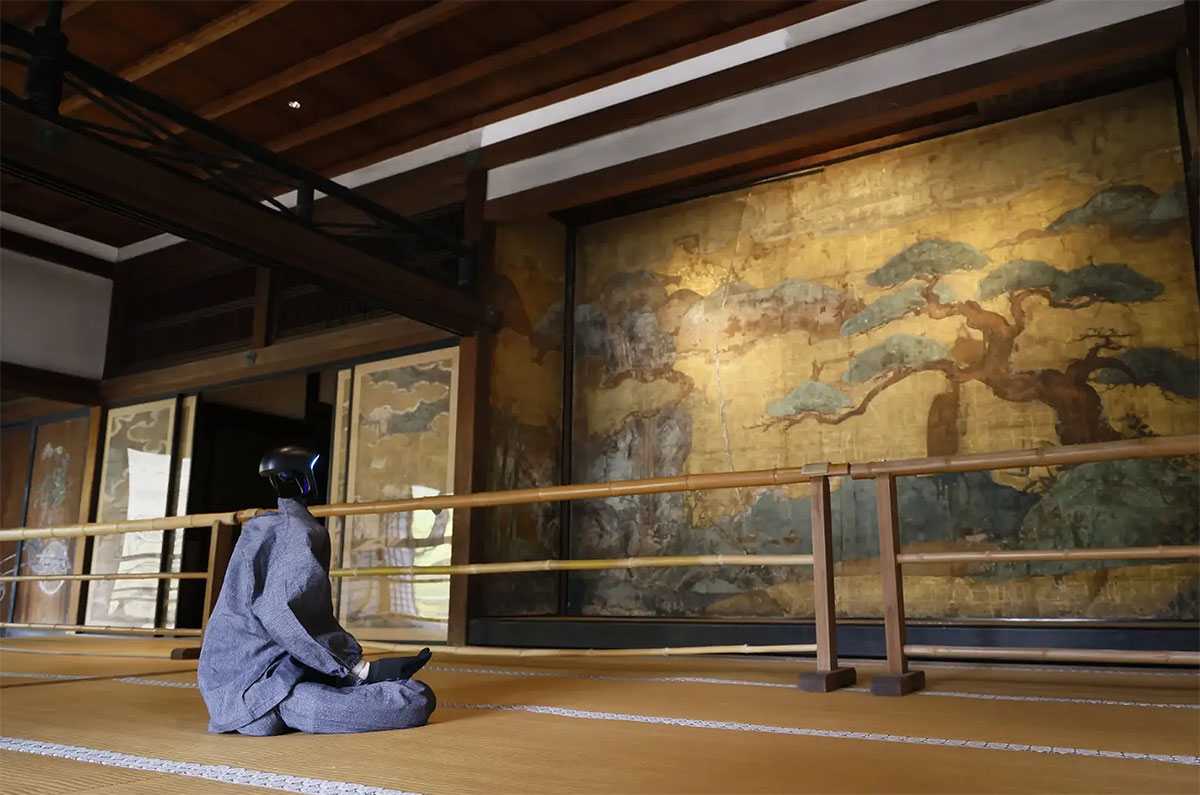
Buddharoid is an experimental humanoid robot that answers questions using a Buddhism-focused conversational AI. Researchers demonstrated it at Shoren-in Temple in Kyoto in February 2026, where it spoke about Buddhist teachings and responded to personal concerns while performing simple gestures.
Calling it an “AI monk” is convenient shorthand, but the robot is not an ordained religious authority and cannot reproduce the experience, judgment, or pastoral responsibility of a human practitioner.
How Buddharoid works
The project combines a Unitree G1 humanoid platform with BuddhaBot-Plus, a conversational system developed from earlier Kyoto University research on Buddhist texts. During a demonstration, the robot walked, bowed, brought its hands together in the gassho gesture, and answered questions in a calm speaking style.
The AI generates responses from its training and system instructions. It does not possess faith, consciousness, spiritual attainment, or personal experience. Its answers can still be incomplete, misleading, or inconsistent, so they should be understood as computer-generated interpretations rather than religious rulings.
Who developed the project?
Buddharoid was developed by a team involving Kyoto University researchers and technology partners, including Teraverse and XNOVA. The physical platform comes from Unitree Robotics, while the Buddhism-oriented dialogue system builds on BuddhaBot research.
The demonstration explored whether giving a text-based AI a physical presence changes how people receive and discuss religious ideas. A humanoid can direct its body toward a visitor and use familiar gestures, but those effects also raise questions about whether people may place too much trust in a machine that appears socially present.
Why test a robot in a temple?
Japan’s aging and declining population has left some temples with fewer visitors, workers, and possible successors. Researchers and religious communities have therefore explored digital archives, online services, conversational systems, and robots as ways to preserve or explain teachings.
Buddharoid is best viewed as one such experiment, not a proven solution to the demographic problems facing temples. A robot still requires technical staff, maintenance, curated source material, electricity, connectivity, and human oversight.
How it differs from Mindar
Kyoto has hosted an earlier religious robot called Mindar at Kodaiji Temple. Introduced in 2019, Mindar represents Kannon and delivers a prepared sermon with programmed movement and multimedia accompaniment.
Buddharoid’s distinguishing goal is live conversation. Instead of only playing a fixed sermon, its AI can formulate a new response to a visitor’s question. That flexibility makes the encounter more interactive, but it also introduces the risk of generated errors that a prerecorded script can avoid.
Questions the project raises
- Authority: Visitors should be told clearly when guidance is generated by AI and who is responsible for reviewing it.
- Accuracy: Buddhist traditions and texts contain important differences; one system cannot represent every school or interpretation.
- Privacy: Personal questions may reveal sensitive information, so data collection and retention need transparent limits.
- Dependency: A robot should complement access to qualified human teachers, not become the only available source of spiritual or mental-health support.
- Design influence: Robes, voice, and human-like gestures can make an answer feel more authoritative than its evidence warrants.
What Buddharoid demonstrates
The project shows how conversational AI can be embodied in a mobile humanoid and placed in a cultural setting. Its significance lies as much in the questions it prompts—about trust, tradition, interpretation, and presence—as in the robot’s technical abilities. Whether it becomes a useful temple tool will depend on careful evaluation with religious communities, clear disclosure, and continuing human responsibility.
Related Articles
 Robot Monk: Complete Guide3 minutes read
 What Is Monk Mode? How to Use Monk Mode to Complete Goals9 minutes read
 The Giant Robot War Between the US and Japan Will Take Place3 minutes read
 Giant Robot War: America Wins Japan2 minutes read
 Japan Introduced Assistant Robots for the Olympics 20206 minutes read
 Xiaomi Launched the Vacuum Cleaner Robot Mi Robot 1S Capable of Memorizing Maps, Scanning Each Room3 minutes read
Reader Comments 0
Sign in with email or Google to join the discussion.