Table of Contents
A severe solar storm could disrupt parts of the internet by affecting electrical power, satellites and other supporting infrastructure. That is different from saying a storm will inevitably shut down the entire global network or keep it offline for months.
The outcome depends on the storm, local ground conditions, equipment design and the availability of alternative routes and power. Some effects are well established; others, including the consequences for long submarine-cable systems during an extreme event, require more careful qualification.
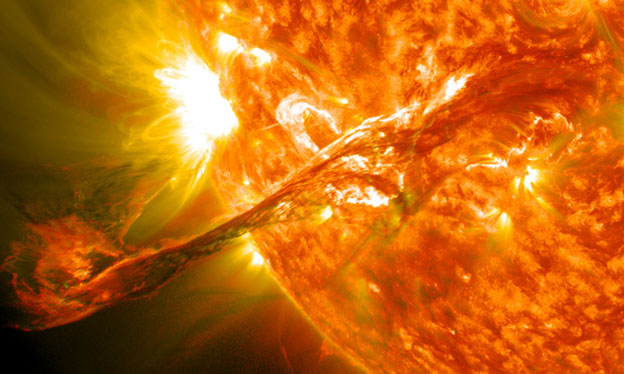
What causes a geomagnetic storm?
The solar wind is a continuous flow of charged particles from the Sun. It is not simply another name for an explosion. A coronal mass ejection, or CME, is a large release of plasma and magnetic field that can disturb Earth's magnetic environment if conditions align.
NOAA's CME explanation distinguishes these eruptions from the surrounding solar wind. Solar flares involve electromagnetic radiation and can produce effects different from those of a CME-driven geomagnetic storm.
Earth's magnetic field is generated within the planet; this explanation of Earth's core provides related background. Space-weather effects depend on how solar material and fields interact with that environment.
How space weather affects technology
Power grids
Changing magnetic conditions can induce currents in long conducting systems. In power networks, these currents can interfere with transformer operation and contribute to outages. A loss of electricity can interrupt routers, mobile networks and data facilities even when the optical fibers themselves are intact.
The March 1989 Quebec blackout is a documented example. NASA's space-weather educational material describes a nine-hour outage, not a universal duration for solar-storm disruptions.
Satellites and navigation
Storm-driven changes in the upper atmosphere can increase drag on low-orbit satellites. This is atmospheric resistance, not an increase in gravitational pull. SpaceX's mission updates document the premature loss of Starlink satellites after a February 2022 geomagnetic storm.
Disturbances in the ionosphere can also degrade radio propagation and satellite-navigation signals. NOAA's space-weather scales describe possible effects at different storm levels. A GPS disturbance does not, by itself, mean the internet has failed.
Why submarine cables are part of the discussion
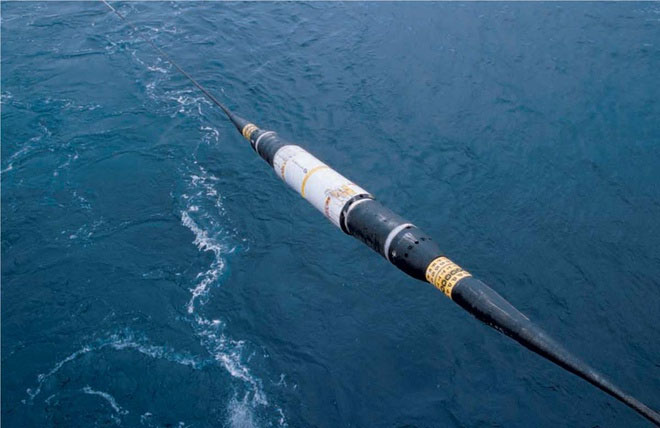
Optical fiber carries light, so it does not respond to induced electrical currents like a metal power line. Long submarine systems nevertheless rely on powered repeaters and electrical supply equipment. The whole system therefore needs assessment, not just the glass fiber.
Sangeetha Abdu Jyothi's 2021 study of solar superstorms and internet resilience examined the potential for large disruptions and highlighted submarine-cable exposure under its modeling assumptions. It was a risk analysis, not an observation that every repeater will fail in the next major storm.
Nor does the failure of one component necessarily disconnect an entire continent. Cable design, power arrangements, routing alternatives and the pattern of simultaneous failures matter. For network background, see how undersea-cable disruption affects internet connectivity.
What cannot be predicted with confidence
The Carrington Event of 1859 and the 1921 storm are important historical events, not the only geomagnetic storms ever recorded. Their effects on earlier electrical systems do not provide a direct measurement of how today's internet would behave.
A fixed “chance per decade” needs a defined storm threshold and a stated statistical model. Likewise, a single dollar-loss estimate or a months-long outage claim cannot describe every possible event.
Forecasting uses solar observations, measurements of the solar wind and other data; it is not limited to counting sunspots. Warning time and confidence vary. Follow NOAA's alerts, watches and warnings for actual conditions rather than treating a general risk article as an imminent-outage forecast.
Practical resilience matters more than dramatic predictions
Network and power operators can assess equipment exposure, backup power, routing diversity and recovery procedures. For ordinary users, keeping important files and essential contact information available offline is a sensible continuity measure for many types of outage. No special consumer product can guarantee internet access through a widespread infrastructure failure.
Related Articles
 Here's How Solar Storms Help Develop Life on Alien Planets: Complete Guide6 minutes read
 Could the Global Internet Completely Shut Down: Explained5 minutes read
 Ways Solar Storms Could Destroy Life on Earth: Explained6 minutes read
 What Is Solar Storm? How Solar Storm Affects the Earth4 minutes read
 Breakthrough Solar Panels That Can Withstand Even the Biggest Storms3 minutes read
 Maybe the Solar System 2.0 Is Not the Cradle of Nurturing Life3 minutes read
Reader Comments 0
Sign in with email or Google to join the discussion.