Table of Contents
This practical guide walks through how to use optical out (s / PDIF) port on a PC, explains the main requirements, and highlights common issues that may appear along the way.
( Note : for this feature to work, both your PC and audio system must be equipped with an optical port.)
How to use the Optical (S / PDIF) Audio port
First, make sure that both your speaker and PC have optical ports (S / PDIF). For now, just plug your PC into the speaker using an optical cable.
( Note: if you are using a comprehensive sound system that includes an amplifier (amplifier) instead of a stand-alone speaker, double-check the optical connection you are using. You can provide separate options for the optical-IN and optical-OUT ports. In this case, connect the cable from the PC's optical-OUT port to the optical-IN port on the amplifier, speakers.) .
As for cables, in general, optical cables work in a similar way to HDMI in that they can transmit digital signals without any loss of quality. The main difference is that the audio data uses less bandwidth than HDMI, so even if the quality of the cable is not good, the sound quality is not affected much.

Once the optical cable is connected, click on the speaker icon in the bottom right corner of the Windows taskbar, then click on the speaker name above the volume slider to see whether the audio output is' Optical 'or'. Digital display or not. If so, just click to activate it.
If the speaker doesn't show up in the cord, right-click the speaker icon in the taskbar, click Sounds , then click the Playback tab .
Next, right-click anywhere in the Playback tab list, then click ' Show Disabled Devices '.
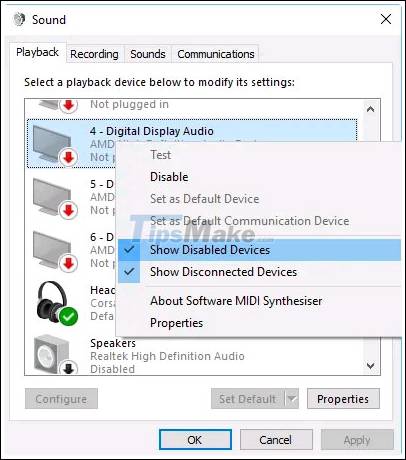
Next, a device called ' digital output ' or ' optical output ' will be displayed. Right click on it and click ' Enable ' to enable it. Then right-click on this device again and click ' Set as default device '. Now the optical audio connection has been activated.

How to enable 5.1 Optical surround sound on PC
Analog audio may be fine with regular stereo setups. However, when you enter the world of 5.1 and modern audio formats like DTS, you will need a digital connection. Otherwise, the audio decoding will take place on your PC instead of the dedicated hardware of the external audio system. The sound is then transmitted to the external system in a lower quality analog format.
In general, you should use an independent optical connection for your audio system instead of the HDMI port. HDMI audio can be a bit easier to set up but comes with significant limitations.
HDMI has limited bandwidth and is mainly used for video transmission. The HDMI port might not have enough bandwidth to transmit uncompressed 5.1 digital audio to your speaker system.
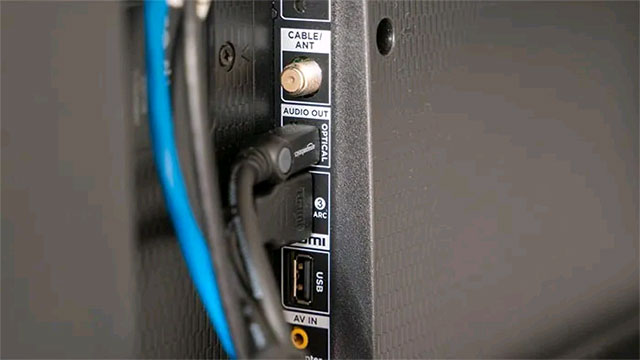
By using two dedicated cables for video and audio, you'll have an audiovisual setup for the best possible quality. However, there are some caveats.
First, is your motherboard capable of generating 5.1 surround sound signals? Having only an optical output port does not guarantee that you will get surround sound on all games, movies, etc. The optical port on your motherboard should support 5.1 audio.
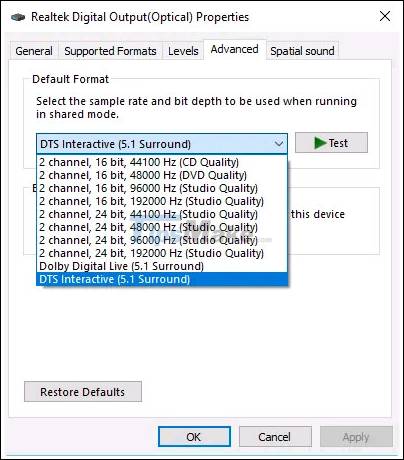
You can check if your setup supports one of the Dolby 5.1 formats by navigating to the Sound -> Playback window . Right-click your device, click Properties , and then click the Advanced tab . Next, click the drop-down menu, choose ' DTS Interactive ' or whatever surround sound settings you want to use, then click OK .
In addition, you should also click the ' Supported Formats ' tab to make sure that the formats your receiver can handle are checked.
Key Takeaways
Use the information above as a practical reference for how to use optical out (s / PDIF) port on a PC. Review each step carefully, confirm any requirements, and choose the option that best fits your situation.
FAQ
What does this guide explain about Use Optical Out (S / PDIF) Port on a PC?
It explains the main concepts, practical considerations, and useful steps related to use optical out (s / PDIF) port on a PC without requiring advanced knowledge.
Who can benefit from learning about Use Optical Out (S / PDIF) Port on a PC?
This information is useful for readers who want a clear overview, practical guidance, and reliable steps related to use optical out (s / PDIF) port on a PC.
What should I check before applying this information?
Review the requirements, confirm that your device, software, or situation matches the instructions, and back up important data before making major changes.
Related Articles
 What Is Optical Audio Port? Should We Use It?13 minutes read
 What Is Port 0 Used For?4 minutes read
 What Is AAA PC Port? Why Do They Have So Many Problems?7 minutes read
 How to Change LPT Port in CMOS7 minutes read
 An Optical Switch Explained16 minutes read
 How to Connect Printer 2.0 USB Port to USB 3.0 Port on Windows 104 minutes read
Reader Comments 0
Sign in with email or Google to join the discussion.