Table of Contents
An AI agent is a model-driven system that can choose and use tools to pursue a goal over multiple steps. A chatbot may answer from the conversation alone; an agent can retrieve data, run code, update state, inspect the result, and decide what to do next.
That extra autonomy is useful but creates more failure modes. The model may select the wrong tool, supply bad arguments, repeat an action, trust malicious page content, or continue after the task should have stopped. A reliable agent therefore depends as much on its surrounding software—tools, permissions, state, evaluation, and monitoring—as on the model.
Level 1: the basic agent loop
At the simplest level, an agent has five parts:
- Goal: a clear description of the desired result and constraints.
- Model: chooses the next supported action based on the available context.
- Tools: typed functions that search, calculate, read, write, or call a service.
- State: records the current plan, completed work, outputs, and limits.
- Controller: executes tools, returns observations, enforces policy, and stops the loop.
while not finished:
    next_action = model(goal, state, available_tools)
    policy_check(next_action)
    observation = run_tool(next_action)
    state = update_state(state, next_action, observation)
    finished = success(state) or limit_reached(state)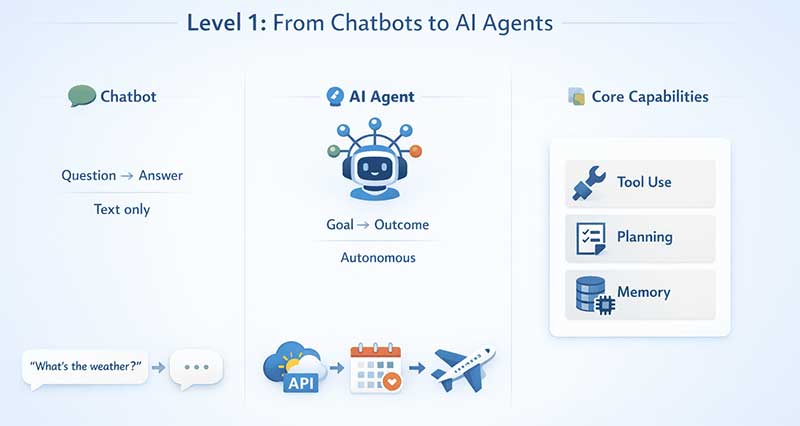
Tool use is what turns generated text into an action. A weather agent should call a weather service rather than inventing current conditions. A travel agent may search and compare flights, but purchasing should normally be a separate action that requires confirmation.
Memory is often misunderstood. A prototype does not need a database of everything the model has ever seen. It first needs reliable working state: which step is active, which results were accepted, what remains, and how much time or money is left.
Level 2: a reliable single-agent system
The fastest route to a useful agent is usually a small number of deterministic workflow steps plus one model-controlled loop where flexibility is actually needed. Anthropic's guide to effective agents recommends starting with the simplest solution and adding agentic complexity only when it improves the result.
Choose a planning pattern
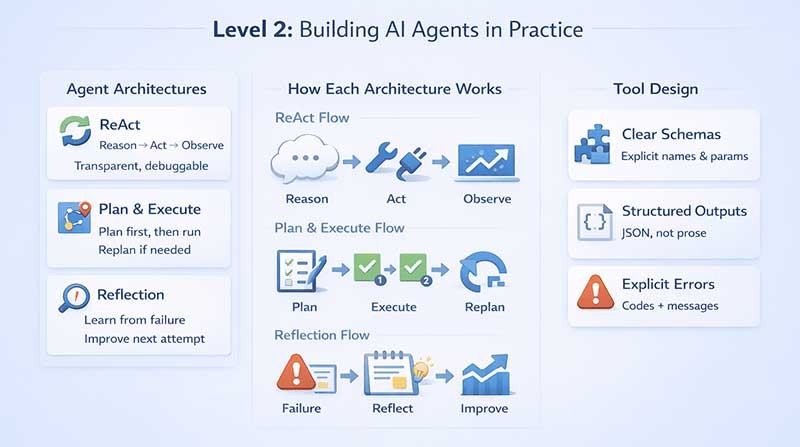
- Tool-calling loop: the model selects one action, observes the result, and repeats. It is simple and adapts well to changing information.
- Plan then execute: the system creates a high-level plan, validates it, and performs the steps. It works well when dependencies and approval points are known.
- Router and specialists: a classifier sends the task to a narrower prompt or workflow. This is often more predictable than one agent with every tool.
- Evaluator loop: a separate check scores an artifact against explicit criteria and requests revision until a limit is reached.
The ReAct paper established an influential pattern that interleaves model reasoning with actions and observations. In a production system, expose action traces, tool inputs, evidence, and concise decision summaries for debugging; do not depend on displaying private model reasoning or unstructured hidden thoughts.
Design narrow, typed tools
A tool should perform one understandable operation and have a strict input schema. find_orders_by_customer_id is easier to use and authorize than a general run_database_query. Return structured data and machine-readable errors:
{
  "ok": false,
  "error": {
    "code": "RATE_LIMITED",
    "retry_after_seconds": 30,
    "message": "The service temporarily rejected the request."
  }
}
Describe side effects explicitly. A tool that previews an email should be separate from the tool that sends it. Where possible, make write operations idempotent and require a request key so retries do not create duplicates.
Keep state outside the conversation
Use a structured state object for the goal, plan, artifacts, sources, approvals, retry counts, and budget. Conversation history is useful context but is a poor database. Summarize older observations and preserve the original source or artifact identifier so facts can be rechecked.
Set stopping conditions
Every run needs a definition of success and hard limits: maximum steps, elapsed time, model tokens, tool calls, retries, and monetary cost. Stop when the goal is met, a required approval is unavailable, evidence is insufficient, or repeated states indicate a loop. A safe partial result is better than an endless “one more attempt.”
Evaluate tasks, not eloquence
Create a versioned test set that represents common, difficult, and adversarial cases. For each task, define what correct completion means and how side effects will be checked. Useful measurements include:
- Task success and partial success.
- Wrong tool, wrong arguments, or wrong sequence.
- Unsupported claims and source quality.
- Unnecessary actions, retries, latency, tokens, and cost.
- Safety-policy violations and approval bypasses.
- Recovery from timeouts, malformed results, and unavailable services.
Review complete trajectories, not only the final answer. A correct result reached through unsafe actions is still a failure.
Level 3: production agents
Production adds concurrency, identity, auditability, privacy, deployment controls, and real users who behave differently from the test set. The agent should run inside the same engineering disciplines applied to other systems: staged releases, access control, incident response, backups, and rollback.
Use multi-agent designs only when the split is real
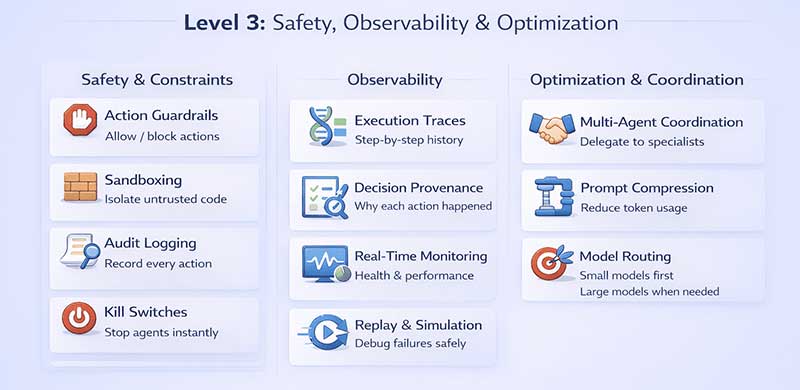
Multiple agents can help when work is genuinely parallel, needs isolated context, or requires different tools and permissions. A coordinator might delegate independent research areas, then merge the sourced results.
Multi-agent systems also multiply token use, coordination failures, and inconsistent assumptions. Start with a single agent plus deterministic workers. Add a sub-agent only when evaluation shows a measurable improvement over the simpler design. TipsMake's comparison of AI agent frameworks can help match an orchestration pattern to the project.
Add memory deliberately
Production memory can include:
- Run state: current steps, observations, and artifacts.
- User or project preferences: approved, editable facts with a clear owner.
- Retrieved knowledge: documents fetched for the current task with citations and permissions.
- Learned procedures: reviewed instructions or successful templates, not raw model guesses promoted automatically.
Attach provenance, timestamps, access rules, and deletion controls. Retrieval by semantic similarity can find useful context, but the returned item still needs authorization and relevance checks. Do not let memory grow without retention and consolidation policies.
Separate permissions from prompts
A prompt saying “never delete data” is not an access-control system. Enforce allowlists, scoped credentials, sandboxes, network restrictions, transaction limits, and human approval in code outside the model. Treat tool output, webpages, documents, and emails as untrusted input that may contain prompt-injection attempts.
Make the system observable without leaking data
Record run IDs, model and prompt versions, tool names, durations, status codes, token usage, retries, approvals, and artifact references. OpenTelemetry provides common concepts for traces, metrics, and logs, and its GenAI observability guidance covers model and tool operations.
Prompts, outputs, and tool results may contain secrets or personal data. Redact by default, restrict trace access, and define retention before enabling full-content logging. TipsMake's guide to LLMOps tools covers evaluation, monitoring, and guardrail layers that complement application telemetry.
Production readiness checklist
- The task has measurable success criteria and a maintained evaluation set.
- Each tool has a strict schema, limited authority, predictable errors, and idempotency where needed.
- State, source provenance, and budgets are explicit.
- High-impact actions require approval outside the model.
- Every run has step, time, retry, token, and cost limits.
- Traces support replay and debugging without exposing unnecessary sensitive content.
- Adversarial inputs, prompt injection, service outages, and duplicate actions have been tested.
- There is a kill switch, rollback path, incident owner, and process for deleting retained data.
The useful progression is not “chatbot, then maximum autonomy.” It is a sequence of controlled capabilities. Add tools, planning, memory, or multiple agents only when each addition solves a measured problem and still leaves the system understandable, testable, and safe to stop.
Related Articles
 Practical Exercise on Production Statistics Table in Excel3 minutes read
 How Are AI Agents Changing the Journalism Industry?8 minutes read
 AI Automation Process with N8n13 minutes read
 7 Practical Applications of OpenClaw You Should Know6 minutes read
 What Are Workspace Agents?6 minutes read
 Implement Three Practical Production Processes12 minutes read
Reader Comments 0
Sign in with email or Google to join the discussion.