Table of Contents
Researchers at the Hong Kong University of Science and Technology (HKUST) built an experimental full calcium-ion cell using a covalent-organic-framework quasi-solid electrolyte. The cell retained more than 74.6% of its capacity after 1,000 cycles at the study's higher test current. That is a notable laboratory result, but it does not show that calcium-ion batteries are ready to replace lithium-ion packs in electric vehicles or grid storage.
What the study tested
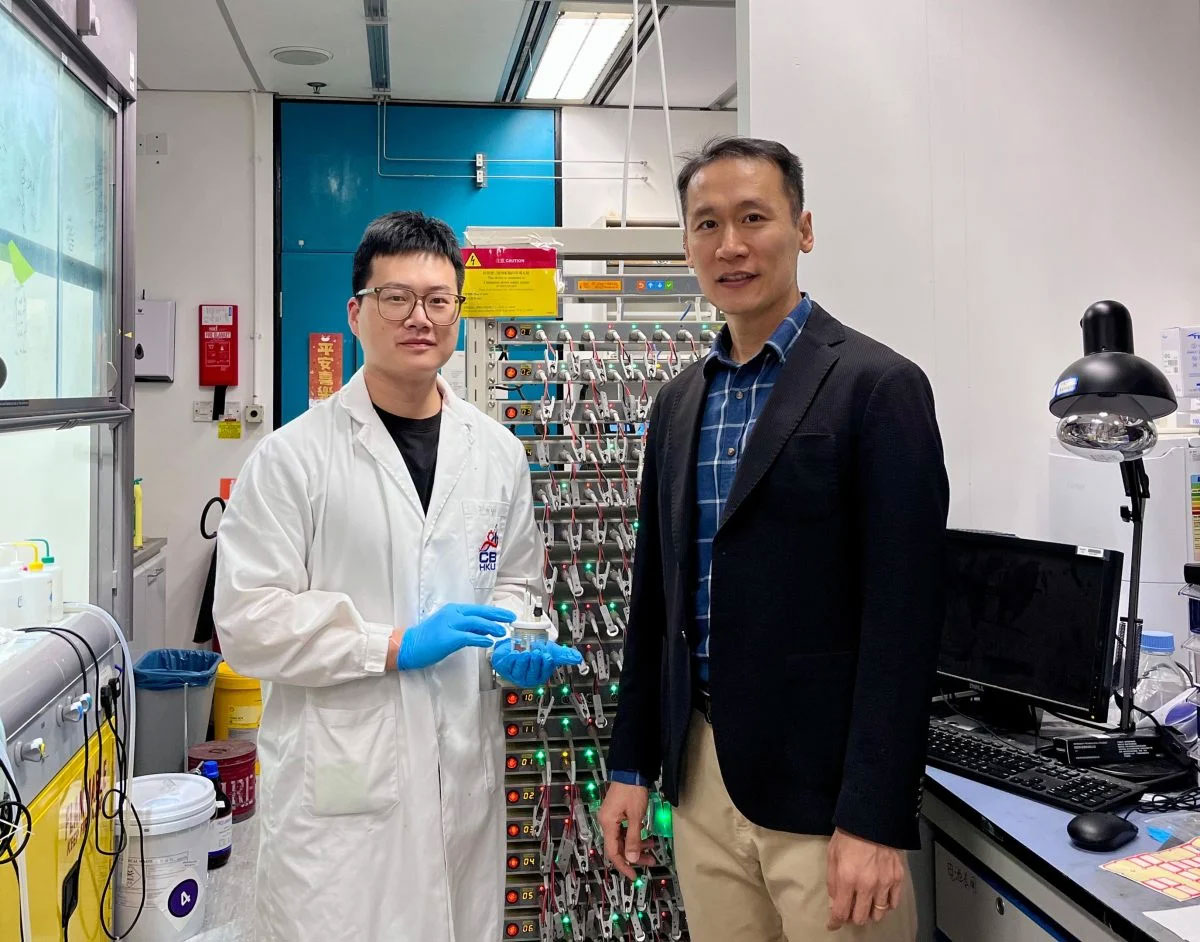
The peer-reviewed paper, High-Performance Quasi-Solid-State Calcium-Ion Batteries from Redox-Active Covalent Organic Framework Electrolytes, appears in Advanced Science. The research was led by Yoonseob Kim at HKUST in collaboration with researchers at Shanghai Jiao Tong University.
The team prepared two porous, redox-active covalent organic frameworks (COFs) with different densities of carbonyl groups. One of them, described as PT-COF, served as a quasi-solid-state electrolyte: it provides a structured pathway for calcium ions while reducing the amount of freely flowing liquid compared with a conventional liquid electrolyte.
Why calcium-ion batteries are difficult
A calcium ion carries two positive charges. That makes calcium attractive from a charge-storage perspective, but the strong interaction between Ca2+, solvent molecules, electrodes, and electrolyte structures can slow ion motion. Surface passivation at the anode and unstable cycling have also limited practical calcium-ion cells.
The HKUST design uses ordered pores lined with carbonyl groups. Experiments and simulations indicated that those aligned sites can provide a path for Ca2+ transport. The framework is also redox-active, so it participates in the cell's electrochemistry rather than acting only as an inert separator.
Results reported by the researchers
| Measurement | Reported result | What it describes |
|---|---|---|
| Ionic conductivity at room temperature | 0.46 mS cm−1 | How readily ions move through the PT-COF quasi-solid electrolyte under the test conditions. |
| Ca2+ transference number | 0.532 | The fraction of ionic current attributed to calcium ions in the electrolyte measurement. |
| Reversible specific capacity | 155.9 mAh g−1 at 0.15 A g−1 | Charge stored per mass basis specified by the study at the lower test current. |
| Long-cycle result | More than 74.6% capacity retention after 1,000 cycles at 1 A g−1 | Remaining capacity after repeated cycling at the higher current used in the experiment. |
These values are taken from the article and HKUST's research record. They should be read together with the paper's cell design, mass basis, voltage window, loading, temperature, electrolyte amount, and test protocol. A headline number cannot be compared fairly with a commercial battery unless those conditions are aligned.
Why this does not yet replace lithium-ion
The experiment addresses ion transport and cycling in a research-scale calcium cell. A vehicle or stationary-storage product must meet a much larger set of requirements:
- Pack-level energy density: the mass and volume of the electrolyte, separator, current collectors, enclosure, cooling, and control electronics all count.
- Power and charging: the cell must charge and discharge at useful rates without rapid degradation or unacceptable heat.
- Calendar life: capacity must remain stable not only over cycles but also during years of storage at different states of charge.
- Temperature range: performance and safety must be established in cold, hot, and rapidly changing conditions.
- Safety: large cells require abuse, short-circuit, overcharge, impact, and thermal-propagation testing.
- Manufacturing: COF synthesis, membrane formation, moisture control, yield, and quality must scale reproducibly.
- Materials supply and recovery: an abundant charge carrier does not guarantee that every electrode, solvent, salt, or synthesis reagent is inexpensive or low impact.
- Cost: a useful comparison includes production yield, equipment, lifetime energy delivered, recycling, and balance-of-system costs.
The paper did not report a vehicle-size cell, module, pack, field trial, manufacturing line, or cost model. Claims that it will power electric vehicles or renewable-energy installations are therefore possible future directions, not demonstrated outcomes.
Calcium versus lithium: the real trade-off
Calcium is abundant in the Earth's crust and calcium chemistry can offer favorable theoretical properties. Calcium metal also has the potential to transfer two electrons per atom. Those advantages motivate research into multivalent batteries.
Lithium-ion technology, however, benefits from decades of development: mature supply chains, optimized electrodes and electrolytes, established manufacturing, extensive safety engineering, and real-world performance data. Replacing it requires more than matching one capacity or cycle metric in a small cell.
Calcium-ion systems may eventually fit a particular niche rather than displacing lithium everywhere. Grid storage, for example, can tolerate more weight than an electric aircraft, while a vehicle prioritizes volume, fast charging, cold-weather power, and certification. The winning chemistry depends on the application.
What would demonstrate further progress?
Useful follow-up evidence would include independently reproduced cells, higher active-material loading, practical electrolyte-to-capacity ratios, larger pouch or cylindrical formats, pack-relevant voltage and energy density, calendar-aging data, low- and high-temperature cycling, safety tests, and a transparent cost and life-cycle assessment.
Researchers would also need to show that the COF electrolyte can be produced consistently at scale and integrated into established cell-manufacturing steps. Stable performance after storage and repeated fast charging would matter as much as a high cycle count under one laboratory condition.
How consumers should interpret the result
This research does not change how a current phone, laptop, home battery, or electric vehicle should be charged or maintained. Those products still use the battery chemistry and management system specified by their manufacturers. For current devices, practical monitoring matters more than speculative chemistry; TipsMake's guide to checking laptop battery health explains the measurements users can act on today.
The fair conclusion is that redox-active COF electrolytes are a promising route for improving experimental calcium-ion cells. The 1,000-cycle result justifies more research, but “promising alternative” is not the same as “commercial replacement.”
Related Articles
 Successful Development of a New Ultra-thin and Lightweight Lithium-sulfur Battery5 minutes read
 Alarming Truth: Lithium Batteries Can Be an Environmental3 minutes read
 New Materials for Lithium-ion Batteries Can Double the Distance for Electric Vehicles4 minutes read
 Lithium-Sulfur Batteries Will Help Smartphones Work Longer4 minutes read
 Researchers Develop Rechargeable Lithium Batteries: Explained6 minutes read
 Future Notebook Batteries Will Be Made From. .. Polymer5 minutes read
Reader Comments 0
Sign in with email or Google to join the discussion.