Table of Contents
Physical AI is a broad term for AI systems that perceive conditions in the physical world, decide what to do, and affect that world through a machine. A warehouse robot that detects a package, plans a safe path, and moves it is a clear example. A chatbot that merely explains how to move the package is not.
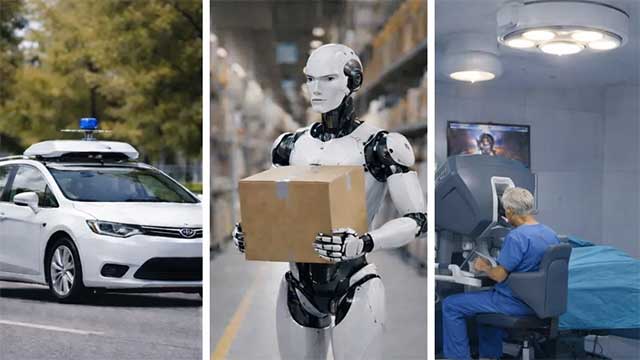
The term is increasingly used in robotics and autonomous-systems discussions, but it is not one universally standardized technical category. Its boundaries overlap with embodied AI, robot learning, autonomous vehicles, and intelligent control. The most useful definition is therefore functional: the system closes a loop from sensing to physical action.
How a Physical AI system works
Physical AI is not a single model. A working system normally combines several layers:
- Perception: cameras, microphones, force sensors, lidar, encoders, or other sensors collect information.
- State estimation: software determines where the machine and relevant objects are, often while accounting for noisy or incomplete data.
- Planning and decision-making: the system selects a goal, route, grasp, or control action.
- Control: commands are translated into timing, force, steering, or motor movement.
- Actuation and feedback: hardware acts, sensors measure the result, and the loop repeats.
Examples include industrial robot arms, mobile warehouse robots, drones, autonomous vehicles, agricultural machines, and assistive devices. Because errors can cause physical damage, these systems also need constraints, monitoring, emergency stops, and testing beyond what is required for a text-only application.
Physical AI compared with related terms
| Term | Main idea | Can it be part of Physical AI? |
|---|---|---|
| Physical AI | An AI-enabled system senses and acts in the physical world | It is the overall system or capability |
| World model | Represents an environment and predicts how it may change | Yes, as a planning or prediction component |
| Embodied AI | Studies intelligence in an agent with a body interacting with an environment | Often; the concepts substantially overlap |
| Physics-informed AI | Uses physical laws or constraints in modeling and learning | Yes, when its predictions inform real-world control |
| Digital twin | A digital representation of a specific physical asset or process, usually updated with operational data | Yes, for monitoring, simulation, testing, or optimization |
Physical AI and world models
A world model helps an agent represent its environment and predict possible outcomes. A robot may use one to estimate whether an object will fall after a push or whether a route will lead to a collision.
The distinction is scope. A world model performs representation or prediction; it does not by itself supply sensors, motors, safety logic, or an operating robot. A Physical AI system may use a world model, but it can also use simpler maps, rules, or learned policies without a separately labeled world model.
Physical AI and embodied AI
Embodied AI focuses on an intelligent agent whose body and interaction with the environment matter to perception, learning, or behavior. That makes it the closest term to Physical AI, and in many robotics projects both labels are reasonable.
The difference is emphasis rather than a hard boundary. “Embodied AI” is common in research questions about how an agent learns through interaction and how its body shapes that process. “Physical AI” is often used more broadly for deploying AI-driven perception, planning, and control in real machines. It is misleading to treat them as mutually exclusive categories.
Physical AI and physics-informed AI
Physics-informed AI uses known physical relationships to guide a model. A common example is a neural network trained not only on observations but also with constraints derived from differential equations, conservation laws, or boundary conditions.
Such a model might estimate fluid flow, structural stress, or battery temperature without controlling any machine. It becomes one component of a Physical AI application only when its output contributes to a real sensing-and-action loop—for example, when a controller adjusts cooling based on a physically constrained temperature estimate.
Physical AI and digital twins
A digital twin represents a particular real asset or process and stays connected to operational data. Engineers can use it to inspect current state, test scenarios, plan maintenance, or evaluate changes before applying them.
A digital twin is not necessarily passive: a broader system may use its output to recommend or trigger actions. The useful distinction is that “digital twin” describes the digital representation and its connection to the physical counterpart, while “Physical AI” describes AI-enabled perception, decision, and action. The same industrial system can contain both.
How the concepts work together
Consider an autonomous warehouse vehicle. Its digital twin can mirror the vehicle and facility for monitoring. A world model can predict how nearby people and carts may move. Physics-informed models can estimate traction or battery temperature. Embodied learning can improve navigation through interaction. The complete vehicle becomes Physical AI when these capabilities are connected to sensors, controls, and actuators that move safely through the warehouse.
What makes Physical AI difficult
- Incomplete perception: sensors have blind spots, noise, delay, and failure modes.
- Unpredictable environments: people, weather, wear, and unusual objects create cases that were absent from training.
- Real-time constraints: a correct decision delivered too late may still be unsafe.
- Simulation gaps: behavior that succeeds in a simulator may fail when friction, lighting, or hardware differs.
- Safety and accountability: physical actions require defined operating limits, validation, human oversight, and a safe fallback.
When reading product announcements, ask what the system senses, what physical action it can take, how it is controlled, where it has been tested, and what happens when confidence is low. Those questions are more informative than the label alone.
Related Articles
 30 Terms You Should Know When Using the Internet12 minutes read
 The 9 Biggest Mysteries of Modern Physics Make Scientists Headaches5 minutes read
 10 Most Confusing Terms in the Field of Information Technology5 minutes read
 Test Terminology: Test of Technology Terminology -- Part 126 minutes read
 Technology Terminology Test -- Part 15 minutes read
 4 Reasons Esim Is More Secure Than Physical SIM Card7 minutes read
Reader Comments 0
Sign in with email or Google to join the discussion.