Table of Contents
Composer 2.5 is Cursor's in-house model for its coding-agent loop. It is designed to inspect a repository, use search and editing tools, run commands, and continue working through multi-step software tasks. Cursor released Composer 2.5 in May 2026 as a successor to Composer 2, emphasizing better behavior on long-running work and more reliable instruction following.
Two similar names can cause confusion: Composer was also the name of Cursor's multi-file editing experience. In current Cursor documentation, that workflow is generally presented as Agent, while Composer 2.5 is a model that Agent can use.
What Composer does inside Cursor
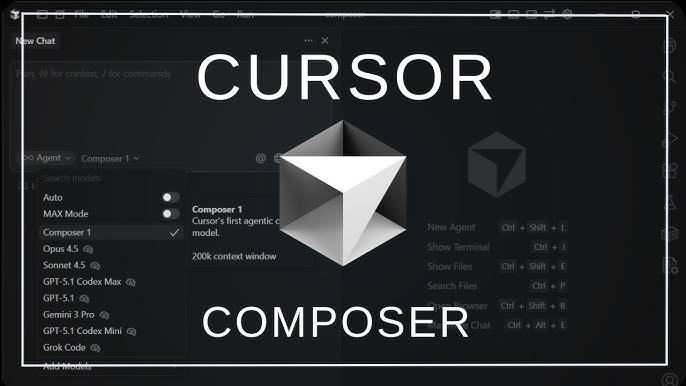
With an agent model selected, a developer can describe a bug, feature, refactor, or investigation in natural language. The agent can then:
- search and read relevant files;
- propose a plan or answer a question about the codebase;
- edit one or more files;
- run shell commands, builds, linters, and tests when permitted;
- inspect failures and revise its work;
- present the changes for review.
This is different from a chat response that merely prints a code snippet. The model operates through Cursor's agent harness, which supplies repository context and tools and records the resulting edits. The model does not bypass the need for source control, tests, permission boundaries, or human review.
Composer 2.5 versus Composer 2
Cursor says Composer 2.5 improves on Composer 2 in intelligence, collaboration behavior, sustained work, and compliance with complex instructions. The company provides both standard and faster service options, but model availability and token prices can change; check the current Composer 2.5 documentation before selecting it for a team or API workflow.
Cursor has published a detailed technical report for Composer 2. It has not disclosed every corresponding training detail for Composer 2.5, so claims from the Composer 2 report should not automatically be attributed to the newer model.
How Composer 2 was built
The base model was Kimi K2.5, not Qwen 2.5 Coder
The original article's “Qwen K2.5” description combines two unrelated model names. Cursor's Composer 2 technical report states that the company selected Kimi K2.5, a mixture-of-experts model, as the base for Composer 2 after comparing several candidates. The report does discuss experiments on a smaller Qwen model, but Qwen 2.5 Coder was not identified as Composer 2's base.
Starting from an open-weight base lets a company continue training and specialize model behavior for its own workload. Cursor describes two main stages for Composer 2:
- Continued pretraining: additional training on a code-heavy data mix, including a long-context extension and targeted supervised fine-tuning.
- Agentic reinforcement learning: training in software-development environments where the model can search, edit, run commands, and receive rewards tied to the resulting work.
Why reinforcement learning matters for a coding agent
Ordinary next-token training can teach a model common programming patterns. An agent must also decide which file to inspect, what command to run, how to react to an error, and when the task is complete. Cursor's training setup evaluates complete tool-using trajectories rather than isolated code completions.
The Composer 2 report says rewards consider correctness, succinctness, and conformance to software-engineering principles. It also describes asynchronous reinforcement learning, which separates experience generation from model updates so training infrastructure can operate at scale. That is more specific and supportable than guessing that Cursor uses a particular unpublished “process reward model” or other proprietary technique.
What the benchmarks do and do not show
Cursor reports Composer 2 results on its private CursorBench evaluation and on public tasks including SWE-bench Multilingual and Terminal-Bench. The report compares the model with general-purpose systems and argues that specialization improves its balance of accuracy and inference cost.
Those figures are useful evidence about Cursor's engineering work, but they require context:
- CursorBench is designed and run by Cursor and is not a fully independent evaluation.
- Agent scores depend on the prompt, tool harness, environment, time limit, and model settings—not only the underlying language model.
- Public benchmark tasks can differ from a team's frameworks, repository size, tests, and coding standards.
- Composer 2 benchmark numbers do not establish Composer 2.5's performance unless Cursor publishes the same evaluation and methodology for that version.
The most relevant test is therefore a controlled trial on representative issues from your own repository, with the same tools and review criteria applied to every candidate model.
Composer 2.5 versus Cursor Tab
| Capability | Cursor Tab | Composer 2.5 in Agent |
|---|---|---|
| Primary job | Predict edits and completions while you type | Work toward a described software task |
| Interaction | Inline suggestions accepted or rejected by the developer | Conversational task with tool calls and multiple steps |
| Scope | Usually the current editing context and predicted next change | Potentially many files, commands, tests, and iterations |
| Best use | Fast, small edits in an active coding flow | Bug fixes, features, refactors, investigations, and plans |
| Main review risk | An incorrect completion accepted too quickly | A plausible multi-file change with hidden regressions |
Cursor Tab uses Cursor's specialized completion technology, but it should not be assumed to run locally on the user's computer. Data handling depends on Cursor's product settings, privacy mode, account type, and current policies.
How to evaluate Composer on a real repository
- Choose three to five previously completed issues with known acceptance criteria and tests.
- Start from the same clean commit for each model.
- Give the issue description without revealing the final patch.
- Record whether the agent found the right files, asked necessary questions, and changed only what was needed.
- Run the full relevant test suite and review security, dependencies, migrations, logging, and error handling.
- Measure total review time and repair effort, not only generation speed or token cost.
Composer's main value is the combination of a software-specialized model and Cursor's agent environment. It can accelerate repository exploration and implementation, but benchmark claims and polished diffs are not substitutes for tests, code review, and accountability for the shipped result.
Related Articles
 Cursor Composer User Guide: What You Need to Know8 minutes read
 How to Install and Use PHP Composer on Debian 117 minutes read
 Cursors and Arrays in C ++: Cursor and Array in C ++1 minutes read
 Dropbox Notes - Group Collaboration Online Notes Service3 minutes read
 How to Enable and Use the GPT-5.5 Codex in Cursor (Detailed Instructions)7 minutes read
 Create Snow Effect When Moving Mouse on Windows3 minutes read
Reader Comments 0
Sign in with email or Google to join the discussion.