Table of Contents
ChatGPT is a product you use; GPT is a type and family of AI model. ChatGPT provides a conversational interface, account features, and tools for completing tasks. A GPT model is one of the underlying systems that can interpret input and generate output inside ChatGPT or another application.
The terms overlap because ChatGPT has used GPT-family models, but they are not interchangeable. A useful analogy is that a model is an engine, while ChatGPT is a complete vehicle built around an engine, controls, safety systems, and other components.
ChatGPT and GPT at a glance
| Term | What it means | How people use it |
|---|---|---|
| ChatGPT | A user-facing AI assistant and product | People interact through a chat interface and use available features and tools |
| GPT model | A trained model in OpenAI's GPT family | It can generate or process content in ChatGPT, through an API, or within other software |
| A custom GPT | A configured version of ChatGPT for a particular purpose | A builder combines instructions, knowledge, and selected capabilities for a repeatable use case |
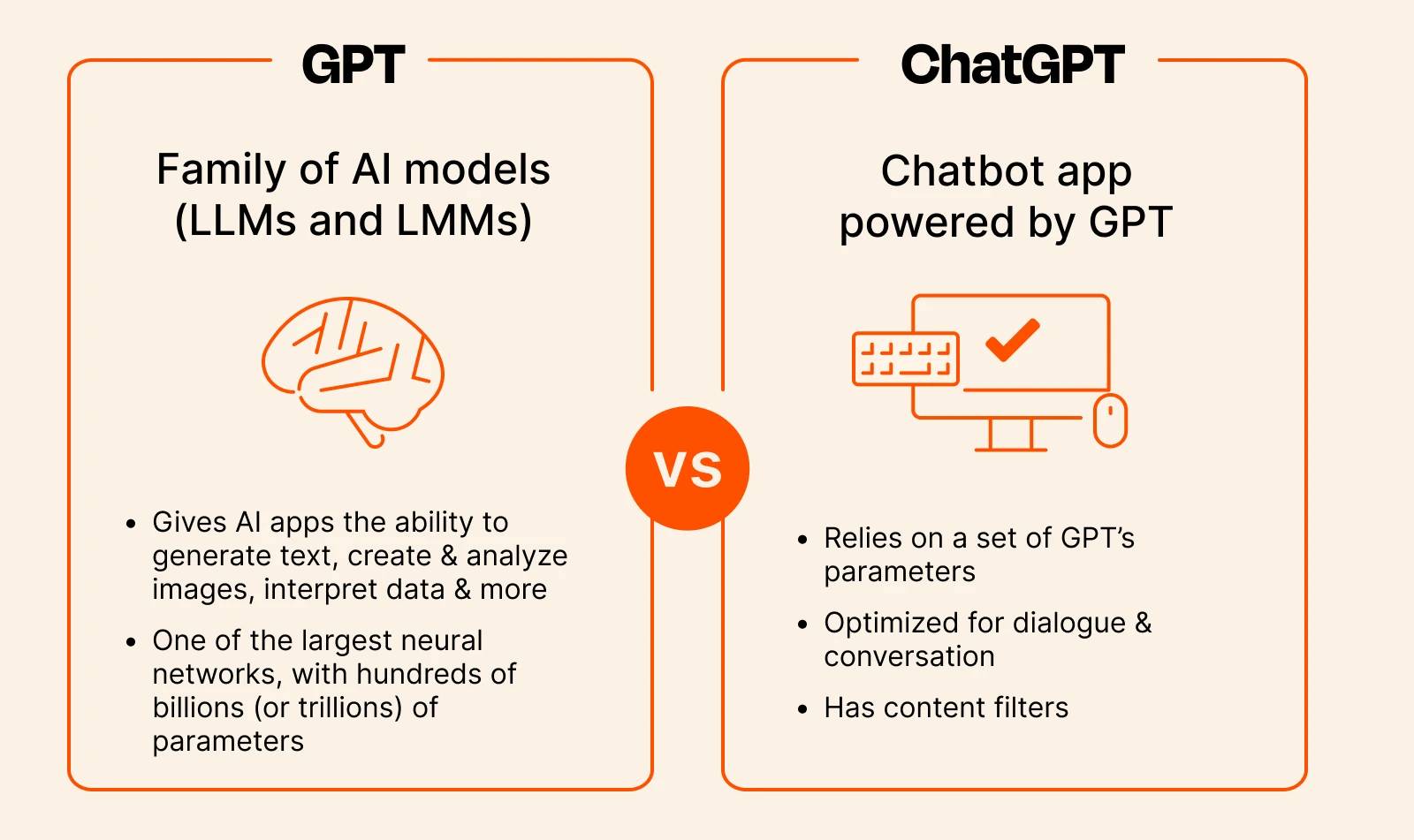
What is ChatGPT?
ChatGPT is an AI assistant delivered as a product. The exact features available can depend on the account, plan, workspace settings, device, and current rollout. In addition to generating a reply, the product may manage conversations and provide tools for tasks such as working with files, searching, analyzing data, or creating content.
This product layer matters. Two applications can use related models but offer very different experiences because they provide different instructions, tools, interfaces, permissions, memory, data handling, and safety controls.
What does GPT mean?
GPT stands for Generative Pre-trained Transformer:
- Generative: the model produces output rather than only assigning a label.
- Pre-trained: it learns broad patterns during training before it is adapted or instructed for particular tasks.
- Transformer: it uses a neural-network architecture designed to process relationships within sequences of data.
“GPT” can refer broadly to this model family or to a specific model in that family. Capabilities are model-specific, so it is unsafe to assume that every GPT accepts the same input types, has the same tools, or performs equally well. OpenAI's current API model catalog is the appropriate place to compare models supported by the platform.
Why the distinction matters
A ChatGPT subscription is not the same as API usage
ChatGPT and the OpenAI API are separate ways to use OpenAI systems. ChatGPT provides a ready-made application for people, while the API lets developers send requests from their own software. Access, billing, rate limits, and available features can differ, so having a ChatGPT plan should not be treated as an API entitlement.
If you are deciding whether to automate a process, this overview of AI automation in n8n shows the sort of workflow in which an API model may be one component rather than the whole application.
ChatGPT may combine a model with tools
A model generates or interprets content, but a product can add retrieval, file handling, external actions, conversation management, and other tools around it. Therefore, a result obtained in ChatGPT may not be reproducible by sending the same sentence to an API model without also reproducing the instructions, context, tool calls, and settings.
“Powered by GPT” does not mean “the same as ChatGPT”
Another service can use an OpenAI model while supplying its own interface, prompts, data sources, moderation, and business logic. Its output, privacy terms, and capabilities belong to that service's implementation. Check the provider's claims and policies instead of assuming that every GPT-powered tool behaves like ChatGPT.
A third meaning: custom GPTs inside ChatGPT
In ChatGPT, the plural GPTs can also refer to custom versions configured for a particular purpose. A custom GPT is not a newly trained foundation model. It is a tailored ChatGPT experience that may include instructions, uploaded knowledge, and selected capabilities or integrations. OpenAI's GPT Actions documentation describes how custom GPTs can connect to external services.
This creates three distinct statements:
- “I used ChatGPT” identifies the product.
- “The application uses a GPT model” describes part of its underlying AI system.
- “I built a custom GPT” means a tailored experience within ChatGPT, not a foundation model trained from scratch.
How ChatGPT and a GPT model fit together
- You enter a prompt or provide another supported input in ChatGPT.
- The product assembles relevant conversation context and instructions.
- Depending on the feature and configuration, it may use tools or retrieve additional information.
- An underlying model processes the available context and generates output.
- ChatGPT presents the result through its interface and may retain product-level conversation state according to the applicable settings.
The simplified “product versus engine” analogy is useful, but it has limits: ChatGPT is not necessarily tied to one permanent model, and some features involve more than a language model alone.
Which term should you use?
- Say ChatGPT when you mean the assistant, website, desktop or mobile experience, or product features.
- Say GPT model when discussing an underlying model, model selection, API behavior, or technical capability.
- Use the exact model name when reproducibility, cost, latency, or compatibility matters.
- Say custom GPT when referring to a configured assistant created within ChatGPT.
- Say OpenAI API, rather than “ChatGPT API,” when referring broadly to the developer platform unless a specific document or endpoint uses a more precise name.
What this changes for everyday users and developers
Everyday ChatGPT users usually do not need to manage an API or choose an implementation architecture. They should focus on the product features available to their account and write clear requests. This guide to structuring a prompt can help organize instructions and source material.
Developers need to be more exact. They must choose an available model, protect credentials, supply instructions and context, implement tools, test variable outputs, monitor costs, and evaluate whether results meet the application's requirements. When comparing the wider market, distinguish foundation models from the applications built around generative AI.
In short, ChatGPT is one complete way to interact with AI, while GPT names a model family that can be used in many contexts. Keeping the product, model, and custom-GPT meanings separate makes comparisons and technical decisions much clearer.
Related Articles
 The Difference Between Claude and ChatGPT13 minutes read
 9 Key Differences Between ChatGPT and Bing's AI Chatbot: Top Picks and Buying8 minutes read
 Useful ChatGPT Prompt Templates for Professionals7 minutes read
 The Difference Between Gemini and ChatGPT13 minutes read
 3 Reasons to Give Up ChatGPT to Switch to Claude: What You Need to Know6 minutes read
 Learn About ChatGPT-4o: Features, Benefits and How to Use It: Complete Guide7 minutes read
Reader Comments 0
Sign in with email or Google to join the discussion.