Table of Contents
This updated guide explains how to Find Out Who Registered a Domain through clear steps, practical examples, and important checks that help prevent common errors.
Method 1 of 3:
Using Whois. Com
-
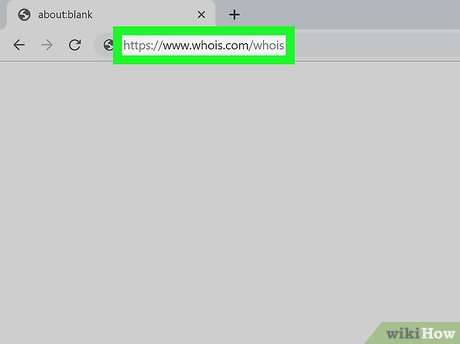 Go to https://www. whois. com/whois in a web browser. Whois. com is a free website that can find the registered owner for most domain names.
- There are other tools you can use to look up domain names, but many do not support newer top-level domains like . io or . blog.
- If a domain's owner signed up for private domain registration, their name and contact info cannot be found with this method.
-
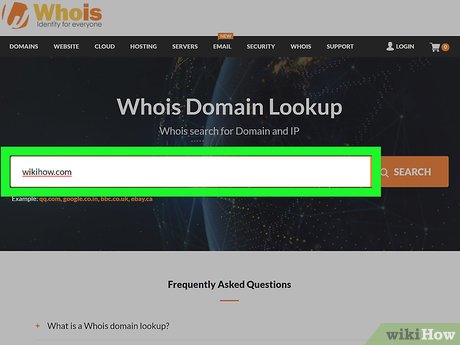 Enter the domain name into the field. For example, wikihow. com, harvard. edu, or wordpress. org.
 -
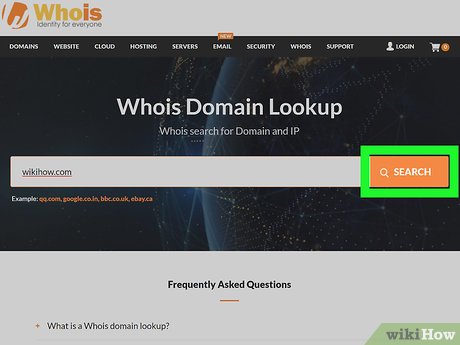 Click Search. It's the button to the right of the text field. The domain's registered owner will appear under the "Registrant Contact" header near the middle of the page.
- If the domain is registered privately, you'll see something like "Private" or the contact info of the company through which the domain is registered.
Method 2 of 3:
Finding the Owner of an IP Address
-
 Go to https://network-tools. com/nslookup in a web browser. If the domain's owner is not public but the domain is linked to a website (or any IP address), you can look up who owns the IP address. There's a slight chance the domain registrant also owns that IP address, although it usually belongs to the company who hosts their website.
 -
 Type the domain name into the "Host" field.
 -
 Select A – Address from the "Query Type" drop-down menu. This option will display IP addresses associated with this domain.
 -
 Click Go. A list of IP addresses in the domain's record will appear.
 -
 Copy the IP address after "A" in the search results. Highlight the full IP address, long-tap (or right-click) the highlighted area, and then select Copy.
 -
 Go to https://search. arin. net. ARIN is the service through which all IP addresses on the internet are registered.
 -
 Paste the IP address and click Search. You can paste by long-tapping (or right-clicking) the typing field and selecting Paste.
 -
 Scroll down to the "Source Registry" section to find the owner. You may find several contacts for a single IP address. Though it's not guaranteed the IP address owner also owns the domain name, this might be helpful information for your research.
Method 3 of 3:
Using Publicly Available Information
-
 Search Google for " domain name " contact. If the domain ever had a public registration record, someone may have archived that information publicly.
 -
 Check the website's About or Contact page. If the domain has a website that contains one of these links, you may find the name and/or contact information for the site's owner.
- The person who runs the website may not be the person who owns the domain. The only way to find out for sure would be to contact the site's owner and ask.
- If you can't find links to these pages, try adding sitemap. xml to the end of the domain name (e. g., wikihow. com/sitemap. xml ) in the address bar and pressing ↵ Enter or ⏎ Return. Look through the URLs on that page for an "About" page, or something similar that might contain personal or contact info.
-
 Find social media accounts using the same name. For example, if you're searching for the owner of wikiHow. com, you could figure out who is using the name wikiHow as their username on various social media networks. There's a chance that the user is the person who registered the domain name.
- Most social media networks will require that you create an account before searching their user database.
-
 Use the Whois History tool. If the domain's owner used to have a public registration record, you may be able to find them using a tool called Whois History.[1]XResearch source This tool provides all of the registration records ever created for the domain.
- This service requires a paid subscription.
- Even if you are able to find a somewhat-recent registration record with this method, it doesn't guarantee that the domain is still owned by the same person.
FAQ
What is the easiest way to Find Out Who Registered a Domain?
Start with the requirements in this guide, then follow each step in order. Check the result after every major change so problems are easier to identify.
Can beginners follow these instructions?
Yes. The process is organized into practical steps, and you can repeat any step before moving forward.
What should I check if the method does not work?
Confirm your software or device version, permissions, settings, file format, and internet connection when the task depends on online services.
Related Articles
 What Is Domain Io: Learn About .Io Domain Names4 minutes read
 How to Check. Vn Domain Name on VNNIC5 minutes read
 Turn on // Off Concurrent Connections to Both Non-domain Network5 minutes read
 Anyone Can Now Register A.app Domain with HTTPS Integration4 minutes read
 How to Choose a Domain Name: How to Choose the Best Domain Name?8 minutes read
 What Is Domain Hijacking? How Dangerous Is It?4 minutes read
Reader Comments 0
Sign in with email or Google to join the discussion.