Table of Contents
This guide provides a clear overview of a pair of galaxies with unique question mark shapes discovered, including how it works, key details, and practical considerations that can help you use the information effectively.
Overview
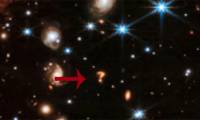
Another fascinating new image sent back from the world's most expensive space telescope, the James Webb Space Telescope, shows a galaxy shaped like a question mark. The reason for its unusual shape reveals an essential truth about how the $10 billion telescope system looks at some of the most distant galaxies ever observed.
This question mark-shaped galaxy is actually part of an image of the galaxy cluster MACS-J0417.5-1154, which is so massive that it warps spacetime. Massive objects—in this case, clusters of multiple galaxies—exert such a strong gravitational pull that they warp space, causing light passing through them to stretch. It's like using a magnifying glass. In some cases, this effect, called gravitational lensing, can even cause the same galaxy to appear multiple times in various locations in a single image.
The specific case that led to this unique image is the result of Earth, the galaxy cluster, and the target galaxy all aligning, in a phenomenon known as hyperbolic gravitational lensing. There is actually a pair of galaxies here, but the lensing makes it appear five times, creating the question mark shape.

"We currently know of only three or four cases of similar gravitational lensing configurations in the observable universe. That fact makes this discovery exciting because it demonstrates the power of Webb and suggests that we will probably find many more such configurations now," astronomer Guillaume Desprez of Saint Mary's University in Halifax, Nova Scotia, said in a statement.
The image was taken with Webb's NIRCam instrument, but the researchers also used the space telescope's NIRISS system to determine where stars are forming, even in a galaxy billions of light years away. Star formation rates can increase when two galaxies are in the process of merging or colliding.
'Knowing when, where, and how stars form in galaxies is crucial to understanding how galaxies have evolved over the history of the universe,' said astronomer Vicente Estrada-Carpenter of Saint Mary's University. 'Both question mark galaxies show active star formation in some compact regions, possibly the result of gas from the colliding galaxies. However, neither of their shapes has been disrupted too much, so we may be seeing the beginnings of interactions between them.'
Aside from their strange shapes, the galaxies seen here are useful simulations of what our galaxy might have looked like when it was "young."
FAQ
What is james webb?
It is the main topic covered in this guide, including the relevant tools, settings, features, or steps connected with a Pair of Galaxies with Unique Question Mark Shapes Discovered.
Why is james webb useful?
It can make a Pair of Galaxies with Unique Question Mark Shapes Discovered easier to understand, compare, configure, or troubleshoot by organizing the most important information in one place.
What should I check before using this guide?
Confirm that the instructions match your device, software version, region, and intended use, then back up important data before making major changes.
Related Articles
 Detecting a Mysterious Question Mark in the Universe3 minutes read
 How to Fix a Blinking Question Mark on a Mac on Startup6 minutes read
 Did You Answer the Question: How Many Stars in the Sky3 minutes read
 Shapes Powerpoint: How to Include Shapes in Powerpoint3 minutes read
 How to Fix MacBook With Question Mark Folder Error13 minutes read
 The Number of Galaxies in the Universe Is 10 Times More Than What4 minutes read
Reader Comments 0
Sign in with email or Google to join the discussion.