Table of Contents
The right AI writing tool depends on the job. ChatGPT is the most flexible general assistant in this group; NightOwl and Frase focus on search-led content; Copy.ai is oriented toward go-to-market workflows; and Jasper emphasizes marketing operations and brand governance. None removes the need for source verification, subject expertise, and a human editor.
Quick comparison
| Tool | Best fit | Main advantage | Main limitation |
|---|---|---|---|
| NightOwl | SEO teams already using Nightwatch data | Keyword, ranking, competitor, and content research in one SEO environment | Less suitable if you only need a general writing workspace |
| ChatGPT | Writers who need flexible research, drafting, analysis, and revision | Works with prompts, files, projects, and web sources across many content types | Does not replace a dedicated SEO data platform or editorial fact-check |
| Copy.ai | Go-to-market teams automating repeatable content and sales workflows | Brand voices, shared data, and multi-step workflows | Can be more platform than a solo writer needs |
| Frase | SEO and content teams building briefs and search-led articles | Research, brief, draft, optimization, and AI-visibility workflow | Optimization guidance is not a guarantee of rankings or citations |
| Jasper | Marketing organizations managing multiple brands, markets, or campaigns | Brand knowledge, governance, and coordinated marketing outputs | Value depends on having clear brand inputs and a team workflow |
Pricing, limits, integrations, and included models change frequently. Before paying, verify the current plan against your required seats, output volume, data controls, and CMS or marketing integrations.
1. NightOwl: SEO research tied to content work

NightOwl is Nightwatch's AI SEO agent. Its value is not merely generating paragraphs: Nightwatch says the agent can work with keyword research, clustering, content gaps, competitors, rankings, and content briefs. That makes it a logical fit when a team wants recommendations grounded in its search data rather than a standalone chatbot's interpretation of a keyword.
Best for: SEO specialists, agencies, and multi-site teams already measuring rankings and content gaps in Nightwatch.
Use it for: topic discovery, keyword grouping, competitor review, brief creation, identifying pages to refresh, and drafting from an approved brief.
Check before buying: confirm which search markets, projects, data sources, and Nightwatch features are included in the intended plan. Live search data can support a decision, but it does not prove that a suggested topic will rank.
2. ChatGPT: the most flexible writing workspace
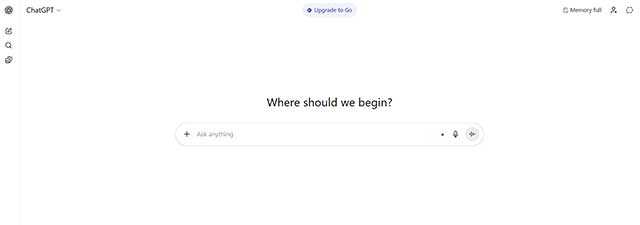
ChatGPT works well for brainstorming, outlining, transforming source material, interviewing a draft, comparing documents, and revising selected passages. Projects can keep chats, uploaded files, and instructions together, while web search can return links for timely research. Available models, usage limits, and collaboration controls depend on the plan.
Best for: writers and editors who move among articles, reports, scripts, research, data, and document analysis.
Use it for: turning a source pack into an outline, finding gaps in a draft, generating alternatives, checking consistency against a style guide, creating interview questions, and producing channel adaptations after the main article is approved.
Limit: ChatGPT can produce incorrect claims or cite a page that does not support the sentence. Open every important source, verify the date and scope, and preserve the distinction between sourced facts and editorial inference. OpenAI's Projects documentation explains how files and instructions can be shared as working context.
3. Copy.ai: repeatable go-to-market workflows
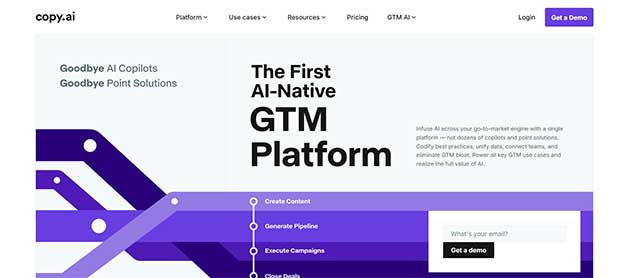
Copy.ai now centers its product on go-to-market workflows. Its Brand Voice feature can analyze approved examples or use manually defined rules, while Workflows can standardize multi-step tasks across marketing and sales content.
Best for: teams producing recurring campaign assets, sales enablement, product messaging, email sequences, social variations, and other structured GTM work.
Use it for: applying an approved voice to several channels, generating drafts from a shared information base, and automating predictable transformations such as turning a product brief into a campaign asset set.
Limit: automation scales mistakes as easily as good process. Lock down approved inputs, specify which claims may be used, route uncertain output to review, and test how the workflow behaves when a required field is missing.
4. Frase: SEO briefs, drafting, and content optimization
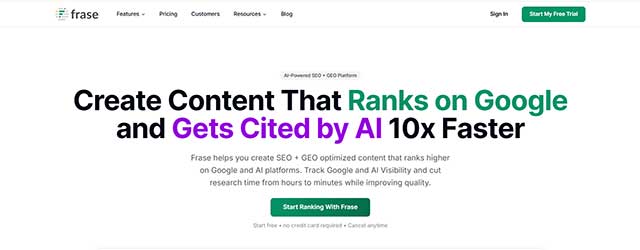
Frase is built for search-led content teams. Its current product combines research, briefs, drafting, on-page optimization, publishing connections, and monitoring for traditional search and AI-answer visibility. It is more structured than a blank chat box when the goal is to create or refresh a page around a defined search intent.
Best for: content strategists, SEO writers, freelancers, and agencies that repeatedly build briefs from competing pages and search questions.
Use it for: SERP research, content briefs, outline review, topic coverage checks, draft optimization, and refresh recommendations.
Limit: a content score is a diagnostic, not an editorial target to maximize at any cost. Adding every suggested term can create repetitive writing and blur the page's purpose. Retain only topics that help the reader complete the task.
5. Jasper: brand control for marketing teams
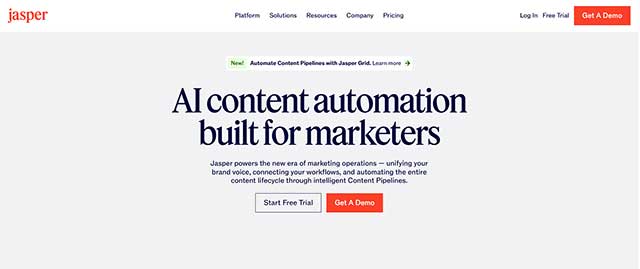
Jasper is designed for marketing organizations that need consistent messaging across teams, regions, audiences, and channels. Jasper's brand system can store voice, style guidance, audience information, and product knowledge, then apply that context across marketing agents and campaign workflows.
Best for: larger marketing teams, agencies, franchises, and organizations managing several brands or approval layers.
Use it for: campaign briefs, product marketing, brand-compliant first drafts, localization support, repurposing, and controlled content pipelines.
Limit: brand consistency starts with accurate source material. A vague style guide, stale product facts, or contradictory examples will produce inconsistent output. Assign owners to update brand knowledge and review sensitive claims.
How to choose without relying on a “best tools” list
- Name the bottleneck. Decide whether the real problem is research, blank-page drafting, SEO briefing, brand consistency, localization, review, or distribution.
- Test the same work sample. Give each shortlisted tool the same brief, approved sources, style rules, and output requirements.
- Measure editing effort. Track factual corrections, unsupported claims, tone fixes, structural rewrites, and minutes to approval—not just generation speed.
- Inspect data controls. Check retention, model-training settings, workspace permissions, auditability, deletion, and rules for confidential client material.
- Review the full cost. Include seats, usage caps, SEO data, integrations, onboarding, and the editor time needed to make output publishable.
- Run a trial workflow. Evaluate at least one article, one refresh, and one short-form adaptation before committing a team.
For alternatives outside these five, compare TipsMake's broader list of AI content writing tools. Teams doing source-heavy work should also review AI tools for in-depth research, while channel teams can compare AI social media management tools.
A safe AI-assisted content workflow
- Create an editorial brief with audience, intent, scope, exclusions, and success criteria.
- Collect primary sources, product documentation, interviews, and approved internal material.
- Use AI to identify gaps and propose an outline; the editor approves the structure.
- Draft from the verified source pack. Mark unsupported claims instead of filling gaps with guesses.
- Fact-check names, dates, figures, quotations, links, technical steps, and legal or medical statements.
- Edit for usefulness, original insight, examples, transitions, and brand voice.
- Check originality and attribution, then complete SEO, accessibility, and HTML review.
- Require human approval before publishing or sending to customers.
AI is most valuable when it removes mechanical work while leaving editorial judgment visible. If a tool makes a team publish more pages but increases factual risk, duplication, or review time, it has not improved the content operation.
Related Articles
 Best AI Writing Tools in 2026: 10 Options Compared12 minutes read
 7 Top AI Writing Tools Today: Recommended Choices10 minutes read
 How to Use AI Writing Tools on TeraBox3 minutes read
 Top AI Tools to Support Essay Writing and Scientific Research9 minutes read
 The Secret to Becoming an Expert in Web Content Writing14 minutes read
 6 Steps to Write Good Content in SEO18 minutes read
Reader Comments 0
Sign in with email or Google to join the discussion.