Table of Contents
Quick Overview
Monster : Compare useful Monster options and learn how to evaluate them.
According to Sci-News, a "monster" radio beam coming from a quasar that is also a monster in the early universe has just been recorded simultaneously by many international observatories including the Low Frequency Array (LOFAR), the Gemini North telescope and the Hobby Eberly telescope.
Measuring 215,000 light years long, it is the most terrifying radio beam from the early universe ever to reach the "eyes" of Earth's observatories.
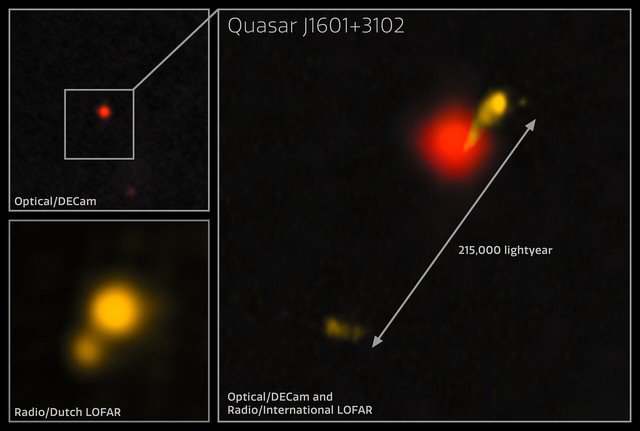
The images that LOFAR recorded of the terrible radio beam and the quasar that emitted it, are both "monsters" in the universe - Photo: LOFAR NOIRLab
According to Dr. Anniek Gloudemans from the NOIRLab of the US National Science Foundation (NSF), the monster cosmic rays were discovered while they were using astronomical observation facilities to search for quasars emitting powerful jets in the early universe.
This is to help understand when these radio rays first appeared and how they influenced the formation and early evolution of galaxies.
These jets also reflect properties of the quasar, such as its mass and rate of material consumption, which are essential to understanding its formation history.
Quasars are black holes that have "disguised" themselves as stars, due to their massive consumption of matter. They are often the nuclei of galaxies.
The record-breaking radio burst was found when they pointed it at J1601+3102, a quasar located in a region of space-time when the universe was just 1.2 billion years old.
That's more than 12.6 billion years ago, because our universe is now more than 13.8 billion years old.
Light takes time to reach Earth. So using telescopes to observe objects billions of light years away is capturing images of those objects in the past, when they were still pristine and had not yet been pushed too far away by the expansion of the universe.
While the quasars we've observed recently can be billions of times more massive than the Sun, this ancient quasar is quite small, weighing in at just 450 million times the mass of the Sun.
The radio jets emitted from the two sides of this quasar are asymmetric in both brightness and length, suggesting that they may be influenced by the harsh and significantly different environments on either side of the black hole's plane.
The paper, published in the scientific journal Astrophysical Journal Letters, concludes that in the early universe, giant radio jets could have been produced without the need for very large black holes.
This evidence adds to a growing body of evidence suggesting that the early universe was wilder than we imagined, with powerful processes and "monster" objects behaving in ways that may no longer exist today.
FAQ About Monster
How do you choose the best Monster?
According to Sci-News, a "monster" radio beam coming from a quasar that is also a monster in the early universe has just been recorded simultaneously by many international observatories including the Low Frequency Array (LOFAR), the Gemini North telescope and the Hobby Eberly telescope
Which features matter most when comparing Monster?
Understanding Monster helps you evaluate its benefits, limitations, and potential risks before making a decision.
Are free Monster options reliable?
Use the steps and recommendations in this guide, confirm important settings, and review the results before making further changes.
Related Articles
 minutes read
 22 Unexplained Radio Signals Caught from 'Stellar Graveyard'4 minutes read
 What Is UV Rays? Which UV Level Is Safe for Humans3 minutes read
 Inkathazo: Monster Structure Discovered That Could Contain 30 Milky4 minutes read
 4 Best Radio Apps for Iphone6 minutes read
 Object from Unknown Location Continuously Emitting Radio Waves5 minutes read
Reader Comments 0
Sign in with email or Google to join the discussion.