Table of Contents
Miniaturizing a wearable is not simply a matter of shrinking every component. A device worn on the wrist, finger, ear, clothing, or skin must combine power, sensing, processing, wireless communication, durability, and comfort in a tightly constrained enclosure.
Improving one dimension often harms another. A larger battery extends runtime but adds weight. A smaller enclosure traps heat. A sensor pressed closer to the skin may collect a stronger signal but become uncomfortable. Successful products come from system-level tradeoffs across hardware, materials, software, manufacturing, and human factors.
Battery size and workload pull in opposite directions
Wearables are expected to remain light while supporting bright displays, continuous or periodic sensors, wireless synchronization, notifications, and sometimes satellite positioning. Each feature has a different power pattern: a radio may create brief peaks, a sensor may run at intervals, and background processing may continue for long periods.
Battery capacity generally falls as the available cell volume shrinks, but the engineering problem is not only capacity. Cell shape, discharge behavior, charging rate, protection circuitry, temperature, swelling allowance, and mechanical stress all affect the usable design.
Power optimization therefore occurs across the complete system:
- Duty-cycle sensors instead of operating them continuously when the use case allows.
- Perform simple filtering on lower-power hardware before waking the main processor.
- Batch radio transmissions and choose an appropriate wireless protocol.
- Reduce unnecessary display brightness, refresh, animation, and background work.
- Move carefully selected computation to a paired phone or remote service only when privacy, latency, and connectivity requirements permit.
- Measure real workloads rather than relying only on standby specifications.
Heat has little room to escape
A desktop can use large heat sinks, fans, and generous airflow. A wearable is usually sealed against moisture and dust, has little surface area, and may sit directly against skin. There may be no space or power for active cooling.
Designers manage heat primarily by preventing concentrated power use, spreading heat through suitable structures, and controlling workloads before the surface becomes uncomfortable or components leave their rated operating range. Charging, radio transmission, display use, and heavy computation can overlap, so testing must include realistic worst-case combinations.
Thermal limits affect user comfort, battery aging, measurement accuracy, adhesive life, enclosure materials, and processor performance. Software may need to reduce sampling, radio activity, charging, or compute speed when internal or skin-contact temperatures approach a limit.
Circuit density creates electrical challenges
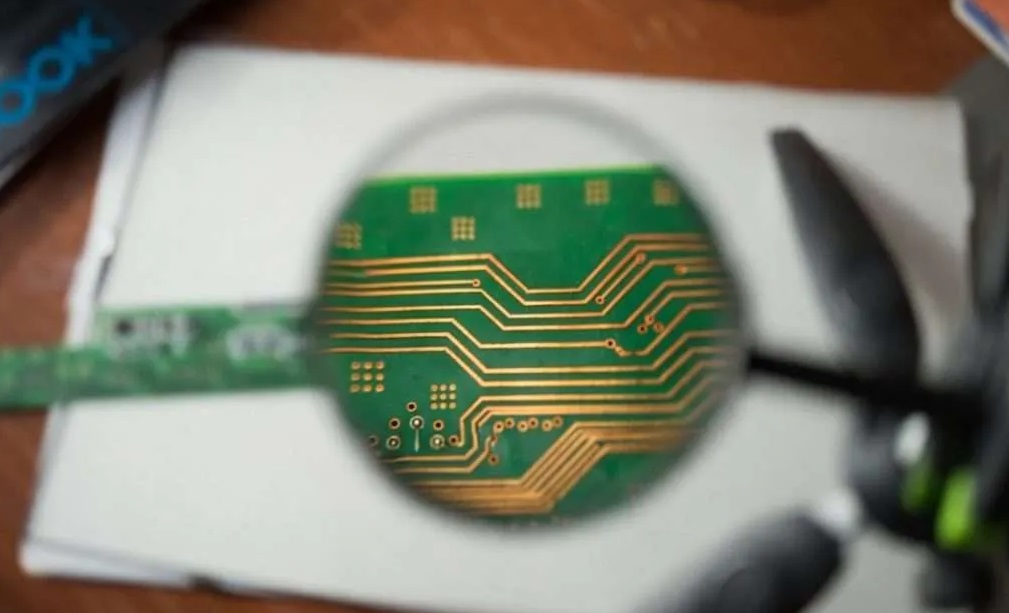
High-density interconnect (HDI) circuit boards, flexible circuits, stacked packages, and compact connectors help place more functions in less volume. As traces, vias, antennas, power paths, and sensors move closer together, signal integrity and electromagnetic compatibility become harder to maintain.
Digital switching noise can interfere with sensitive analog measurements. Radios can affect sensor circuits. A ground or power layout that works in a larger prototype may behave differently after the board is folded, stacked, or placed beside a battery and metal enclosure.
Mitigation can include layer planning, controlled-impedance routing, shielding, filtering, separation of noisy and sensitive circuits, and repeated testing in the final mechanical assembly.
Materials matter at small dimensions
Thinner conductors and dielectrics reduce board thickness, but they must remain consistent enough to manufacture reliable fine features. Copper roughness, thickness variation, adhesion, and material properties can affect loss, etching, bending, and long-term performance.
This is why the selected PCB copper foil material can influence a compact board's electrical and manufacturing behavior. It is one part of a larger stack that includes the laminate, surface finish, adhesives, solder, flex materials, shielding, and enclosure.
A laboratory design is not ready until it can be produced repeatedly. Tighter geometry can reduce manufacturing yield and make inspection, repair, and supplier variation more important.
Antennas do not shrink freely
A wearable may need Bluetooth, Wi-Fi, cellular, near-field communication, or positioning. Antenna performance depends on frequency, geometry, ground plane, nearby components, the enclosure, and the human body.
Metal, battery placement, water in tissue, and changing wrist or ear positions can detune or block a compact antenna. Increasing transmit power to compensate uses more energy and can create more heat. Antenna placement must be developed with the final industrial design rather than added after the electronics are complete.
Sensor accuracy depends on mechanical design
Optical, electrical, motion, temperature, and acoustic sensors need a stable relationship with the body or environment. Miniaturization can reduce optical path length, electrode area, acoustic volume, or the mechanical isolation needed for a clean signal.
Fit and motion are often as important as the sensor itself. A device that is loose, rotates, admits stray light, or creates pressure points may produce inconsistent measurements or be removed by the user. Algorithms can filter some noise, but they cannot reconstruct information the hardware never captured.
Durability and serviceability still need space
Wearables encounter sweat, rain, cosmetics, cleaning products, impact, vibration, repeated flexing, and temperature changes. Seals, adhesives, protective coatings, strain relief, and mechanical supports consume volume that a concept model may overlook.
A very thin product can be harder to open, repair, or recycle. A sealed battery may simplify water resistance but shorten practical service life when the cell degrades. Design decisions should consider repair, replacement, and end-of-life as well as first-day dimensions.
Comfort sets a lower limit
The smallest possible device is not always the most wearable. Weight distribution, edge shape, skin contact, pressure, heat, clasp design, cable routing, and accessibility affect whether a person will use it for the required period.
A sensor may need firm contact, but too much pressure can irritate skin or alter the measurement. A tiny display may reduce device size while making controls unreadable. A compact button or gesture can exclude users with limited dexterity.
Human testing should include different body sizes, skin characteristics, movement, climates, clothing, dominant hands, and use durations appropriate to the product. Comfort feedback must reach electrical and mechanical teams early enough to change the architecture.
A system-level miniaturization checklist
- Define which functions must run locally and their real duty cycles.
- Create a complete volume and mass budget, including seals, connectors, tolerances, and assembly space.
- Build a power budget from measured workloads and battery aging assumptions.
- Model and test thermal behavior during charging and peak operation.
- Validate sensor and antenna performance on the body and in the final enclosure.
- Run electromagnetic, environmental, drop, flex, sweat, and lifecycle tests appropriate to the use.
- Review manufacturing yield and supplier variation at the target geometry.
- Include comfort, accessibility, repair, and end-of-life requirements.
Wearable miniaturization advances when several constraints improve together. Better materials help, but so do lower-power electronics, more efficient software, careful radio design, realistic thermal control, manufacturable packaging, and a form that people can wear comfortably.
Related Articles
 Mysterious Cosmic Signals of Aliens Challenge the Scientific World4 minutes read
 Have You Tried Audition Dancing with Facedance Challenge?7 minutes read
 What Is JJJ? What Is JJJ Challenge: Clear Explanation5 minutes read
 10 Best Tech Programs for High School Students10 minutes read
 WinRAR Remains One of the Biggest Security Risks on Windows7 minutes read
 Google Denies That Challenging Momo Can Cause Children to Commit Suicide on YouTube4 minutes read
Reader Comments 0
Sign in with email or Google to join the discussion.