Table of Contents
By elucidating the molecular-level interactions that give spider silk its extraordinary properties, researchers have revealed principles that could inspire advanced materials in the future, and shed light on biological processes that go far beyond… a spider web.
Scientists have identified tiny chemical forces that allow spider silk to achieve a rare balance: extreme strength yet remarkable flexibility . Understanding how this material 'links' itself together at the molecular scale could pave the way for designing biomimetic fibers that mimic nature, and applications in aerospace components, protective clothing, and biomedicine. More significantly, similar self-organizing mechanisms could also provide clues about neurological diseases such as Alzheimer's.
The research, published in the Proceedings of the National Academy of Sciences (PNAS) , is the result of a collaboration between King's College London and San Diego State University (SDSU).
Instead of viewing spider silk as a 'mystery material' to be replicated exactly, the research team focused on discovering the fundamental 'rules' that nature uses – principles that can be applied to create a generation of more efficient and sustainable materials in the future.
The molecular design of spider silk is revealed.
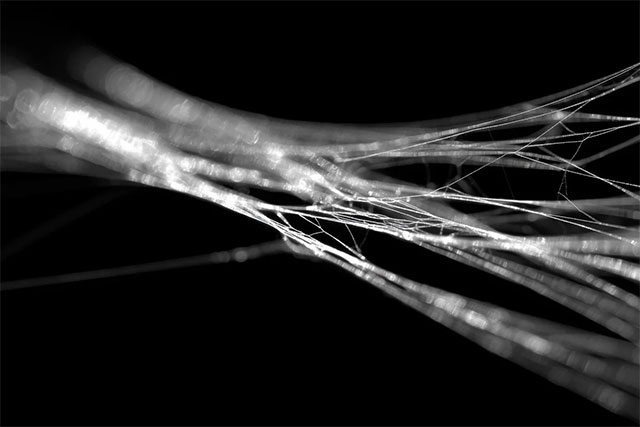
Spider silk is made up of proteins – long chains formed from amino acids. Research shows that within these proteins, some amino acids interact with each other like molecular 'stickers' . These repeating but reversible bonds help the proteins clump together, arrange themselves in an orderly manner, and ultimately 'lock' into a structure that is both strong enough to withstand significant tensile force and retains its flexibility.
Professor Chris Lorenz, a computational materials science expert at King's College London and the leader of the UK research group, said:
The potential applications are incredibly broad – from ultralight protective clothing, aircraft components, biodegradable biomedical implants, to soft robots, all can benefit from fibers designed based on these natural principles.
Spider dragline silk stands out in the world of natural materials because it is stronger than steel by weight and tougher than Kevlar – the material used to make bulletproof vests. Spiders use this silk to spin webs and support their own bodies, and for decades, scientists have been trying to replicate these extraordinary properties.
This type of silk is produced inside the spider's silk glands, where the protein exists as a thick liquid called 'silk dope' . When the spider spins its silk, this liquid transforms into solid fibers.
Scientists have long known that proteins first clump together into liquid-like droplets before transforming into fibers, but the precise molecular sequence connecting this phase transition to the final structure of silk has remained a mystery – until now.
Key amino acids determine the formation of silk.
The interdisciplinary research team, comprising chemists, biologists, and engineers, utilized advanced tools such as molecular dynamics simulations , the AlphaFold3 structural model , and nuclear magnetic resonance (NMR) spectroscopy . The results showed that the two amino acids arginine and tyrosine interact to trigger the initial aggregation of the protein.
Importantly, these interactions persist throughout the fiber formation process , contributing to the complex nanostructure – a key factor in the superior mechanical performance of spider silk.
"This is an atomic-level explanation for how disordered proteins can self-assemble into highly ordered and superior-performing structures," Lorenz added.
Professor Gregory Holland, a physical and analytical chemistry expert at SDSU who led the research team in the US, said one of the most surprising things was the level of chemical sophistication of the process.
What surprised us was that spider silk – often considered a simple and beautiful natural fiber – actually relies on an incredibly sophisticated molecular 'trick'. The types of interactions we discovered are also found in neurotransmitter receptors and hormone signaling mechanisms.
Therefore, this finding could have implications for human health. The way silk proteins undergo phase separation and form β-sheet-rich structures reflects mechanisms we observe in neurodegenerative diseases such as Alzheimer's. Spider silk research provides us with a 'clean,' optimally evolved system to understand how phase separation and β-sheet formation are controlled.
Related Articles
 Super Silk Spider Spider 1 Time to 25m Long as the Bridge Across2 minutes read
 The Only Big Silk in the World Woven from the Natural Silk4 minutes read
 Seven New Species of Spiders Were Discovered, Named After Harry4 minutes read
 Japanese Scientists Successfully Developed Soft Gel Like Jelly, 5 Times Stronger Than Steel3 minutes read
 If You Suffer from the World's Most Poisonous Spider, How Will Your Body Be Destroyed?3 minutes read
 Cold with the World's Largest Large Spider, Can 'Re-eat' the Mouse in the Blink of an Eye5 minutes read
Reader Comments 0
Sign in with email or Google to join the discussion.