Table of Contents
Gemma 4 is Google DeepMind's family of open-weight generative AI models for text, image, audio, video-frame, coding, and reasoning workloads. The lineup spans small edge-oriented models, a unified 12B model, a mixture-of-experts model, and a larger dense model. Google publishes both pretrained and instruction-tuned variants under the Apache 2.0 license.
Gemma is intended for developers building or researching AI systems. Running the weights yourself gives more control over deployment and customization, but the application owner remains responsible for infrastructure, safety controls, evaluation, and compliance.
Gemma 4 model lineup
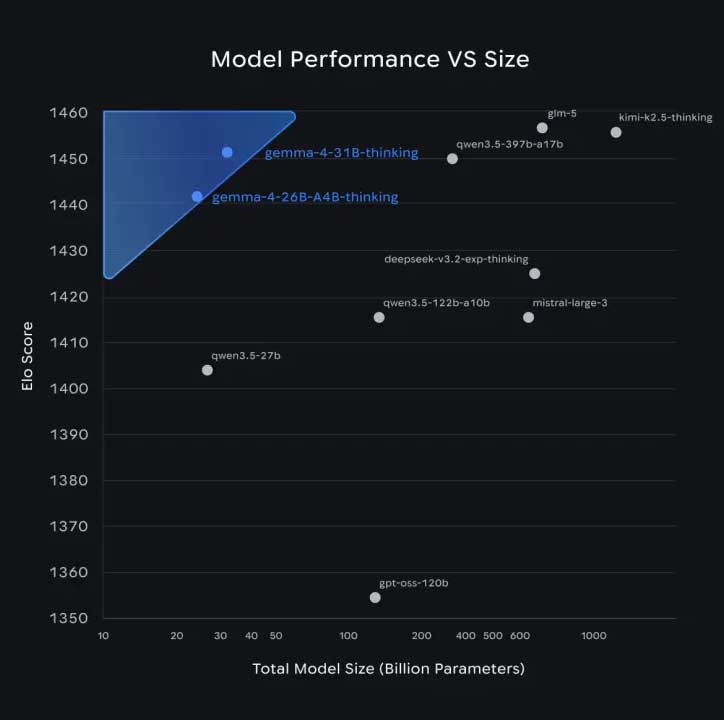
Google's current Gemma 4 overview lists five sizes across four architectural approaches. “Effective” and “active” parameter labels should not be read as total model size.
| Model | Architecture | Context | Native inputs | Typical deployment direction |
| E2B | Small model with per-layer embeddings | 128K tokens | Text, image, audio | Mobile, edge, and constrained environments |
| E4B | Larger small model with per-layer embeddings | 128K tokens | Text, image, audio | Edge devices and local applications needing more capability |
| 12B Unified | Dense, encoder-free multimodal model | 256K tokens | Text, image, audio | Laptops and workstations |
| 26B A4B | Mixture of experts; roughly 4B active parameters per inference step | 256K tokens | Text and image | Higher-throughput reasoning and serving |
| 31B | Dense model | 256K tokens | Text and image | Workstations and server-class deployment |
All models generate text output. Video understanding is performed from sequences of frames rather than a generated video stream. The model card documents input-length and media-duration limits, so application developers should not infer support from the broad “multimodal” label alone.
What “open model” means here
Gemma 4 weights are downloadable and the license is Apache 2.0. This permits broad commercial use, modification, and redistribution subject to the license's conditions. Review the model distribution's notices, license text, acceptable-use requirements, and third-party dependencies before shipping a product.
Open weights do not mean that every part of the training process or dataset is available, and they do not make deployment cost-free. Storage, accelerators, inference software, monitoring, updates, and human review still carry operational cost.
Multimodal input
Every Gemma 4 model accepts text and images. E2B, E4B, and 12B also accept audio. According to Google's model card, supported uses include document and screen understanding, chart interpretation, OCR, handwriting recognition, audio transcription, and speech translation.
Image inputs can use different aspect ratios and visual token budgets. More image tokens preserve additional detail but consume more compute and context. For video, applications sample frames; selecting too few can miss a brief event, while too many increases cost and may exceed limits.
Long context and system instructions
The small E2B and E4B models support a 128K-token context window; 12B, 26B A4B, and 31B support up to 256K. A maximum context window is a capacity, not a guarantee that every detail in a long document will be recalled correctly. Evaluate retrieval and citation accuracy at the document lengths your application will actually use.
Gemma 4 also supports the system, user, and assistant roles. This makes it easier for chat applications to separate persistent behavior instructions from the user's request, but untrusted documents can still contain prompt-like text. Keep system rules in the application and treat retrieved content as data.
Function calling and agent workflows
Gemma 4 can generate structured function calls from tool definitions. The application supplies a schema describing a function, the model proposes a function name and arguments, and application code decides whether to execute it.
The model does not call an API or run code by itself. Google's function-calling guide explicitly says that generated code must be executed by the developer's application and validated with safeguards.
- Define a narrow tool schema and required argument types.
- Validate the generated function name and every argument.
- Enforce user authorization and resource permissions outside the model.
- Apply rate, cost, and side-effect limits.
- Require confirmation before destructive or consequential actions.
- Return a minimal tool result to the model and log the complete decision path.
This distinction matters: native function-call formatting can improve interoperability, but it does not turn model output into trusted instructions.
Reasoning and coding
Gemma 4 includes configurable thinking modes and is designed for reasoning and coding workloads. The larger variants are generally more capable but require more memory and computation. A model's published benchmark score does not predict every private task, so choose with an application-specific evaluation set.
- Test the exact programming languages, frameworks, and repository sizes you use.
- Measure correctness and test pass rate, not only whether code looks plausible.
- Review generated dependencies and commands for security and licensing risk.
- Evaluate both thinking-enabled and standard modes for latency, cost, and quality.
Deployment and ecosystem
Google distributes Gemma 4 through Kaggle and Hugging Face and provides guidance for local, edge, Python, and production deployment. Framework support evolves, so confirm that the exact model variant and quantization are supported by your chosen runtime.
Hardware needs depend on model weights, precision, context length, cache size, batch size, media inputs, and runtime overhead. “Runs on a laptop” does not mean every configuration will run well on every laptop. Start with the memory estimate and model card, then benchmark on the actual target hardware.
How to choose a variant
- E2B: Start here when download size, memory, and latency dominate and the task is narrow.
- E4B: Consider it for an edge application that needs more reasoning capacity while remaining relatively compact.
- 12B: Useful when local multimodal work needs native audio as well as stronger mid-sized capability.
- 26B A4B: Evaluate it when the mixture-of-experts design may provide better throughput for a more capable model.
- 31B: Test it when maximum family capability matters more than the lower serving cost of smaller variants.
Quantized releases can reduce memory and sometimes improve speed, but lower precision can affect quality. Validate the selected quantization separately rather than assuming it behaves like the full-precision checkpoint.
Limitations and production responsibilities
- The model can generate false, biased, unsafe, or outdated content.
- Long context, reasoning mode, and multimodal input do not eliminate hallucinations.
- OCR, charts, audio, and video-frame interpretation require task-specific accuracy tests.
- Function-call arguments must be treated as untrusted input.
- A self-hosted model still needs authentication, abuse controls, privacy safeguards, monitoring, and an incident process.
- Model updates and community runtimes can change behavior or compatibility.
Gemma 4 is notable because a single open-weight family covers small edge deployments through workstation-scale agentic and multimodal applications. The practical choice should be based on a measured trade-off between task quality, memory, latency, safety, and maintenance—not on model size or headline benchmark rank alone.
Related Articles
 Google Launches TranslateGemma –– a New Open-source Translation Model with Many Advantages4 minutes read
 Comparing the Performance of Qwen 3.5 and Gemma 413 minutes read
 Is Google Gemma 4 Better Than ChatGPT?7 minutes read
 Gemma 4 Vs. Gemini: Which Google AI Suite Is Right for Your Workflow?15 minutes read
 Google DiffusionGemma Explained: Architecture and Usage10 minutes read
 Is Gemma 2 or Llama 3 the Best Open Source Model?8 minutes read
Reader Comments 0
Sign in with email or Google to join the discussion.