Table of Contents
Gemma 4 and Gemini are related Google AI families, but they are not interchangeable products. Gemma 4 provides open-weight models that you can download, tune, and run in your chosen environment. Gemini is a managed model and service ecosystem accessed through products such as the Gemini API, Google AI Studio, Vertex AI, and the Gemini app.
The practical decision is therefore not “which model wins?” It is whether your workflow benefits more from infrastructure control and local deployment, or from a hosted platform with managed scaling, built-in tools, and specialized media services.
Gemma 4 vs Gemini at a glance
| Category | Gemma 4 | Gemini |
|---|---|---|
| Product model | Apache 2.0 open-weight model family from Google DeepMind | Google-managed models, APIs, apps, and cloud services |
| Where it runs | Your device, server, cloud account, or compatible partner platform | Google-hosted service endpoints and products |
| Current core variants | E2B, E4B, 12B, 26B A4B, and 31B | Several stable and preview text, multimodal, live, image, audio, video, and agent models |
| Input and output | Text and image input across the family; native audio on E2B, E4B, and 12B; text output | Varies by endpoint; supported services include text, image, video, audio, PDF, speech, image generation, and video generation |
| Context | 128K tokens on E2B/E4B; 256K on 12B/26B A4B/31B | Varies by model; several current developer models support roughly one million input tokens |
| Customization | Weights, quantization, tuning, runtime, and surrounding application are under your control | Prompting, model parameters, tools, schemas, fine-tuning where offered, and service configuration |
| Offline use | Possible when the chosen runtime and all dependencies are local | Not equivalent to a self-contained offline deployment |
| Operations | You manage hardware, inference, updates, monitoring, security, and scaling | Google manages the model-serving infrastructure; you manage application and service configuration |
| Cost basis | Compute, memory, storage, engineering, power, monitoring, and support | Usage or subscription pricing plus application and data-service costs |
Check Google's current Gemma 4 model card and Gemini API model list before making a production decision; model status, endpoints, and prices can change.
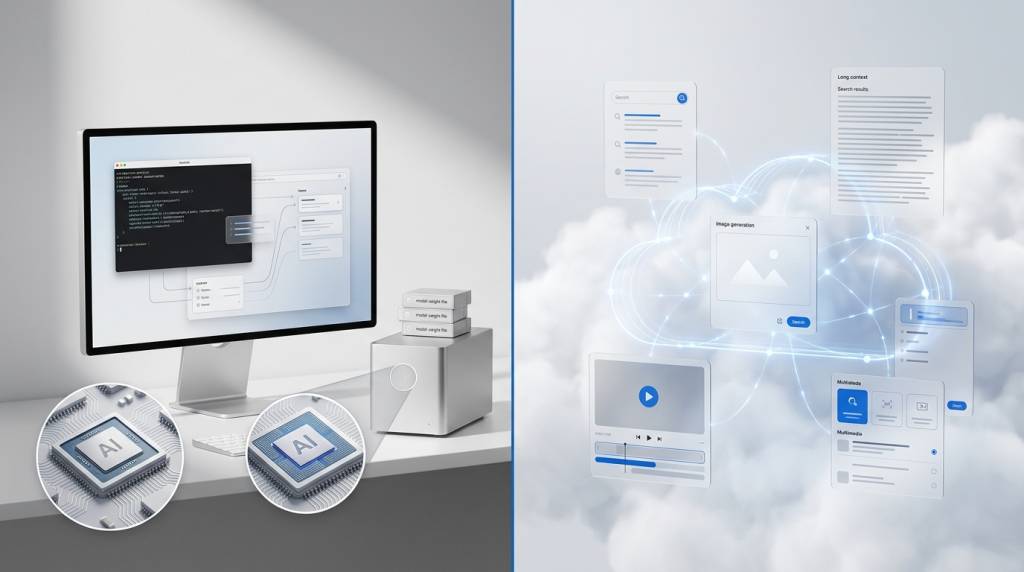
The central trade-off: control versus managed capability
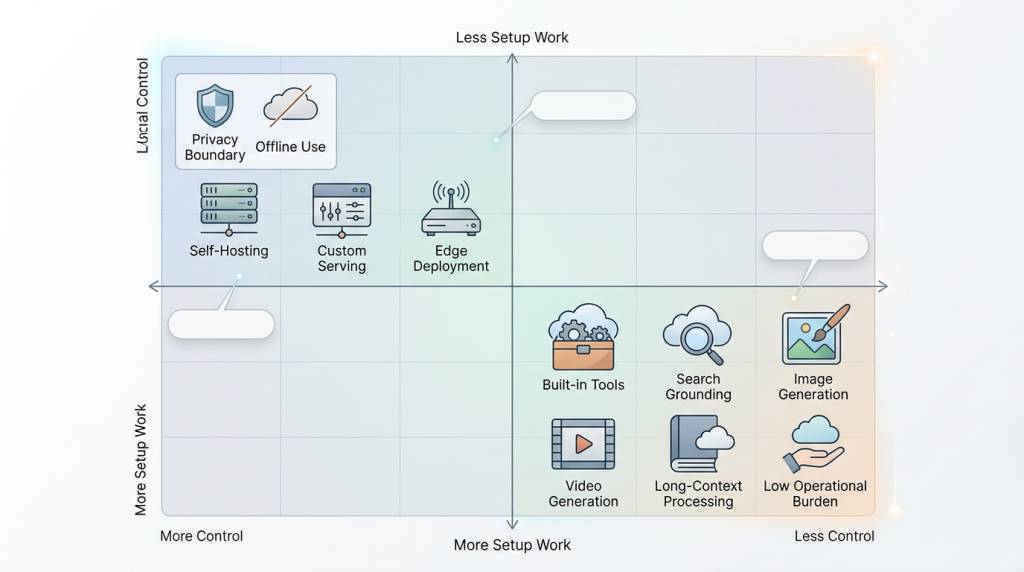
Gemma 4 gives an engineering team control over the model artifact and deployment. You can choose a runtime, quantization, hardware, network boundary, update schedule, and tuning approach. That makes it attractive for edge devices, restricted networks, predictable high-volume inference, and applications where the model must run alongside local data.
Control also creates responsibility. “Downloadable” does not mean “runs well on any laptop.” The required memory and acceleration depend on model size, precision, context length, batch size, and runtime. You must test latency, throughput, thermal limits, and output quality on the target hardware.
Gemini exchanges that operational control for a managed interface. A developer can call an endpoint without deploying model weights, and can use supported tools or specialized services for research, live audio, images, and video. This usually shortens prototyping time and simplifies scaling, but the application depends on network access, service availability, quotas, model lifecycle, and Google's terms.
Model size and modality matter
Gemma 4 spans small on-device models and larger workstation or server models. The E2B and E4B variants target mobile and laptop-class deployment; 12B, 26B A4B, and 31B increase capability and resource requirements. The 26B A4B mixture-of-experts model has about 26 billion total parameters while activating a smaller subset for inference.
All core variants can process text and images and generate text. Native audio input is available on E2B, E4B, and 12B. Do not describe Gemma 4 as an image or video generator: its core output is text, even when it analyzes multimodal input.
Gemini support is endpoint-specific. A text model that accepts video is different from an image-generation model or a live speech model. Select the exact stable endpoint that supports the required input, output, context, region, and tool. Avoid a “latest” or preview alias in production unless you accept its change and deprecation policy.
Tools and application architecture
Gemma 4 supports function-calling patterns, but the model does not execute a function by itself. Your application must define tools, validate arguments, authorize the action, run the code, and return the result. You also build retrieval, file handling, observability, and safety controls.
The Gemini API offers managed capabilities that can include function calling, structured output, code execution, URL context, search grounding, file inputs, and specialized agents, depending on the selected model and account. Built-in does not mean risk-free: validate tool inputs and require appropriate approval for messages, purchases, deletion, access changes, or other consequential actions.
Privacy and compliance require a deployment map
Local Gemma deployment can keep inference data inside your environment only if the entire path is local. Telemetry, package downloads, cloud logging, remote vector databases, external tools, or a hosted front end can still transmit data. Secure the operating system, model files, prompts, outputs, backups, and administrators just as you would any other sensitive workload.
For Gemini, data handling depends on the product, account type, paid or free service, region, logging settings, and contractual terms. Read the terms for the exact service rather than applying a consumer-app assumption to Vertex AI or an API workload.
Use a data-flow review for either option:
- What data enters the system, and is any of it sensitive?
- Where are prompts, files, caches, and outputs stored?
- Which people and services can access them?
- Which network calls or connectors can transmit them?
- How are retention, deletion, audit, and incident response handled?
TipsMake's comparison of offline and online AI provides a broader framework for this decision.
Compare total cost, not “free weights” with token price
| Cost area | Gemma 4 questions | Gemini questions |
|---|---|---|
| Compute | Purchase, rent, utilization, power, cooling, and idle capacity | Input, output, cached context, tools, media generation, and batch pricing |
| Engineering | Deployment, quantization, tuning, drivers, scaling, and incident support | API integration, quotas, retries, model migrations, and spend controls |
| Data | Local storage, retrieval system, backup, and network isolation | File storage, retrieval, logging, egress, and regional services |
| Reliability | Monitoring, redundancy, capacity planning, and hardware replacement | Provider availability plus application fallbacks and endpoint lifecycle |
| Governance | Patch management, access controls, model evaluation, and audit | Service configuration, contract review, access controls, and audit |
Do not copy a price table into a long-lived architecture decision. Use the current Google pricing page and estimate your actual mix of input, output, caching, media, and tool calls. For self-hosting, benchmark the target model on real hardware and include engineering time.
Benchmarks are a filter, not the final decision
| Benchmark evidence can help with | It cannot establish by itself |
|---|---|
| Screening model families for reasoning, coding, language, or multimodal tasks | Quality on your documents, prompts, languages, and failure cases |
| Comparing variants under a published test setup | Latency and cost on your hardware or production traffic |
| Identifying capability improvements between releases | Compliance, privacy, support, or operational fit |
| Planning a shortlist for evaluation | Whether tools, retrieval, or post-processing caused the observed system result |
Create an evaluation set from representative inputs and include adversarial, ambiguous, and sensitive cases. Measure task success, error severity, latency, resource use, and human correction time.
Document, code, and media workflows
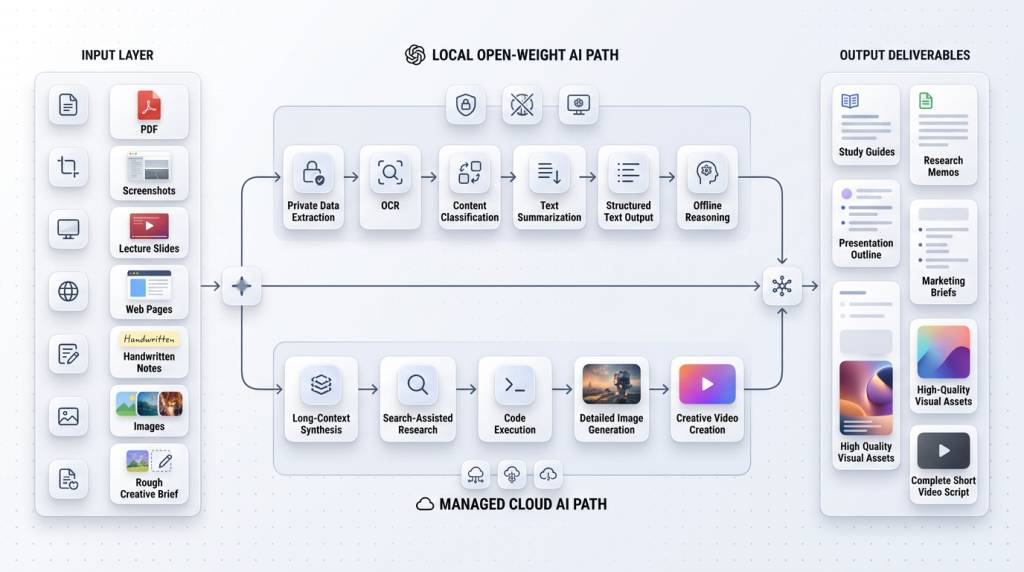
Choose Gemma 4 when the output is mainly text or structured data and inputs must remain within a controlled environment. Examples include local document extraction, private summarization, classification, offline assistance, or an embedded product with known hardware.
Choose Gemini when managed long-context analysis, search grounding, live audio, or Google-hosted image and video services are core requirements. Confirm the exact endpoint: the Gemini ecosystem is a collection of models, not one model that produces every media type.
For another view of local model operations, see TipsMake's comparison of Ollama and LM Studio.
Which should you choose?
- Choose Gemma 4 for open-weight control, offline or edge operation, custom runtimes, local tuning, or a data boundary your team can operate.
- Choose Gemini for rapid managed deployment, elastic capacity, Google-hosted tools, large multimodal inputs, or generative-media services.
- Use both when a clear boundary separates local sensitive processing from cloud tasks that need managed tools or media generation.
Run the same representative workload on a shortlisted Gemma variant and a stable Gemini endpoint before committing. The winning architecture is the one that meets the required quality, privacy, latency, availability, and total-cost targets—not the one with the largest benchmark score or context window.
Related Articles
 How to Use Gemma 4 with the Gemini API and Google AI Studio6 minutes read
 Is Google Gemma 4 Better Than ChatGPT?7 minutes read
 What Is Google Gemma 4? Everything You Need to Know About Google's New7 minutes read
 How Gemini Extensions Help Work More Efficiently on Google7 minutes read
 Comparing the Performance of Qwen 3.5 and Gemma 413 minutes read
 Gemini 3.1 Pro or Gemini 3 Pro: Better?8 minutes read
Reader Comments 0
Sign in with email or Google to join the discussion.