Table of Contents
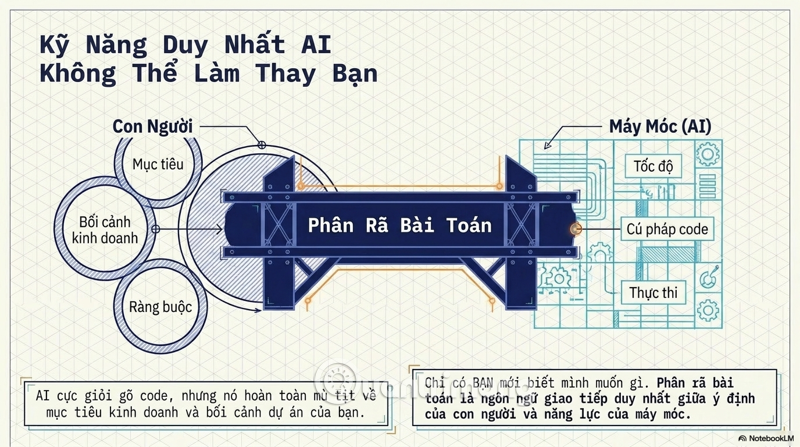
AI coding tools work best when they receive a bounded problem, relevant context, and a clear way to verify the result. A request such as “build a habit-tracking app” leaves dozens of decisions unstated: who uses it, where data is stored, what counts as a completed habit, and what should happen when an operation fails. Problem decomposition turns that vague outcome into small, testable pieces.

Decomposition is not merely writing a longer prompt. It is deciding what the software must do, separating responsibilities, identifying dependencies, and defining what “done” means for each change. The same method helps whether you use an IDE assistant, an autonomous coding agent, or a chatbot that only returns code snippets.
Why broad AI coding requests often fail
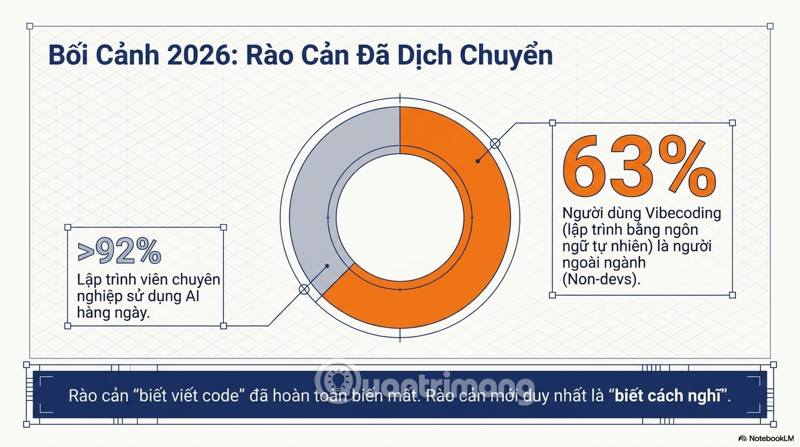
An AI assistant can infer missing details, but those inferences may not match your product. A generated app can appear functional while using the wrong data model, duplicating logic, ignoring error states, or breaking an existing feature. The larger the request, the more hidden assumptions accumulate.
GitHub’s official Copilot guidance recommends breaking complex tasks into simpler tasks, being specific, and supplying relevant code. Anthropic’s Claude Code best practices similarly separate exploration, planning, implementation, and verification for changes that span multiple files. The tools differ, but the useful habit is the same: narrow the unit of work until you can inspect it.

Start with the outcome and acceptance criteria
Before asking for code, write a short problem statement in user terms. Include the user, the action, the expected outcome, and important constraints. Then add acceptance criteria that can be observed or tested.
For a habit tracker, a useful starting point might be:
- A user can create a habit with a name and schedule.
- The app shows which habits are due today.
- A completion can be added or removed for a specific date.
- Reloading the page does not lose saved data.
- Invalid or failed operations produce an understandable message.
This list does not dictate every implementation detail. It gives the AI and the reviewer a shared target. If a requirement is still uncertain, ask the assistant to identify decisions and risks before it edits files.
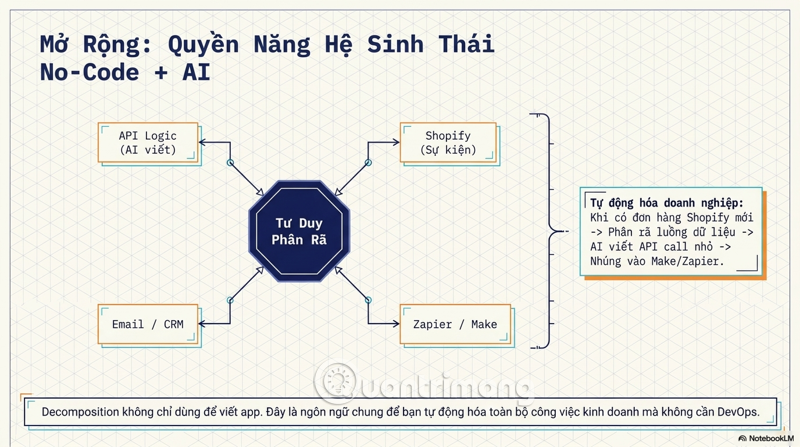
Three ways to decompose an AI coding task
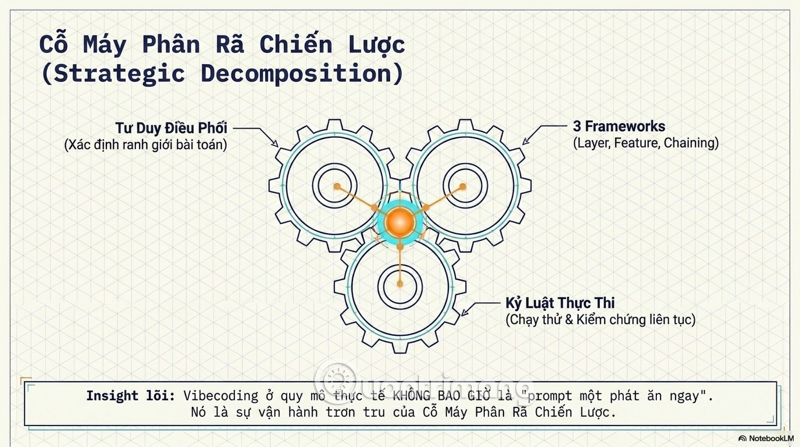
1. Break it into user journeys and vertical slices
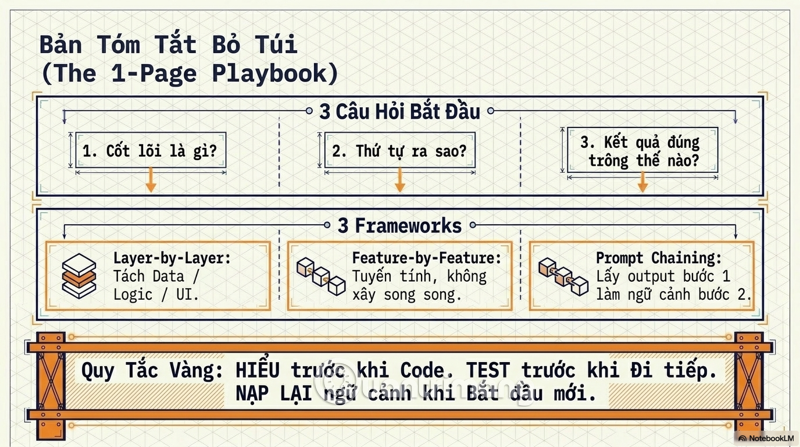
A vertical slice delivers one small behavior from interface to data storage. For example, “create a habit and display it in the list” is a better first slice than “build the entire database layer.” It produces something you can run and verify while keeping the change small.
A sensible sequence for the example is:
- Create and list habits.
- Validate required fields and display errors.
- Mark one habit complete for today.
- Persist habits and completion records.
- Add editing, deletion, filters, and statistics only after the core flow works.
Later slices may alter earlier code, so tell the assistant to inspect the existing implementation first and preserve established conventions. If you are working across many files, see this guide to using Claude Code in VS Code for multi-file programming.
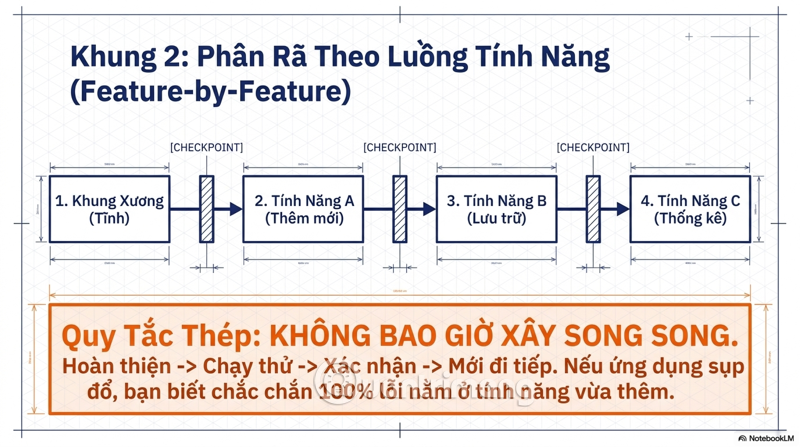
2. Separate data, logic, and interface responsibilities
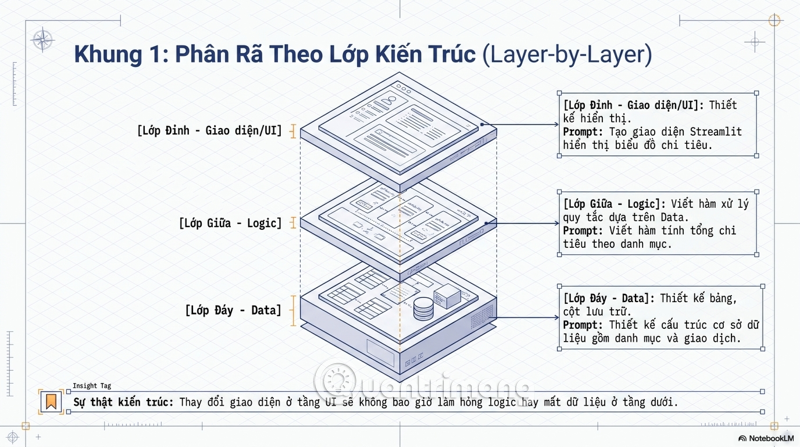
Layering helps reveal responsibilities and dependencies:
- Data: entities, fields, relationships, storage, migrations, and validation boundaries.
- Logic: rules such as which habits are due, how streaks are calculated, and what actions are permitted.
- Interface: forms, views, loading states, error messages, accessibility, and navigation.
This does not mean building each layer in isolation for weeks. Use the layers to reason about one vertical slice. For “mark complete,” define the completion record, implement the operation, connect the control, and test the full path.
3. Separate risks and dependencies
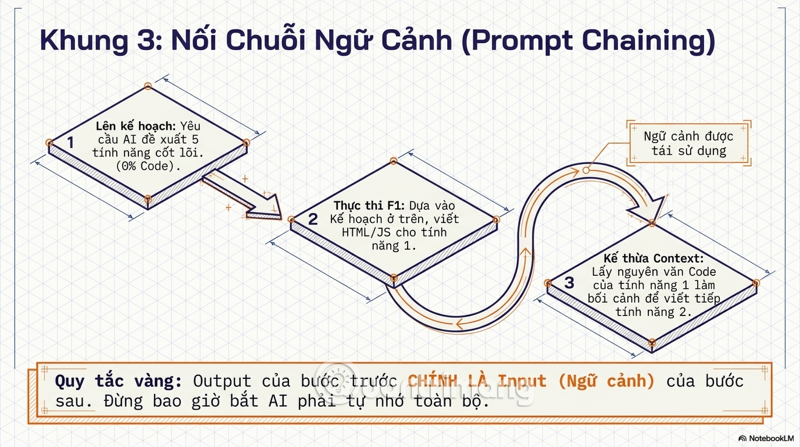
Some parts deserve their own review because mistakes have consequences. Authentication, authorization, payments, destructive actions, file uploads, personal data, and deployment configuration should not be buried inside a broad feature prompt.
List dependencies explicitly: existing APIs, database migrations, environment variables, third-party services, supported browsers, and backward-compatibility requirements. Ask the assistant to state which files it expects to change and which tests it will run. For sensitive changes, require human review and test in an isolated environment before deployment.
Turn the plan into small work packets
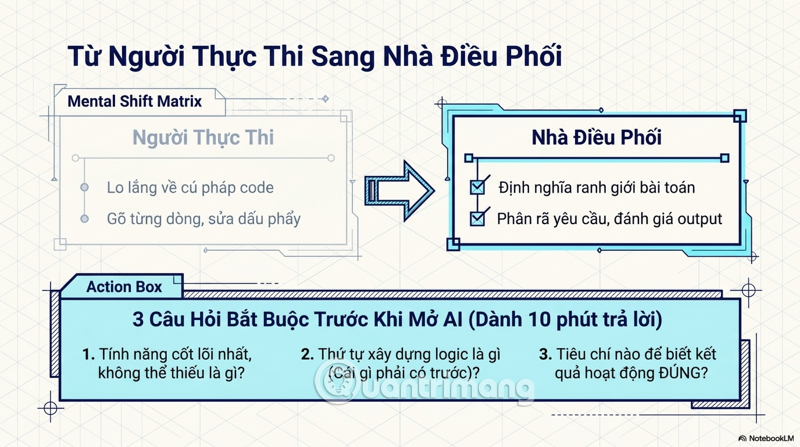
Each AI task should contain enough information to act without reopening the entire product discussion. A practical work packet includes:
- Goal: one observable behavior.
- Relevant context: files, interfaces, schemas, or existing patterns to inspect.
- Constraints: technologies, compatibility, boundaries, and actions that are out of scope.
- Acceptance criteria: expected and error behavior.
- Verification: tests, linting, type checks, and a manual check where appropriate.
For example:
Implement the “create habit” slice. First inspect the existing form components and storage interface. Add name and weekday fields, validate an empty name, save through the existing repository, and show the new habit without a reload. Do not add streaks or reminders. Add tests for a valid habit and an empty name, then run the relevant test and type-check commands. Summarize changed files and any assumptions.
This prompt constrains scope without prescribing code the assistant has not yet inspected.
Use prompt chaining without losing project context
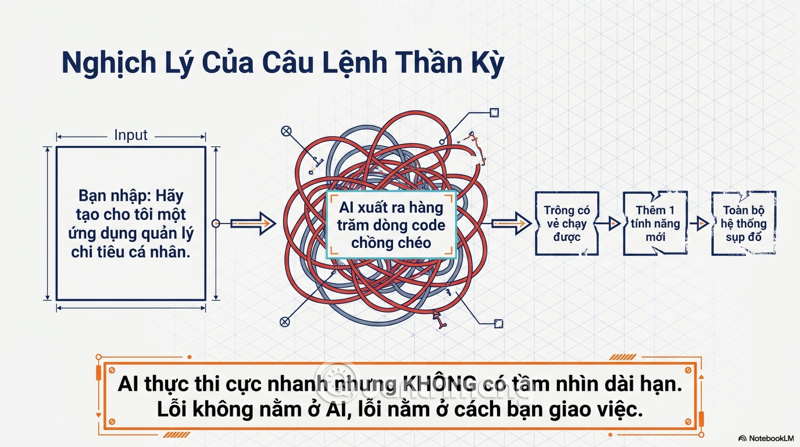
Prompt chaining means using the result of one bounded step as input to the next. A reliable sequence is:
- Explore: identify relevant files, current behavior, dependencies, and unanswered questions.
- Plan: propose a small change and its verification steps.
- Implement: make only the approved slice.
- Verify: run tests and inspect the diff against the acceptance criteria.
- Record: update documentation or the next-task list with decisions that remain valid.
Do not treat a long chat transcript as the source of truth. Keep durable project facts in reviewed files such as a README, architecture note, issue, or tool-specific instruction file. Remove stale instructions when the design changes. If you are comparing agent workflows, this overview of Cursor and GitHub Copilot can help clarify how context and task execution differ.
Verify each slice before expanding it
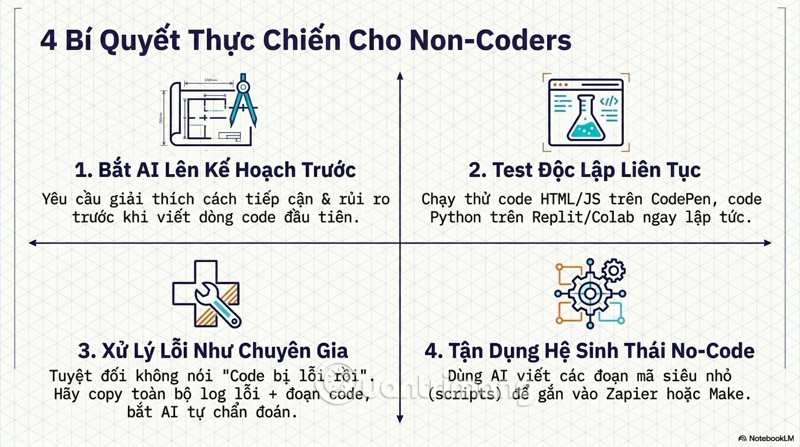
Code generation is not verification. After every slice, inspect the diff and run the smallest relevant checks, then run broader checks before merging or deploying. Confirm both the intended behavior and failure cases.
- Does the implementation meet every acceptance criterion?
- Did it change unrelated files or dependencies?
- Are inputs validated at the correct boundary?
- Are errors handled without exposing secrets or internal details?
- Do automated tests cover the new behavior and an important failure case?
- Do linting, type checks, and the existing test suite still pass?
If a test fails, provide the exact error, the command used, the expected behavior, the actual behavior, and reproduction steps. Redact tokens, passwords, personal data, private URLs, and proprietary code before sharing them with any hosted service.
Common decomposition mistakes
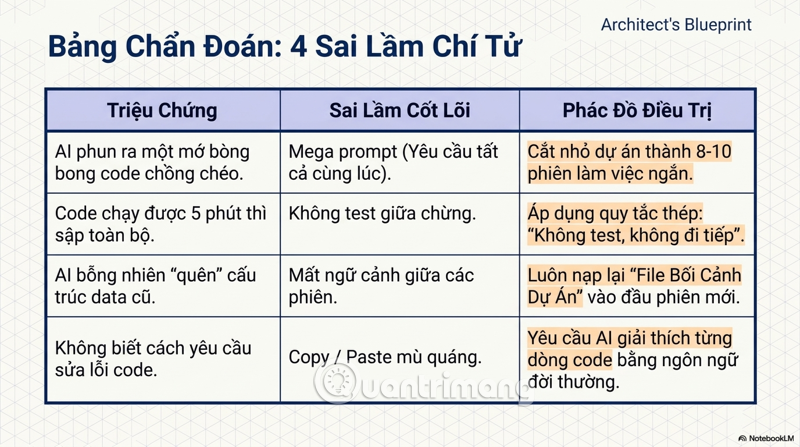
- Splitting only by file: “write the model, then the view” can leave you with unintegrated pieces. Prefer testable behaviors that cross the necessary layers.
- Creating tasks that are still vague: “add authentication” needs user flows, identity provider, session behavior, permissions, and error cases.
- Over-decomposing trivial work: a clear one-line change may not need a formal plan. The process should reduce risk, not add ceremony.
- Accepting each output without checking it: small mistakes compound when later prompts assume earlier code is correct.
- Letting parallel changes collide: independent work can run concurrently, but overlapping files, schemas, or interfaces need coordination and integration tests.
Worked example: decompose a habit tracker
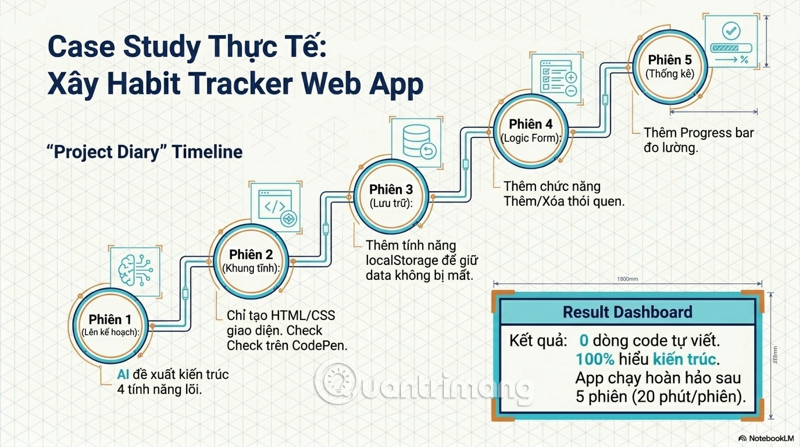
Instead of asking for a complete app, create a short backlog:
- Document the habit and completion data model.
- Build the create-and-list slice with in-memory data.
- Add validation and error states.
- Connect persistent storage and test reload behavior.
- Add daily completion and undo behavior.
- Define streak rules with date and time-zone edge cases before implementing statistics.
- Review accessibility, authorization, privacy, and deployment configuration.
At each step, stop if the acceptance criteria fail or a design decision is unresolved. A beginner can use AI to prototype this flow, but publishing software that handles accounts, payments, or private data still requires security, privacy, and operational knowledge. AI output should be treated as a draft that must be reviewed.
A practical definition of “small enough”
A task is usually small enough when you can describe its behavior in a few sentences, identify the relevant part of the codebase, review the resulting diff, and verify it with specific checks. If you cannot explain how to tell whether the result is correct, decompose further or resolve the missing requirement first.
Good decomposition makes AI assistance easier to steer and easier to audit. It does not guarantee correct code, but it exposes assumptions early and limits the amount of unverified change introduced at once. That is the real advantage: faster feedback with a manageable review surface.
Related Articles
 Close-up of the Transformation of the Human Body After Death2 minutes read
 Forensics Use Bacteria in the Mouth to Estimate the Victim's Death2 minutes read
 Chemical Recycling Can Be a Solution to the Problem of5 minutes read
 How Long Does It Take Waste to Decompose?2 minutes read
 How to Play Pokémon GO on a Computer6 minutes read
 How to Play Pokémon GO on a Smartphone6 minutes read
Reader Comments 0
Sign in with email or Google to join the discussion.