Table of Contents
AI search visibility trackers show whether a brand, product, domain, or page appears in generated answers for a repeatable set of prompts. They can record mentions, linked citations, competitors, answer position, and changes over time. That makes them useful for measuring a part of search visibility that a traditional keyword rank tracker does not capture.
The numbers require context. AI answers can change with the prompt wording, location, account state, model version, web access, and repeated runs. A visibility score is therefore a sample from a defined monitoring setup—not a universal ranking for the entire internet.
What an AI visibility tracker should measure
- Brand mentions: answers that name the organization or product, even without a link.
- Linked citations: answers that cite the tracked domain or a specific page.
- Prompt coverage: the percentage of monitored questions in which the brand appears.
- Competitive share: how often selected competitors appear for the same prompts.
- Source overlap: domains and pages repeatedly used to support answers in the topic.
- Answer context: what the system says about the brand, not merely whether the name is present.
Mentions and links should be reported separately. A brand can be recommended without its site being cited, while a page can be cited as an informational source without the brand being recommended. Neither metric is equivalent to visits, leads, or sales, so connect monitoring data with web analytics and conversion reporting.
Quick comparison
| Tool | Best fit | Core strength | Important check before buying |
|---|---|---|---|
| SE Ranking | SEO teams that want conventional and AI-search reporting together | Brand, link, prompt, competitor, and source analysis alongside an SEO suite | Confirm the engines, markets, languages, refresh rate, and limits included in the chosen plan |
| Profound | Large organizations with dedicated AI-search and reporting programs | Enterprise-scale answer monitoring and competitive analysis | Confirm onboarding, exports, integrations, query volume, regional coverage, and contract terms |
| Otterly.AI | Marketing teams that want a focused monitoring workflow | Prompt-based mention, citation, and competitor tracking in an accessible dashboard | Check which engines are standard or add-ons and whether the reporting depth meets your needs |
SE Ranking: combined SEO and AI visibility reporting
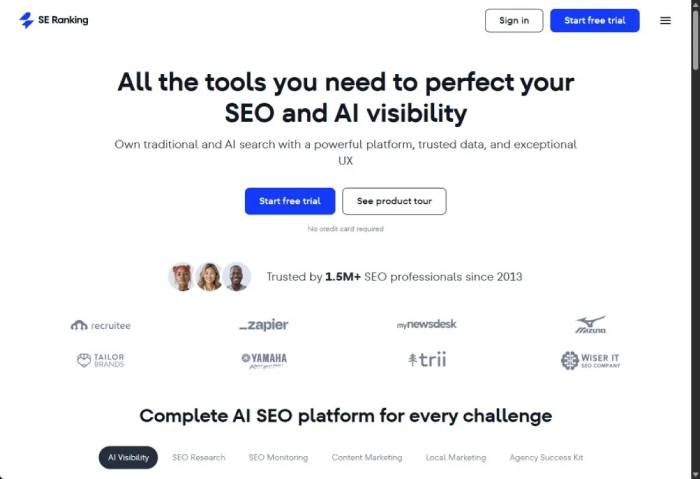
SE Ranking's AI Visibility Tracker monitors prompts across ChatGPT, Google AI Overviews, Google AI Mode, Gemini, and Perplexity. It records brand mentions and links, preserves the answers behind the metrics, compares competitors, and identifies the sources cited for tracked topics.
Its main advantage is context. Teams can use AI-search data alongside conventional rank tracking, keyword research, site audits, and analytics instead of building a separate reporting process. This is helpful when a page ranks in traditional results but rarely appears as a source in generated answers—or when AI visibility improves without a matching change in conventional position.
Choose SE Ranking when
- the SEO team will own AI-search monitoring;
- you need prompt-level answers and source URLs, not just an overall score;
- client or stakeholder reports must combine organic and AI visibility; or
- you want to compare the same brand and competitors across several search channels.
Platform coverage and plan limits can change. Before committing, run a representative prompt set in a trial and verify that the relevant countries, languages, engines, exports, and refresh frequency are available.
Profound: enterprise answer-engine analysis
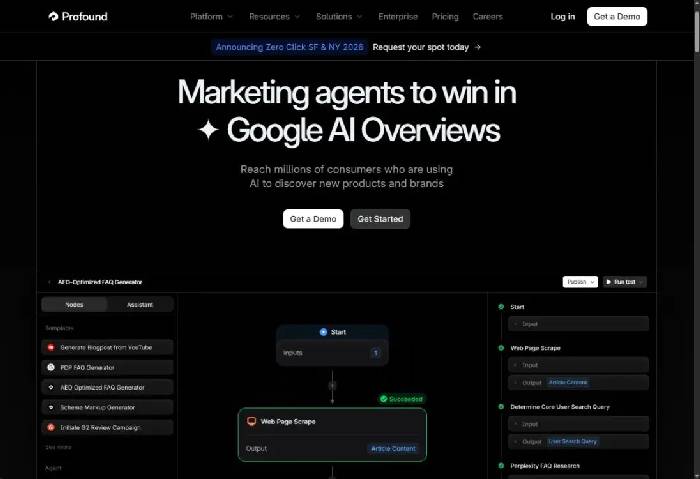
Profound is aimed at organizations that need to analyze how brands and products appear across AI answer systems at scale. Its value is less about checking an occasional prompt and more about organizing large prompt sets, competitor comparisons, topics, source patterns, and reporting for multiple teams or markets.
Choose Profound when
- AI-search measurement has a dedicated owner and budget;
- several brands, markets, product lines, or stakeholder groups need consistent reporting;
- exports, integrations, governance, and onboarding are as important as the dashboard; or
- you need a long-term competitive program rather than a lightweight brand check.
Enterprise depth is only useful if the organization can maintain a disciplined prompt set and act on the findings. Ask for a demonstration using your real topics. Confirm the supported engines, countries, languages, sampling method, data retention, permissions, API or export access, and how the vendor defines every score.
Otterly.AI: focused prompt and citation monitoring
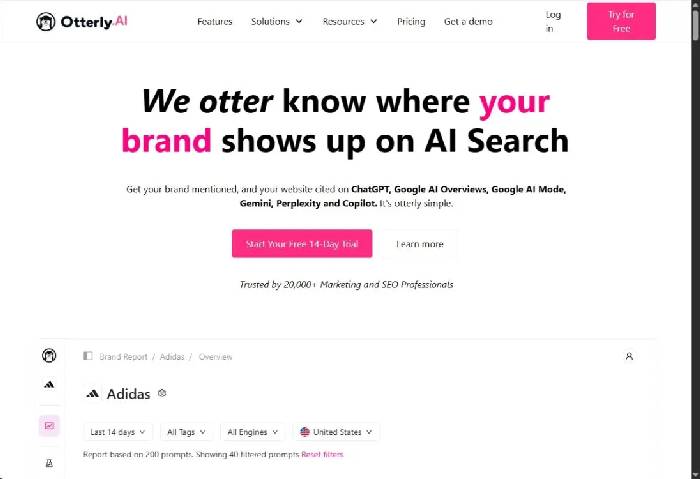
Otterly.AI centers its workflow on a library of questions that resemble the prompts customers ask. It monitors brand mentions, cited links, competitors, and changes in visibility across supported AI search experiences. The focused interface can be easier to adopt when a marketing or content team does not need a full conventional SEO suite.
Choose Otterly.AI when
- you want to start with a manageable list of commercial and informational prompts;
- content marketers need clear mention and citation reports;
- competitor comparisons must use the same questions as the tracked brand; or
- a specialized monitor is preferable to a broader SEO platform.
Otterly.AI currently advertises coverage for ChatGPT, Perplexity, Google AI Overviews, Google AI Mode, Gemini, and Microsoft Copilot. Coverage and packaging can change, so check which engines and locations are part of the intended plan before using the data as a reporting baseline.
How to build a useful prompt set
The tracker is only as useful as the prompts it runs. A list made entirely from short SEO keywords will not represent how people use conversational search. Build a balanced set based on real customer language:
- Start with tasks and decisions. Include questions such as “Which accounting app supports multiple currencies?” or “How do I secure a small office Wi-Fi network?”
- Cover the funnel. Monitor educational, comparison, alternative, troubleshooting, and purchase-oriented questions.
- Add relevant qualifiers. Include audience, location, budget, platform, and use-case details when those factors change the answer.
- Keep a fixed benchmark group. Do not continually replace every prompt; otherwise, trend comparisons become meaningless.
- Add new prompts separately. Expand coverage while preserving the original baseline.
- Track brands and domains. Account for name variations, product names, parent companies, and important page URLs.
If your audience moves between answer engines, TipsMake's comparison of Perplexity and ChatGPT helps explain why the same question may produce different sources and presentation across platforms.
How to evaluate a tracker during a trial
- Choose 20 to 50 prompts that reflect genuine customer questions.
- Define the target brand, domain, important products, and three to five competitors.
- Run the same prompts across the engines and locations that matter to the business.
- Open sample answers and manually verify whether mentions, links, and competitors were classified correctly.
- Repeat the run on different days to see how volatile the results are.
- Export the data and confirm that the fields support your reporting workflow.
- Check whether the dashboard reveals a specific action, such as improving a cited page, correcting outdated information, or filling a documented content gap.
Turn visibility data into content work
Do not rewrite pages merely to repeat phrases from generated answers. Start by inspecting the sources that are consistently cited. Determine whether they provide clearer definitions, original evidence, current product information, better structure, or stronger trust signals. Then improve the page for the reader: answer the question early, support factual claims, make authorship and update information clear, and maintain technically accessible HTML.
Content-generation software can assist with production, but it does not replace source quality or editorial review. If that is part of the workflow, compare TipsMake's guide to AI content writing tools and verify every generated claim before publication.
Report AI visibility as one part of search performance. A sound dashboard keeps traditional rankings, organic clicks, AI referrals, conversions, brand demand, mentions, and citations distinct. This prevents a volatile visibility score from being mistaken for business impact.
Related Articles
 SEO Images - Things You Should Know7 minutes read
 SEO Local: How Does Google Determine Local Rankings?5 minutes read
 3 Free Tools to Keep Track of Google Update Algorithms Every Day4 minutes read
 Search Engine Intelligence and Website Rankings5 minutes read
 Factors Determining Website Rankings on Search Results in 20167 minutes read
 What Is SEO: Learn About SEO on Page9 minutes read
Reader Comments 0
Sign in with email or Google to join the discussion.