Table of Contents
These five open-weight models can be evaluated for local code explanation, debugging, test generation, and agent-style workflows, but they are not equally compact or coding-specific. The 15B-to-36B parameter range generally requires substantial system or GPU memory after quantization, and a model that loads successfully may still be too slow for interactive use. Test the exact quantization, context length, and coding tasks on your own hardware before standardizing on one.
Running locally can keep prompts and source code on the machine, but privacy is not automatic. An IDE extension or agent may still call external search, telemetry, package, or cloud services. Audit the complete tool chain and network behavior, not just the model endpoint.
What to compare before downloading a model
- Task fit: completion, explanation, repository search, debugging, test writing, tool use, or screenshot analysis.
- Model format: GGUF and other quantized variants may work in llama.cpp-based apps; Transformers, vLLM, and SGLang use different packages and hardware paths.
- Memory: total model weights, quantization, key-value cache, context length, and runtime overhead all matter. “Active parameters” in a mixture-of-experts model is not its download or memory footprint.
- Context: a published maximum does not mean the machine can run that length efficiently or that quality stays constant.
- License and policy: read the exact model card and license for commercial, modification, redistribution, and acceptable-use conditions.
- Agent support: tool calling depends on the model, chat template, inference server, and agent harness working together.
1. gpt-oss-20b
OpenAI describes gpt-oss-20b as an open-weight reasoning model under the Apache 2.0 license and the gpt-oss usage policy. The official specification lists about 21 billion total parameters and 3.6 billion active parameters. OpenAI says the model can run with 16 GB of memory, although practical speed and usable context still depend on the runtime, quantization, and hardware.
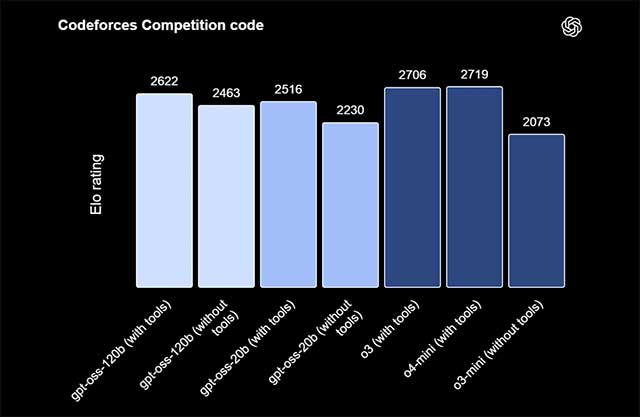
gpt-oss-20b is a reasoning model that can be tested for code review and tool-driven tasks.
Good candidate for: local reasoning, structured tool workflows, patch planning, and code explanation where an OpenAI-published open-weight checkpoint is preferred.
Check first: support for the model's expected chat template and reasoning controls in the local runtime. Do not equate MoE active parameters with the complete memory requirement.
2. Qwen3-VL-32B-Instruct
Qwen3-VL-32B-Instruct is a 32B vision-language instruction model published by Qwen under Apache 2.0. Its practical distinction in this list is visual input: it can be evaluated on UI screenshots, diagrams, terminal captures, and other image-plus-text tasks. Qwen also publishes a GGUF repository with llama.cpp guidance.
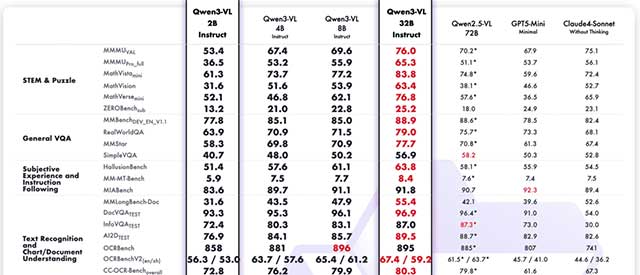
Qwen3-VL is relevant when coding assistance must include screenshots or interface diagrams.
Good candidate for: frontend and QA workflows that combine source code with visual evidence.
Check first: vision support in the selected local app, image-processing overhead, and code quality on your languages. It is a general multimodal model, not a guarantee of superior repository-level coding.
3. Apriel-1.5-15b-Thinker
ServiceNow's Apriel-1.5-15b-Thinker model card describes a 15B multimodal reasoning checkpoint. Its smaller total parameter count makes it the lightest entry in this group, but 15B is still not a small download or a universal fit for ordinary laptops.
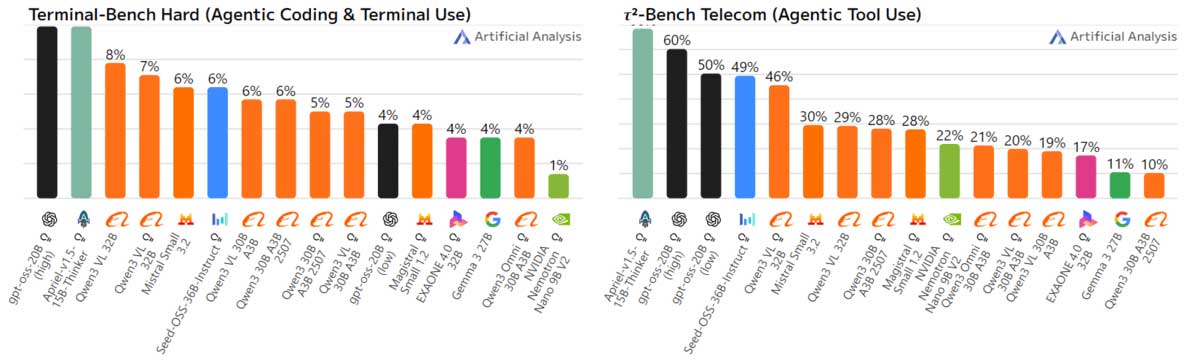
Apriel-1.5-15b-Thinker is a general reasoning model that should be benchmarked on coding tasks before adoption.
Good candidate for: teams that want a mid-sized reasoning model to test in controlled internal workflows.
Check first: the exact checkpoint and current model card. Apriel has later releases, and this 1.5 model is not documented as a dedicated code model. Compare versions on the same tasks rather than assuming a newer or “Thinker” label guarantees better patches.
4. Seed-OSS-36B-Instruct
ByteDance Seed publishes Seed-OSS-36B-Instruct as a 36B instruction model with official examples for Transformers, vLLM, and SGLang. The model card also points users to community quantizations for llama.cpp, Ollama, and LM Studio-compatible use.
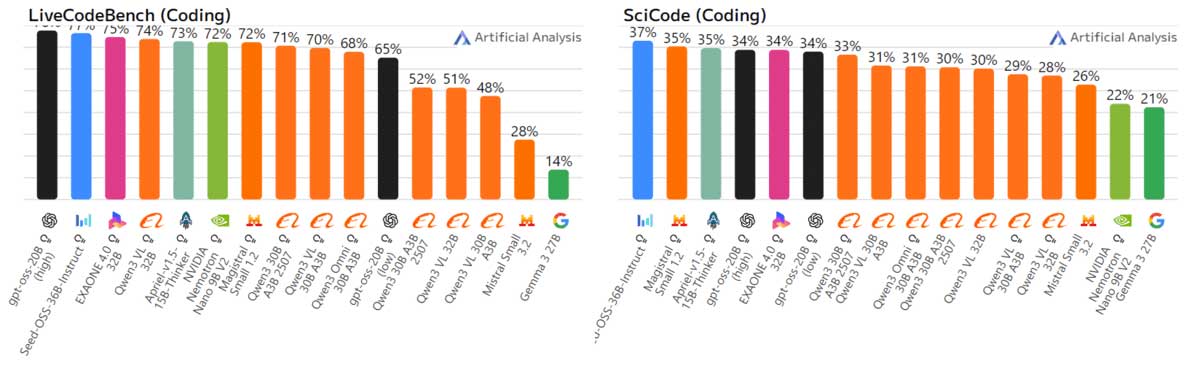
Seed-OSS-36B-Instruct offers several server-runtime paths but needs more memory than the smaller entries.
Good candidate for: workstation or server evaluation where a larger dense instruction model is acceptable.
Check first: license terms, memory capacity, supported quantization, and measured code-edit quality. The model card contains benchmark results, but those scores do not replace testing against real issues, repositories, and acceptance tests.
5. Qwen3-30B-A3B-Instruct-2507
Qwen3-30B-A3B-Instruct-2507 is a mixture-of-experts instruction model. Qwen's official materials describe roughly 30 billion total parameters with about 3 billion active per token; the later 2507 checkpoint extends the instruction model's context specification. Long context can help with multiple files, but the key-value cache and prompt processing cost rise as more code is loaded.
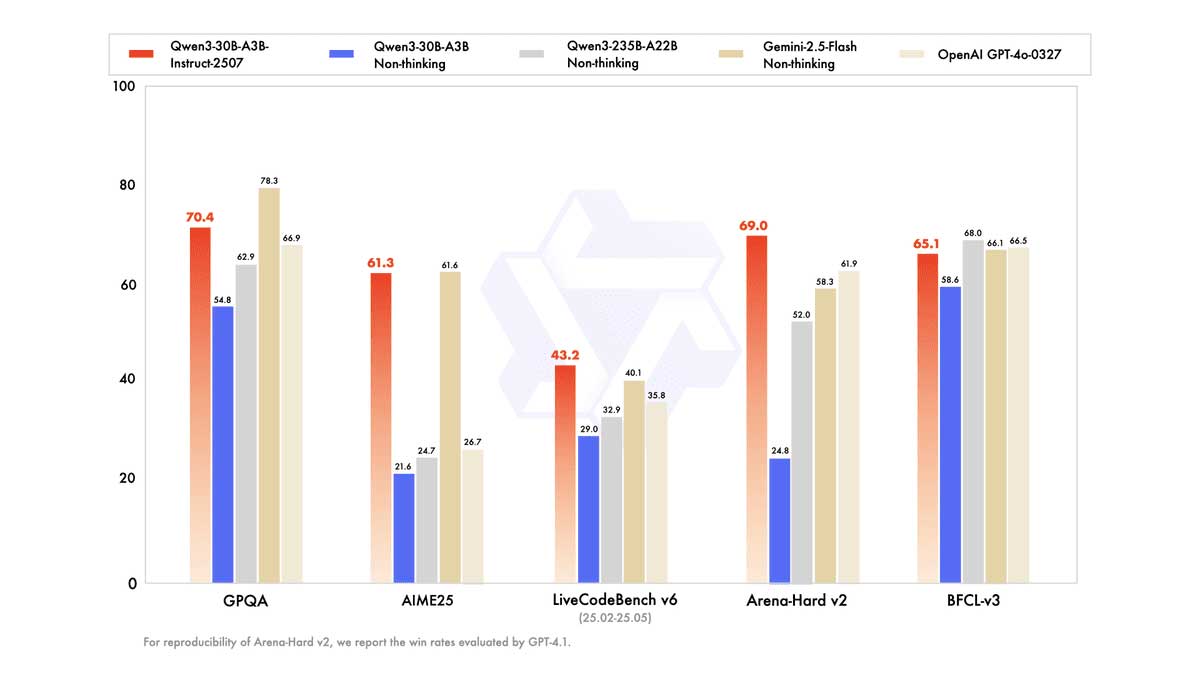
Qwen3-30B-A3B balances a large total model with a smaller active expert set.
Good candidate for: local agents and multi-file assistance when the runtime supports Qwen's template and tool format.
Check first: total memory, not just active parameters, plus whether the 2507 checkpoint or a newer Qwen release is the better maintained choice for the intended harness.
Comparison at a glance
| Model | Published scale | Distinctive capability | Main caveat |
|---|---|---|---|
| gpt-oss-20b | 21B total / 3.6B active MoE | Open-weight reasoning and tool-oriented workflows | Runtime support and full memory footprint still matter |
| Qwen3-VL-32B-Instruct | 32B | Text and image input | General multimodal model, not coding-only |
| Apriel-1.5-15b-Thinker | 15B | Mid-sized multimodal reasoning | Older checkpoint and not documented as code-specific |
| Seed-OSS-36B-Instruct | 36B | Official Transformers, vLLM, and SGLang paths | Highest dense-model memory demand in this group |
| Qwen3-30B-A3B-Instruct-2507 | 30B total / about 3B active MoE | Efficient expert activation and long-context specification | Long contexts add substantial memory and latency |
How to evaluate a local coding model
- Select two or three representative tasks from a non-sensitive test repository: a bug fix, a refactor, and a test-writing task.
- Use the same prompt, context files, quantization quality, temperature, and token budget for every model.
- Measure load time, first-token latency, tokens per second, peak memory, patch size, test pass rate, and whether the model changed unrelated code.
- Review licenses and scan model files through the chosen repository and runtime.
- Keep generated patches in version control and require human review before merging or executing commands.
For runtime selection, compare this guide to the main differences between Ollama and LM Studio and the broader list of tools for running LLMs locally. Also consider the trade-offs in offline versus online AI before assuming that local inference fits every team.
Which model should you start with?
Choose gpt-oss-20b or Qwen3-30B-A3B when MoE efficiency and agent experimentation matter, Qwen3-VL when screenshots are part of the task, Apriel when testing a smaller reasoning checkpoint, and Seed-OSS when a larger dense model fits the available workstation or server. The useful answer is the model that produces reviewable, test-passing changes within your memory and latency budget—not the one with the longest feature list.
Related Articles
 How to Read and Write Files Using JES Application7 minutes read
 How to Run Qwen 3.5 Locally on a Single GPU: Step-by-Step Guide15 minutes read
 Why Write Neat and Organized HTML?6 minutes read
 How to Setup and Run Qwen 3 Locally with Ollama9 minutes read
 7 Best Tools for Running LLM Models Locally: Practical Guide7 minutes read
 Guide the Most Simple and Effective Way to Write Easy-to-read5 minutes read
Reader Comments 0
Sign in with email or Google to join the discussion.