Table of Contents
6G could give robots richer information from networks, nearby sensors, edge computers, and other machines. That may improve coordination and perception in factories, warehouses, transport hubs, and other controlled environments. It will not, by itself, make a robot intelligent or safe.
Robots at mobile-technology events are more than crowd attractions because modern robotics increasingly depends on wireless communication and distributed computing. Research for the next network generation includes capabilities relevant to machines: integrated sensing and communication, precise positioning, dependable low-latency links, and closer coordination between devices and edge infrastructure.
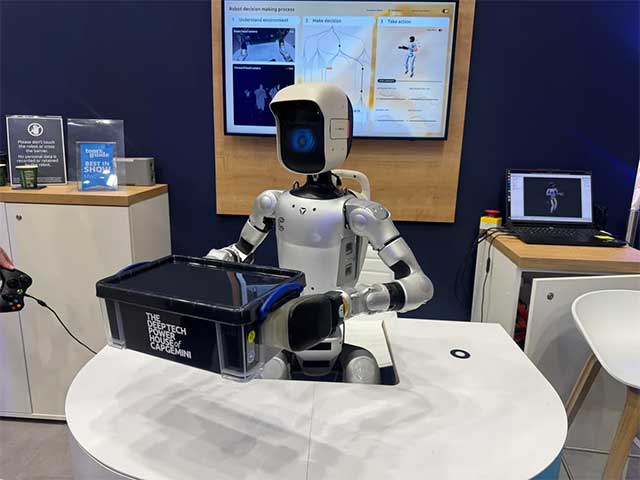
What 6G may add to robotics
Networks that help sense and position
6G research considers using radio signals for both communication and sensing. In suitable environments, network infrastructure could help detect movement, estimate position, or add contextual information beyond a robot's onboard cameras and range sensors.
This would be an additional input, not a replacement for local perception. A mobile robot must continue to detect nearby people and stop safely if the network is unavailable, delayed, obstructed, or wrong.
More computing at the edge
Some robotics workloads can be divided between the machine and nearby computing infrastructure. A robot might handle immediate motion and safety locally while an edge system performs fleet planning, large-model inference, map updates, or analysis across several devices.
Faster data transfer can make that division more practical, but bandwidth alone does not guarantee a responsive system. Queueing, congestion, handoffs, server load, software design, and the physical distance to compute all contribute to end-to-end latency.
Stronger service guarantees
Industrial robotics often values predictable performance more than peak speed. Future networks may offer better ways to allocate resources and maintain service characteristics for a defined task. The meaningful measures include latency variation, reliability, recovery time, coverage, and behavior during overload—not only a maximum throughput figure.
Robot teams could share a wider view
A group of robots can already exchange work status over wired, Wi-Fi, or private cellular networks. Future connectivity may support denser deployments and make it easier to combine information from robots, fixed cameras, shelves, vehicles, and control systems.
For example, one machine unloading goods could report item and location data to another that stocks or transports them. A fleet manager could reassign tasks after a blocked aisle or equipment failure. This coordination requires a shared event model, accurate clocks and identifiers, and explicit rules for conflicting observations.
Planning several steps ahead is mainly an AI and operations problem. Connectivity supplies more current state, but the planner still needs a correct objective, realistic model of the environment, safe constraints, and a fallback when the plan cannot be completed.
Continuous learning needs more than a fast connection
Robots could send selected experience data to a central or edge system, where models are evaluated and improved before controlled updates return to the fleet. This is different from allowing every deployed robot to change its behavior freely while operating.
A responsible update process should:
- Collect only data needed for an approved learning objective.
- Remove or protect personal and confidential information.
- Label failures and environmental conditions accurately.
- Test a new model against a fixed safety and performance suite.
- Deploy gradually and monitor for regression.
- Preserve the previous version and a rollback path.
Learning a skill in one environment does not guarantee that it transfers to another. Different lighting, floor materials, object shapes, human behavior, and layouts can make a model fail in unexpected ways.
Where 6G-enabled robotics may appear first
Controlled sites with clear business cases are more plausible early adopters than general household humanoids.
- Factories: coordinated mobile robots, machine monitoring, and flexible work cells
- Warehouses and ports: fleet routing, asset tracking, and shared perception at busy intersections
- Utilities and infrastructure: remote inspection with edge analysis and operator support
- Hospitals and hotels: bounded transport or delivery tasks under site-specific safety rules
- Agriculture and mining: groups of machines working across large managed areas
Homes are less structured. A domestic robot must cope with children, pets, transparent or deformable objects, clutter, stairs, privacy expectations, and frequent layout changes. Better networking does not remove those manipulation and safety challenges.
Robots must remain safe when the network fails
A networked robot should degrade safely. Emergency stopping, collision avoidance, joint limits, and other time-critical safeguards generally need local execution. Loss of connectivity might reduce speed, pause a task, return the machine to a safe area, or transfer control to an operator; it should not make basic safety depend on a remote response.
Cybersecurity also becomes more important as coordination expands. Mutual authentication, encrypted links, signed software, segmented networks, least-privilege access, secure boot, audit logs, and rapid credential revocation help limit the effect of a compromised device or service.
Questions that still need answers
- Which 6G capabilities will be standardized, licensed, deployed, and affordable in each region?
- Can the network provide the required reliability inside difficult industrial or indoor environments?
- Who controls data collected by robots and ambient sensing infrastructure?
- How will organizations validate updates shared across different robot types and sites?
- What should happen when onboard sensors and network-derived information disagree?
- Can energy and infrastructure costs be justified by measurable operational gains?
6G remains a developing technology rather than a present-day requirement for useful robotics. Current private networks, Wi-Fi, wired systems, and edge computing already support many coordinated-machine applications.
The longer-term opportunity is not simply a faster radio link. It is a dependable environment in which robots, sensors, and computing services can share selected information with predictable timing. Real progress will still depend on better manipulation, perception, planning, security, and safety engineering around that network.
Related Articles
 Are Humans Ready to Live with Robots and AI?7 minutes read
 Startled with the Future Changing Technologies Will Be Popular3 minutes read
 26 Photos of Life Filled with Future Japanese Technology8 minutes read
 Microsoft CEO: Robot Will Never Replace People in the Future7 minutes read
 Attack of Security Robots, a Man Is 'Wanted'6 minutes read
 Admire Uniqlo's Ultra-modern Robot, Which Can Fold Clothes and3 minutes read
Reader Comments 0
Sign in with email or Google to join the discussion.