Table of Contents
Copying an AI answer may finish an assignment, but it gives you little evidence that you can recall, explain, or apply the idea yourself. A better workflow is to attempt the task first, use AI for questions and feedback, verify the correction, and try again without help.
The goal is not to avoid explanations. It is to make the learner perform the essential mental work: retrieval, comparison, self-explanation, problem solving, and correction.

Passive use and active use are not absolute categories
| Passive pattern | Active alternative |
|---|---|
| Ask for a summary and reread it | Write what you remember, then compare it with the source |
| Copy a solved problem | Attempt each step and request a hint only when stuck |
| Generate flashcards and skim them | Answer from memory before revealing each answer |
| Ask AI whether you understand | Explain the idea, take a test, and inspect mistakes |
| Accept feedback immediately | Verify the feedback against notes, a textbook, or an instructor |
Reading a clear explanation can be a useful first step, especially for unfamiliar material. It becomes active learning when you then close the explanation and produce something yourself.
A repeatable AI-assisted study cycle
- Define the target. State what you should be able to explain, calculate, compare, or create.
- Attempt from memory. Write an answer or solve a problem before asking the AI.
- Request a hint or question. Ask for the smallest help that lets you continue.
- Check against an authoritative source. AI feedback can be wrong, so return to course material.
- Correct in your own words. Explain why the first attempt failed.
- Retrieve again later. Reattempt the item after a delay, mixed with related problems.
Research reviews have consistently identified practice testing and distributed practice as broadly useful learning techniques. The widely cited Dunlosky and colleagues review evaluates these approaches alongside self-explanation, interleaving, summarization, and rereading. The evidence supports using AI to create opportunities for retrieval and feedback—not outsourcing the retrieval itself.
1. Organize notes without replacing your judgment
Notes can be handwritten or typed; the useful work is selecting, relating, and explaining ideas. After making your own notes, upload or paste a non-sensitive section and use a constrained prompt:
Organize these notes without adding new facts. Keep my wording where it is clear. Group related ideas, flag contradictions or missing definitions, and make a separate list of terms. For every addition or correction, explain why it is needed.

[Paste notes]
Compare the output with the original source. Optical character recognition can misread handwriting, symbols, dates, and equations, so check the transcription before studying from it.
2. Turn notes into retrieval practice
Flashcards work only when you try to recall the answer before seeing it. Ask for cards that test one idea at a time and that distinguish simple definitions from application:
Using only these verified notes, create:
- 8 short-answer recall cards;
- 4 application questions;
- 2 questions that compare easily confused concepts.
Put all questions first and the answer key afterward. Cite the note heading used for each answer. Do not invent missing information.
Remove ambiguous cards and correct the key. Then study without looking at the notes, mark confidence before revealing the answer, and repeat missed items in later sessions.
3. Ask for hints instead of solutions
When solving mathematics, code, grammar, or science problems, keep the problem-solving decisions with the learner:
Act as a tutor for this problem. Do not give the final answer or complete solution. Ask what I have tried, then give one small hint at a time. After each hint, wait for my next step. If I make an error, point to the step but let me correct it.After finishing, solve a similar problem without AI. If you cannot reproduce the method, you recognized the solution but did not yet learn it.
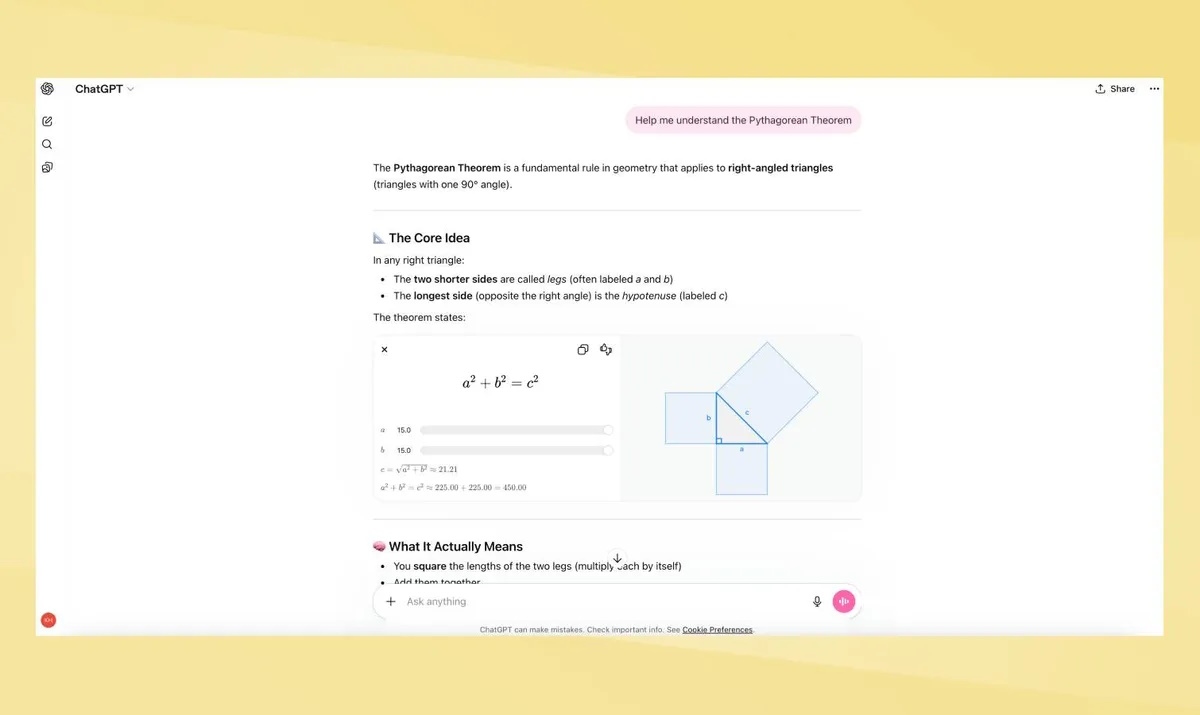
4. Visualize a concept and predict before changing it
Graphs and interactive examples can make relationships easier to inspect, but looking at a visualization is still passive unless you make predictions.
Help me explore [concept]. First ask me to predict what happens when [variable] increases. Then show a small table or graph with three cases and explain the relationship. Give me one new case to predict without help. Use only the formula or source I provide.If the tool can generate an interactive chart, change one variable at a time. For equations, verify axes, units, domain restrictions, and calculated values independently.
5. Use Socratic questions with an evidence check
Question me about [topic] using the source below. Ask one open-ended question at a time. After I answer, ask a follow-up that tests my reasoning or evidence. Do not reveal a model answer until I have attempted three questions. Then identify one strong point and one gap, citing the source.

[Paste source]
Questions alone do not guarantee deep learning. Require evidence, compare alternative explanations, and write a final account that the AI did not compose for you.
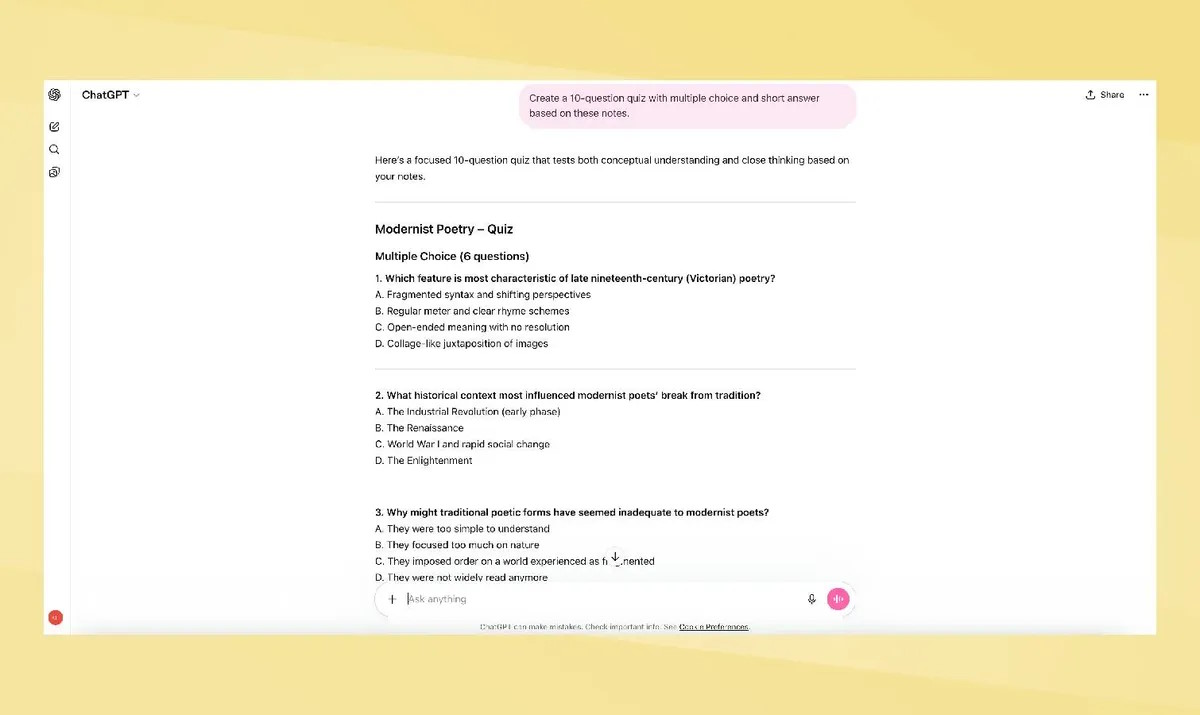
6. Generate a quiz that can reveal gaps
Create a 10-question quiz from these notes: 4 recall questions, 4 application questions, and 2 comparison questions. Do not show answers yet. After I submit all responses, score each one against the notes, quote or cite the supporting section, and separate factual errors from incomplete explanations.Take the quiz closed-book. Review every error, then ask for a new question that tests the same idea in a different context. The Institute of Education Sciences' test-enhanced learning overview lists research on retrieval practice and corrective feedback.
7. Make AI critique your explanation, not replace it
Here is my explanation of [concept]. Do not rewrite it. Identify:
1. the central claim;
2. any missing step;
3. any term I used incorrectly;
4. one counterexample or boundary case;
5. one question I should answer to improve it.
Use the provided source and state when the source does not settle an issue.
Revise the explanation yourself and keep both versions. The change between attempts is more informative than a polished AI rewrite.
Protect learning, privacy, and academic integrity
- Follow the course's rules for AI use and attribution.
- Do not upload private student data, unpublished assessments, or copyrighted material you are not allowed to share.
- Check generated questions and answers against assigned sources.
- Do not use an AI explanation as the only source for factual claims.
- Ask an instructor when feedback conflicts with the course material.
A simple test reveals whether the method is working: close the tool and produce the answer, explanation, or solution independently. If you cannot, return to retrieval and guided practice. For a broader verification routine, use TipsMake's writing quality check and adapt its evidence checks to study material.
Related Articles
 How to Fix Excel Error Not Responding When Copying and Pasting7 minutes read
 How to Use Microsoft Edge in Windows 10 to Share Web Content4 minutes read
 MS Word - Lesson 4: Editing a Word Document: Microsoft Word 20075 minutes read
 How to Copy and Paste in Microsoft Word: Step-by-Step Guide3 minutes read
 2 Ways to Copy Web Content Without Copying8 minutes read
 How to Change the Copy Paste URL Format in Microsoft Edge3 minutes read
Reader Comments 0
Sign in with email or Google to join the discussion.