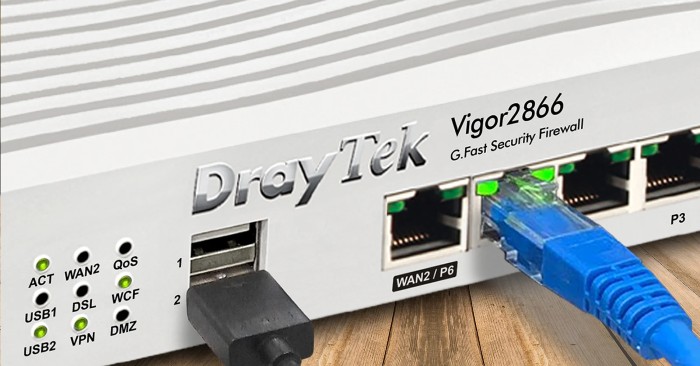
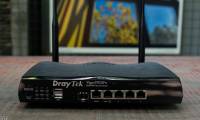
Forescout discovered that more than 704,000 DrayTek routers have web user interfaces exposed on the Internet. The majority of affected cases are located in the United States, Vietnam, the Netherlands, Australia.
List of Security Vulnerabilities on DrayTek Routers
Of the 14 new security flaws, two are rated critical, nine are critical, and three are moderate.
| CVE-2024-41592 |
Regarding a buffer overflow in the "GetCGI()" function in the web UI, which could lead to denial of service (DoS) or remote code execution (RCE) when processing query string parameters. |
| CVE-2024-41585 (CVSS score: 9.1) |
Relates to the case of inserting an operating system (OS) command into the "recvCmd" binary file used for communication between the host and client operating systems. |
| CVE-2024-41589 (CVSS Score: 7.5) |
Using the same administrator credentials across the entire system leaves the entire system compromised. |
| CVE-2024-41591 (CVSS Score: 7.5) |
Reflected Cross-Site Scripting (XSS) Vulnerability in Web UI |
| CVE-2024-41587 (CVSS Score: 4.9) |
Stored XSS vulnerability in web UI when configuring custom messages after login |
| CVE-2024-41583 (CVSS Score: 4.9) |
Stored XSS vulnerability in web UI when configuring custom router names to display to users |
| CVE-2024-41584 (CVSS Score: 4.9) |
Reflected XSS vulnerability in web UI login page |
| CVE-2024-41588 (CVSS Score: 7.2) |
Buffer overflow vulnerability in web UI CGI pages /cgi-bin/v2x00.cgi and /cgi-bin/cgiwcg.cgi leads to DoS or RCE |
| CVE-2024-41590 (CVSS Score: 7.2) |
Buffer overflow vulnerability in CGI pages of web UI leads to DoS or RCE |
| CVE-2024-41586 (CVSS Score: 7.2) |
Stack overflow vulnerability in /cgi-bin/ipfedr.cgi page of web UI leads to DoS or RCE |
| CVE-2024-41596 (CVSS Score: 7.2) |
Multiple buffer overflow vulnerabilities in web UI lead to DoS or RCE |
| CVE-2024-41593 (CVSS Score: 7.2) |
Heap-based buffer overflow vulnerability in ft_payloads_dns() function of web UI leads to DoS |
| CVE-2024-41595 (CVSS Score: 7.2) |
Out-of-bounds write vulnerability in web user interface leads to DoS or RCE |
| CVE-2024-41594 (CVSS Score: 7.6) |
An information disclosure vulnerability exists in the web server backend for the web user interface, which could allow an attacker to perform an adversary-in-the-middle attack. |
How to Fix Security Holes on DrayTek Routers
After receiving the report, DrayTek released patches for multiple router models to address the 14 vulnerabilities.
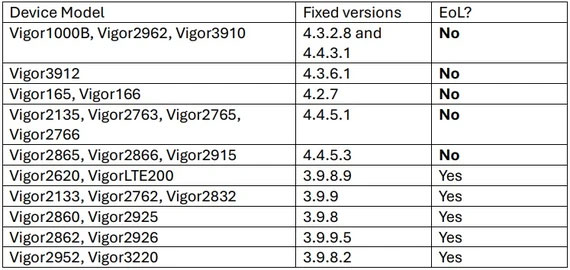
In addition to applying the latest software update, to fix security vulnerabilities on DrayTek routers users are recommended to perform the following actions:
- Disable remote access if not needed.
- Use access control lists.
- Use two-factor authentication when active.
- Check settings for arbitrary changes or added admin users.
- Disable SSL VPN connections over port 443.
- Enable syslog logging to monitor for suspicious events.
- Enable automatic upgrades to HTTPs pages on your web browser.



Reader Comments 0
Sign in with email or Google to join the discussion.