Table of Contents
This updated overview organizes the essential information about Intel Launches 14th Generation Desktop CPU Without E Core, including practical uses, key features, setup considerations, and common questions.
In the context that Intel's 14th and 13th generation desktop CPU lines are facing a number of stability and software compatibility issues, the company today surprised everyone by quietly introducing New SKUs in this product line.
Starting with the specifications, there are a total of 11 14th generation "E" SKUs that adopt only the P-Core architecture. Since these are Raptor Lake CPUs, they are based on Raptor Cove's P-Core. And while the standard product line features up to 16 Gracemont cores, these new "E" SKUs don't come with any Gracemont cores. According to Intel, these chips are aimed at the Embedded and Commercial markets so most likely will not be offered in the DIY channel, although some distributors and retailers may launch them to the market. systems configured with such chips. Below is a list of newly launched 14th generation "E" CPUs:
- Core i9-14901KE
- Core i9-14901E
- Core i9-14901TE
- Core i7-14701E
- Core i7-14701TE
- Core i5-14501E
- Core i5-14501TE
- Core i5-14401E
- Core i5-14401TE

The top SKU in Intel's 14th generation "E" CPU series is the Core i9-14901KE, which has 8 P cores, 16 threads, base clock of 3.8GHz and boost clock of up to 5.8GHz. The chip contains 36MB of L3 cache, 16MB of L2 cache and has a PL1 TDP of 125W. There are no PL2/PL4 ratings listed, so this is likely the default power of the "E" series chip. The Core i9-14901KE features fully unlocked overclocking support, making this an interesting proposition for the limited embedded and DIY market.
The Core i7 and Core i5 SKUs in this product line also have the same number of P-Cores as the standard variant, with 8 P-cores and 6 P-cores respectively. All these processors (Core i9, Core i7, Core i5) will also be available in "T" and "F" series variants, listed in the following:
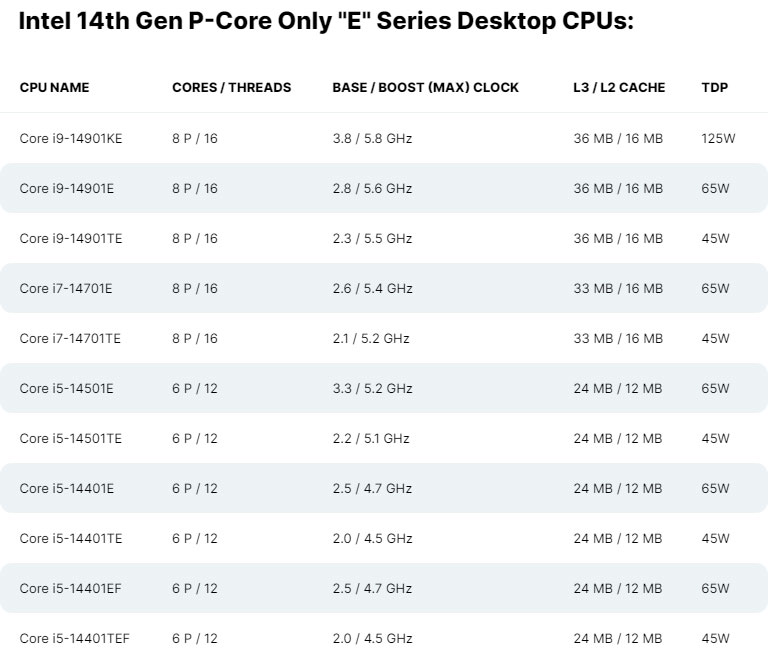
Intel has listed that these new P-Core-only 14th generation SKUs have been "released". However, since they haven't appeared on any retail store shelves yet, it seems like these chips aren't really designed for the DIY market. Intel is also preparing to introduce more P-Core-only SKUs in its desktop processor lineup, such as the Bartlett Lake-S chip that will have up to 12 P-Cores but it is expected that will launch at the end of 2025.
Final Thoughts
Use the instructions and checks above in order, verify the result after each major step, and keep a backup whenever the process changes important files or system settings.
FAQ
What is Intel used for?
In the context that Intel's 14th and 13th generation desktop CPU lines are facing a number of stability and software compatibility issues, the company today surprised everyone by quietly introducing New SKUs in this product line.
Who should consider Intel?
It is most useful for readers who need the features, workflow, or problem-solving approach described in this guide.
What should I check before using it?
Review compatibility, current software requirements, privacy or security settings, costs, and any limitations that could affect your workflow.
Related Articles
 Intel Launches 10th-generation Core X-series Processors, the Most3 minutes read
 Intel's Next Generation of Desktop CPUs Will Have 'huge' Core Counts3 minutes read
 6 Reasons to Avoid Intel's 14th Generation CPU: Best Options Compared12 minutes read
 Learn About E-Core and P-Core in Intel Cpus8 minutes read
 10 Gen Intel 10-core Desktop CPU, 20 Threads, 5.3 GHz and4 minutes read
 MSI Introduces New Generation Motherboards That Support 10th7 minutes read
Reader Comments 0
Sign in with email or Google to join the discussion.