Table of Contents
Phishing often appears as a reliable activity by legitimate companies or a reputable electronic information site like eBay, Paypal, Gmail.
This guide introduces you to some of the most popular Phishing attacks. No matter what form, you should know the basic ways to identify and prevent. Please follow the infographic below.


4 Most Popular Forms of Phishing
- Email Phishing
- Calling (Vishing)
- Texting (SMiShing)
- USB trap
Email Phishing
Phishing emails often appear as a trusted entity to stealing personal data to make money. This Phishing type often attaches malware installation files to a computer or links to illegal websites to trick victims into transferring personal data.
Statistics show that up to 91% of advanced network attacks start with email, 50% of recipients will open the email and select the phishing link. This data shows that phishing by email is an extremely effective way to be used by cyber criminals.
- How to identify and prevent phishing attacks via fake email
Calling (Vishing)
Fraudulent phone calls made by cybercrime by impersonating financial and banking services to entice users to provide money transfer information or other sensitive information.
Global damage Vishing figures are about $ 46. 3 billion per year .
TIP: Limit receiving calls from strange phone numbers and never provide personal information over the phone.
Texting (Smishing)
This is done by using text messages to lure victims to download malware onto their phones, access phishing websites or call fake phone numbers. The SMiShing message can also be towing, prompting the victim to trust leading to an immediate action such as asking for the owner's security information and personal account details.
A recent survey by Pew Research reported that only 32% of smartphone users have installed anti-virus software on their phones. So the possibility of telephone phishing attacks still reaches its goal is quite high.
TIP: Do not reply to the message or select any link. Delete messages and block the number of senders immediately.
USB Trap
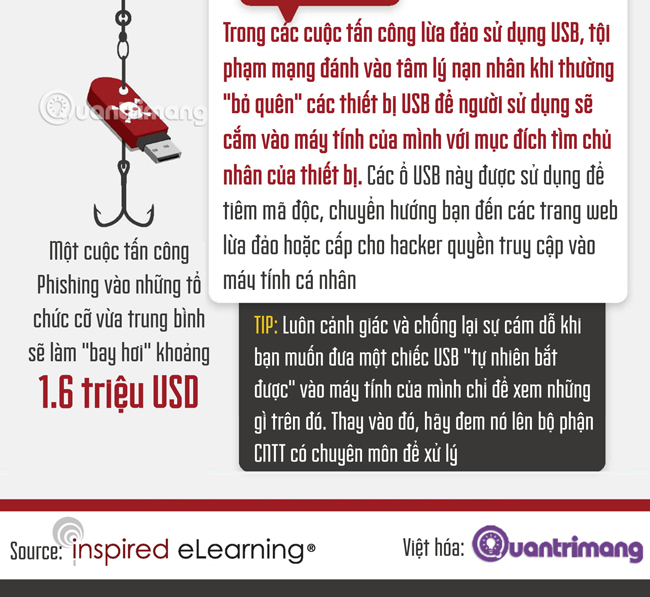
In fraudulent attacks using USB, cybercriminals hit the victim's psychology when they often "forgot" USB devices so that users would plug into their computers to finding the owner of the device. These USB drives are used to inject malicious code, redirect you to phishing sites or give hackers access to personal computers.
A Phishing attack on medium-sized organizations will "evaporate" about $ 1. 6 million each time.
So stay alert and resist the temptation when you want to get a "naturally caught" USB device into your computer just to see what's on it. Instead, bring it to the specialized IT department for processing.
Be careful and protect yourself from Phishing attacks!
Security note: Threat conditions and vendor guidance can change. Install current updates and verify any advisory with the official vendor before taking action.
FAQ
Why does 4 Types of Phishing Are Easy to Trap Users matter?
Phishing often appears as a reliable activity by legitimate companies or a reputable electronic information site like eBay, Paypal, Gmail.
Who may be affected by this issue?
The impact depends on the affected product, version, account, device, or network. Review the article details and the vendor's current advisory to confirm whether your environment is exposed.
How can users reduce the risk?
Install current security updates, use official downloads, enable strong account protection, maintain tested backups, and follow the latest guidance from the relevant vendor.
Related Articles
 What Is Trap: What Is a Trap? Trap Has Any Meaning4 minutes read
![[Infographic] How to Recognize and Prevent Phishing Attacks](/data/thumbs_200x120/[infographic]-how-to-recognize-and-prevent-phishing-attacks_thumbs_200x120_uJR0hPgYg.jpg) [Infographic] How to Recognize and Prevent Phishing Attacks5 minutes read
[Infographic] How to Recognize and Prevent Phishing Attacks5 minutes read Steps to Create an Infographic on Canva7 minutes read
 11 Free Tools That Support Creating Simple Infographic13 minutes read
 Warning: the Fake Apple Support Unit Calls to Trick Users into3 minutes read
 Want to Create a Perfect Infographic, Please Refer to This Advice4 minutes read
Reader Comments 0
Sign in with email or Google to join the discussion.