Table of Contents
This guide provides a clear, practical overview of "Earth's Magnetic Field: Origin, Structure and Impact on Humanity". It organizes the most useful details, explains important considerations, and highlights the steps or choices that matter most.
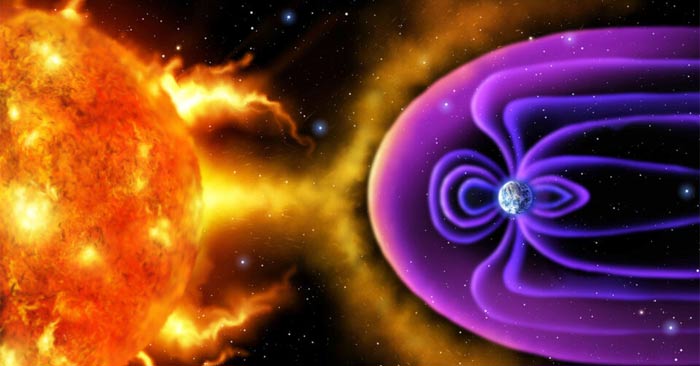
This Earth's magnetic field acts as a protective shield against solar radiation and plays an important role in many of Earth's life-support systems.
Origin of Earth's magnetic field
The Earth's magnetic field originates primarily from a region called the outer core, a layer of molten iron and nickel located about 2,890 km (1,750 mi) below the Earth's surface.
The combination of the fluid nature of the outer core, the rotation of the Earth, and convection currents driven by heat radiating from the deeper inner core creates a system in which moving electrically conducting fluids generate magnetic fields, a process known as geodynamo.
Geodynamic theory suggests that the complex movements of this fluid, caused by forces acting on the outer core, generate electric currents. Due to the geodynamic effect, these currents generate and maintain the magnetic field. Therefore, the origin of the Earth's magnetic field is closely linked to the physical properties and dynamic processes taking place in the Earth's outer core.
Keep in mind that geodynamic theory is based on our current understanding and available evidence. However, there are still many aspects of geodynamics and the processes that generate magnetic fields that scientists are still studying.
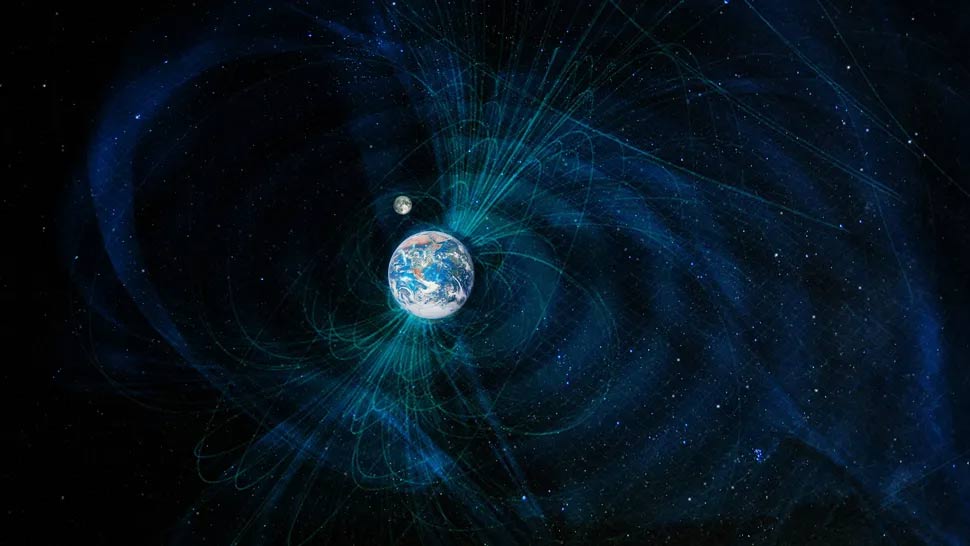
Basic structure of the Earth's magnetic field
- Dipole Fields : Magnetic fields are often considered to be dipole fields, with the magnetic poles near the geographic poles. However, the magnetic and geographic poles are not perfectly aligned and are constantly shifting.
- Strength : The strength of the magnetic field varies across the Earth's surface, ranging from 25 to 65 microtesla (µT).
- Inclination : Magnetic fields have both inclination (the angle between the magnetic field lines and the horizontal) and tilt (the angle between the magnetic north pole and true north pole).
- Magnetosphere : The magnetic field extends far into space, creating a magnetosphere that deflects and traps charged particles from the solar wind.
How does the Earth's magnetic field protect us?
Our protective magnetic 'bubble,' called the magnetosphere, protects us from harmful space weather like solar winds. Without the magnetosphere, solar winds would erode our atmosphere, stripping the blue planet of its life-giving air.
The magnetosphere also protects Earth from the massive amounts of particle radiation emitted during coronal mass ejections (CMEs) and from cosmic rays—atomic fragments—that rain down on Earth from deep space, according to NASA. The magnetosphere deflects harmful energy away from Earth and traps it in regions called the Van Allen radiation belts. These doughnut-shaped radiation belts can swell when solar activity increases.
But our protective shield is not completely invincible.
During particularly strong space weather events such as strong solar winds or large CMEs, Earth's magnetic field is disturbed and geomagnetic storms can penetrate the magnetosphere and lead to widespread blackouts and pose a danger to astronauts and satellites orbiting Earth.
In 1859, a major solar storm known as the Carrington Event caused widespread telegraph system failure, and in 1989, a CME accompanied by a solar flare caused the entire province of Quebec, Canada to experience a power outage that lasted about 12 hours, according to a NASA statement.
The extent of the magnetic disturbance from a CME depends on the CME's magnetic field and Earth's. If the CME's magnetic field is aligned with Earth's magnetic field, pointing from south to north, the CME will pass through without much impact. However, if the CME is aligned in the opposite direction, it can cause Earth's magnetic field to realign, triggering major geomagnetic storms.
Disturbances in the Earth's magnetic field direct ions down to each of the Earth's poles, where they collide with oxygen and nitrogen atoms in the Earth's atmosphere, creating brilliant auroral light shows.

According to Science Daily, in the past 200 million years alone, the Earth's magnetic poles have flipped hundreds of times in a process where the north pole becomes the south pole and the south pole becomes the north pole.
The magnetic poles flip about every 200,000 to 300,000 years, according to NASA, although it's been more than twice that long since the last reversal. Earth's last magnetic reversal happened about 790,000 years ago, so we're pretty overdue for another one. But don't worry, the poles won't flip overnight, it can take hundreds or even thousands of years for the poles to flip.
FAQ
What should you know about origin of Earth's magnetic field?
The Earth's magnetic field originates primarily from a region called the outer core, a layer of molten iron and nickel located about 2,890 km (1,750 mi) below the Earth's surface.
What should you know about basic structure of the Earth's magnetic field?
Dipole Fields: Magnetic fields are often considered to be dipole fields, with the magnetic poles near the geographic poles. However, the magnetic and geographic poles are not perfectly aligned and are constantly shifting.
How does the Earth's magnetic field protect us?
Our protective magnetic 'bubble,' called the magnetosphere, protects us from harmful space weather like solar winds. Without the magnetosphere, solar winds would erode our atmosphere, stripping the blue planet of its life-giving air.
Related Articles
 The Earth's Magnetic Field Is About to Reverse the Polarity6 minutes read
 What Is Magnetic Water? the 1-0-2 Properties of Water From3 minutes read
 The World's Strongest Magnet Can Generate a Magnetic Field of 45.22 Tesla, One4 minutes read
 How Strong a Magnetic Field Can 'Tear' You into Subatomic11 minutes read
 Bit Field in C6 minutes read
 10 Great Astronomers Have Made the Most Important Contribution6 minutes read
Reader Comments 0
Sign in with email or Google to join the discussion.