Table of Contents
The James Webb Space Telescope resolved two dusty rings and holes in the gas around NGC 1514, the Crystal Ball Nebula. It lies about 1,500 light-years away in Taurus. Webb’s Mid-Infrared Instrument, MIRI, shows material that is harder to see in visible-light images.
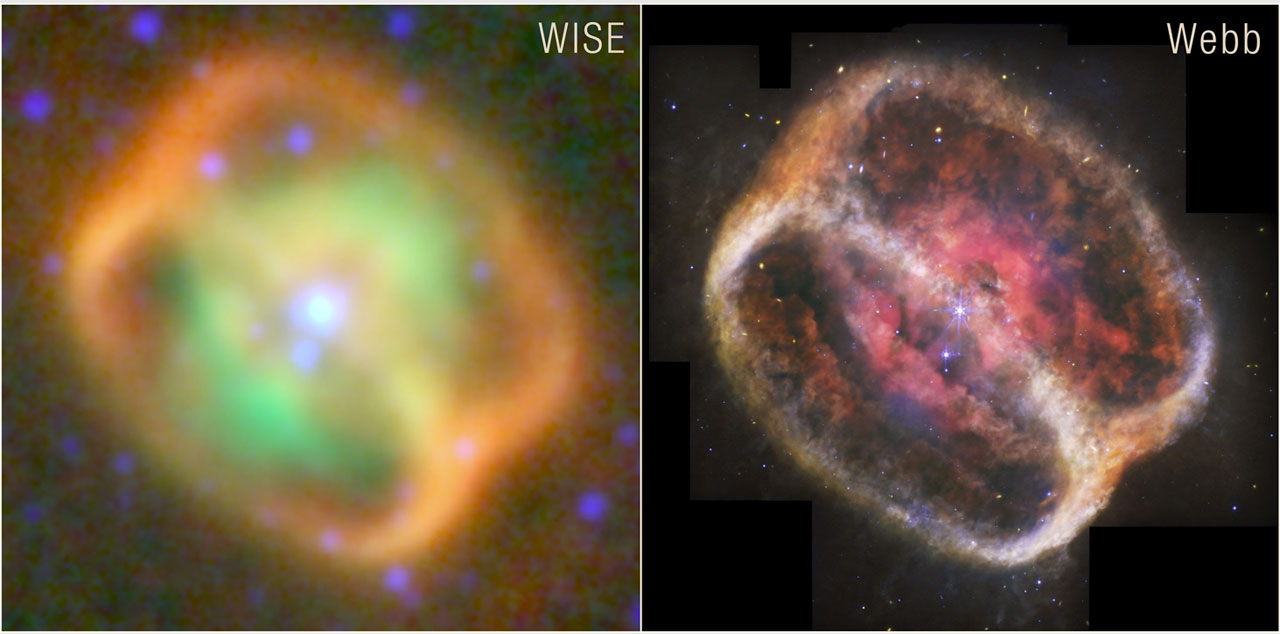
What to look for in the Webb image
Look for the clumps along both rings and the holes near the bright central region. Astronomers first identified the rings in 2010 using NASA’s WISE infrared observations. Webb’s sharper view helps trace how dust is distributed and where faster material may have pushed through it. The published colors represent infrared measurements.
How a dying star may have shaped it
One star in the central pair shed its outer layers and left a hot white dwarf. Gas and dust from that process now make up the planetary nebula. Researchers think interaction with the companion could have helped shape the material into a tilted hourglass, with the two rings marking its outer edges.
See NASA’s full-resolution image and caption. For more on Webb’s observations, see how the James Webb Space Telescope studies distant objects and view images of the Carina Nebula for a different kind of nebula.
Related Articles
 Rare discovery: A giant planet is forming in a cosmic dust vortex
 Cosmic Science: The star system TRAPPIST-1 does not 'exist' the big Moon
 Cosmic science: Inclined planets around small stars can hardly survive life
 Which star lives the longest, brightest, biggest, ... in the universe?
 Hubble Telescope extremely rare photo of the moment of the Supernova explosion
 Early in the morning, Venus and Jupiter will meet in the sky, don't miss this magical, rare moment!
Reader Comments 0
Sign in with email or Google to join the discussion.