Table of Contents
Dragonflies are rated by the scientific community as "masters of creation". Thanks to learning them, humans have created machines that can fly in the sky.
Key Facts About Bacteria
Scientists have discovered yet another amazing ability of dragonflies that people need to learn. It is the ability to kill natural bacteria on dragonfly wings.
When viewed on a microscope, the dragonfly's wings are as rough as a plug plane filled with spikes and extremely sharp bottles. They are like traps for bacteria.

Previously, scientists have tried to create antibacterial surfaces with chemicals. But when bacteria know how to resist them, it also loses its effect over time like antibiotic resistance. Scientists believe that a spiked trap on a dragonfly's wing can kill bacteria by poking through its cell walls.
Inspired by dragonfly wings, scientists also want to create traps to kill bacteria according to physical principles, so it won't be resistant like antibiotics. Traps made from black silicon nanorods pointing up to the sky like a tiny nail is called nano textured surfaces (NTS).
But recently, Nigerian and Australian scientists using super-powerful electron microscopes found that the nails on the dragonfly wings were not identical. It contained sharp nails, a high pitched one and mixed with fragments.
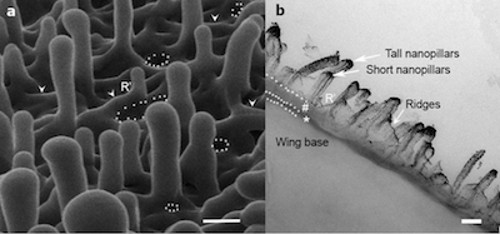 A table of nano nails that people create (on the left) and "nail and bottle" on the dragonfly wing (right).
Why Bacteria Matters
The operating principle of this trap is completely different from what we imagine, the bacteria will not be pierced when it falls into a trap.
Even the bacteria, in this case E. coli, don't even touch a nail directly. They secrete a fluid called. Extracellular polymer that Forms "hands" that adhere to sharp nails.
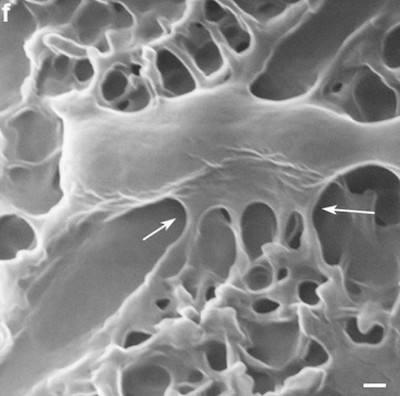 The "fingers" of bacteria attach to the surface of the nail table.
When new bacteria fall into the surface of dragonfly wings, they are immediately subjected to the force of adhesion. This force can only distort a little bit of bacterial membranes and cannot tear off the bacteria in half. If bacteria stay dormant, they will not die.
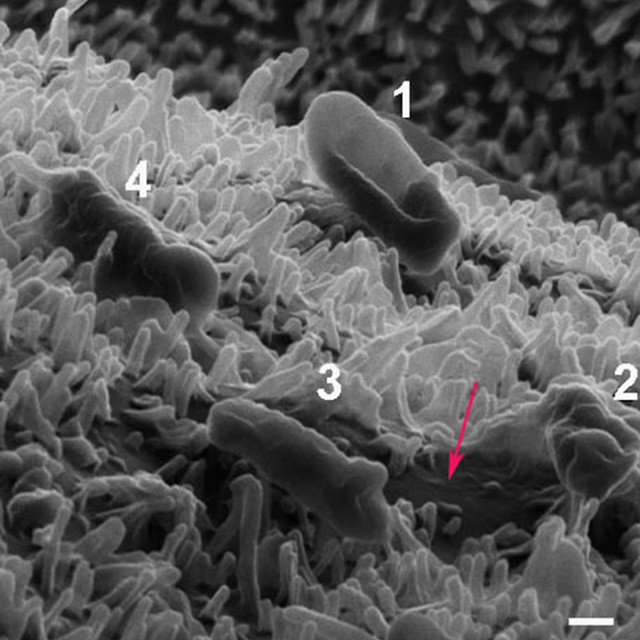 4 the state of bacteria on the nail trap, from normal to dead and flat.
But when bacteria move, the sticky force will cause a pull on the outer membrane to create tears that cause the cytoplasmic leak and organs inside them. This causes the bacteria to collapse like punctured balloons. When the bacteria are dead, nails and spiked, they stab them.
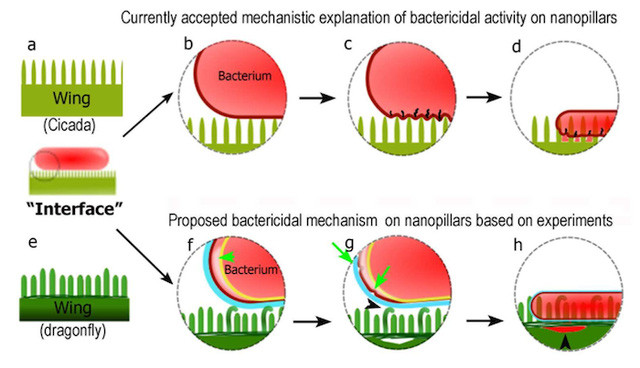 The mechanism of bacteria killed by a trap on the dragonfly wing.
Learning this mechanism to help the wings of these dragonflies stay clean, people can create many useful tools for their present and future lives.
- The device removes 99,999% of bacteria in dirty water in just 20 minutes.
- Get fever with new technology to identify E-coli bacteria.
- How did bacteria learn to fight antibiotics?
FAQ
What is bacteria?
It is the ability to kill natural bacteria on dragonfly wings.
What makes bacteria notable?
They are like traps for bacteria.
What are the key facts about bacteria?
The mechanism of bacteria killed by a trap on the dragonfly wing.
Related Articles
 Using AI to Develop Super Strong Antibiotics That Can Kill4 minutes read
 What Other Viruses Are Bacteria? Why Antibiotics Cannot Treat4 minutes read
 What Is Antibiotic Resistance? Why Is It Dangerous: Harmful Bacteria15 minutes read
 Artificial Skin Can Support Antibiotic Resistance3 minutes read
 The Artificial Neural Network Found That Antibiotics Kill8 minutes read
 How Did Bacteria Learn to Fight Antibiotics?7 minutes read
Reader Comments 0
Sign in with email or Google to join the discussion.