Table of Contents
This updated guide explains how to play go from a to z for beginners with clear steps, practical tips, and useful context. Go is a two-player strategy game that originated in China over 2,500 years ago. The objective of the game is to surround more territory than your opponent by placing black and white pieces on the board one at a time.
Rules of Go
Go has simple rules but great tactical depth, including:
Law of Freedom
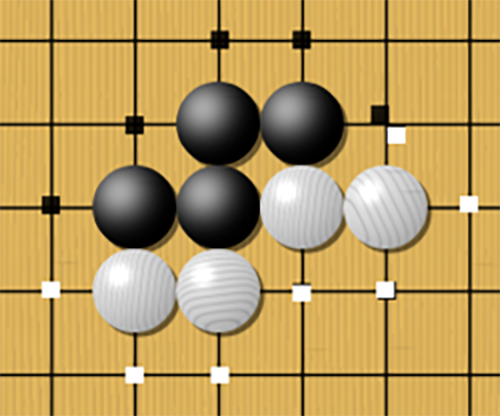
- Each piece or group of pieces must have at least one "qi" (an empty adjacent square). Losing all of its chi will result in capture. You can see below the small black and white squares, which are the chi of the two pieces.
- The pieces in the middle of the board have 4 chi, the pieces at the edges have 3 chi and the pieces at the corners have 2 chi. If a piece or a group of pieces has no more chi, it is considered surrounded and will be captured - removed from the board. If a piece or group of pieces has only 1 chi left, it means it is threatened and will be captured by the opponent's piece after the next move.
- for instance, if a white piece is placed in a place where two groups of pieces have the common energy, the two groups of white pieces will be connected together into one. The opponent's piece will be captured if it has no more energy.
Law No (fight Life)
- The immediate recapture of a previous position, specifically a position on the board where a repetition of a previous situation occurs after a capture, is prohibited. The rule is designed to avoid this situation from repeating indefinitely, i.e. the player is prohibited from immediately recapturing the point and must first move elsewhere, after which the ko point can be recaptured.
At the start, players take turns placing a piece at an empty intersection. Pieces cannot move, and are only eliminated if they run out of air.
The game ends when both sides pass or one side loses, points are calculated based on the number of siege points and the number of captured pieces.
How to calculate points:
- Japanese Rules: Points = surrounded territory + number of captured troops.
- Chinese Rules: Points = surrounded territory + number of troops left on the board.
Compensation points (komi): To balance the advantage of going first, white is usually awarded 5.5–6.5 points depending on Japanese or Chinese rules.
Chessboard and Pieces
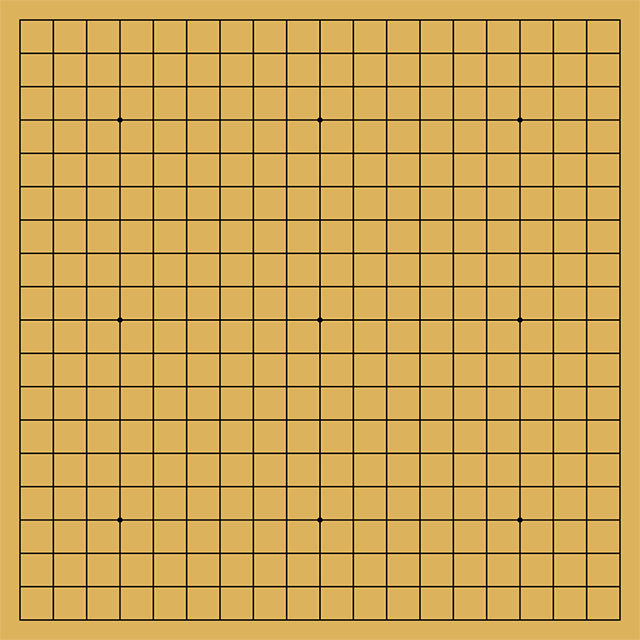
- Goban: Standard 19×19 board (361 intersections). 13×13 and 9×9 boards are for quick learning or short games.
- Go-ishi: Round, black and white stones. Japanese and Korean styles have two convex sides, while Chinese styles have a flat bottom.
- Materials: Plastic, porcelain, marble, or traditional like slate (black) and seashell (white).
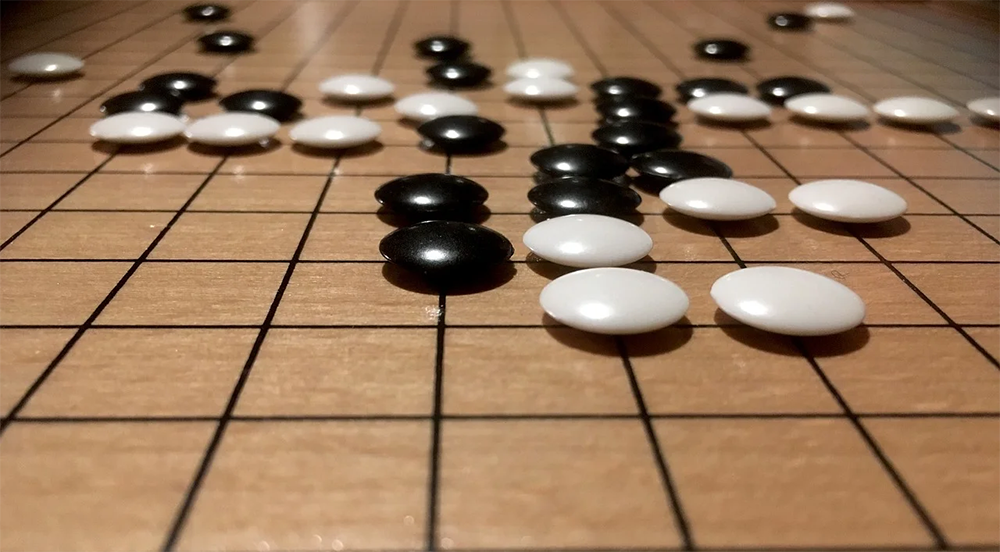
Pieces are placed at intersections and do not move, your piece will be captured if it runs out of air.
Basic and Advanced Tactics
Opening phase (Fuseki):
- Prioritize hitting corners because they are easy to surround.
- Learn common openings (joseki) that help you maximize your territory without losing position.
Mid-game:
- Fierce fighting phase, focus on capturing troops and destroying eyes.
- Techniques such as 'atari' (catch), 'snapback', 'seki', 'ko' appear frequently.
- ensure your group has two eyes to avoid getting caught.
End of the game:
- Focus on optimizing scores: hitting the mid-range, determining damage, completing the chain.
- Emphasize the element of calculation and making the most of each move.
Explanation of some of the Technical terms above
| Terminology | Meaning | Purpose/Tactics |
| Atari | The anvil has only one gas left. | Warn the opponent that he will be captured if he does not react. |
| Snapback | Lure the opponent to catch, then counterattack | A surprise and effective counterattack |
| Seki | Both sides live together without catching each other | Maintain balance, live together |
| No | Avoid infinite looping | Ask to play another water before catching again |
Advanced Concepts:
Thickness, cutting points, life-death, and tsumego exercises are tools for practicing water reading techniques and tactical reflexes.
Variations of Go
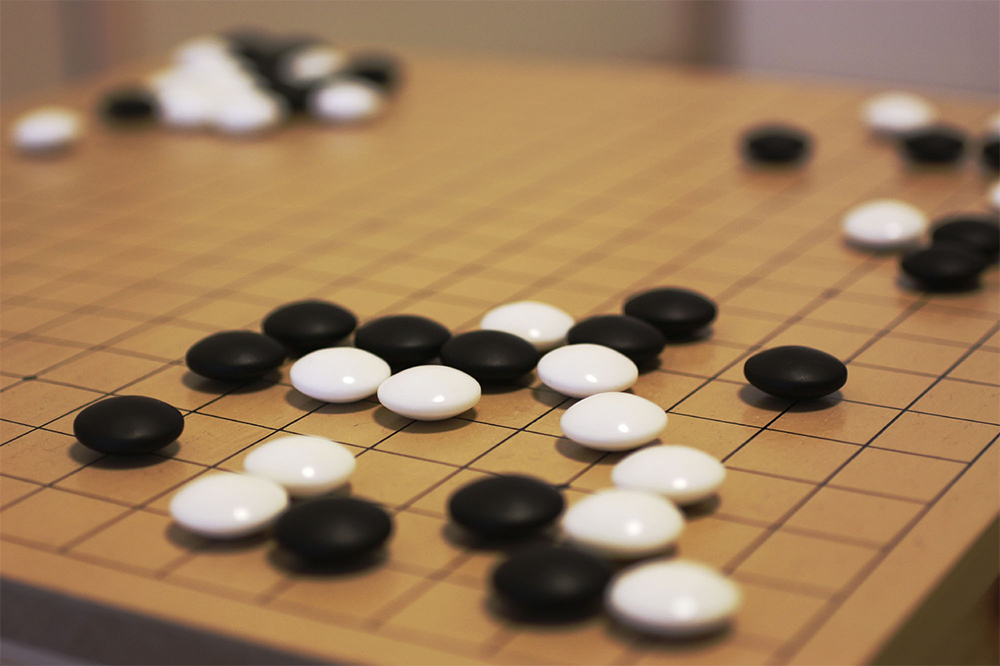
- Go 9×9, 13×13 - shortened for quick learning.
- Capture Go (Atari Go): Whoever captures the first piece wins, for beginners.
- Team Go (Rengo): Each team has 2 players taking turns.
- Batoo (Korea): Online Go with side rules like komi bidding (komi - points added to the white player's total score to create an advantage to compensate for starting the game after the black player).
Regardless of which variation you start with, the principle is still to surround territory and keep troops alive.
Study Guide for Beginners and Intermediates
Newbie:
- Start with a 9×9 board, practice the concept of air and capturing pieces.
- Playing Atari helps you quickly get acquainted with simple strategies.
- Learn how to create two eyes for troops to survive, creating eyes is for a group of troops to not be captured and can "live", it needs to create at least two eyes. A small eye has 1 - 2 empty chi, while a large eye has 3 or more chi and occupies a large area. Normally, if you create a large eye with 5 chi in the corner/edge or 6 chi in the center, the group of troops has a high chance of survival because it can easily create more small eyes when invaded by the opponent.
Intermediate:
- Move to the big table, learn joseki, practice tsumego.
- Analyze old games, play online or in clubs to improve thinking and reflexes.
- Motto: 'it is better to be alive than to be captured' – do not risk killing the enemy and losing your team.
Whether you are a beginner or an experienced player, Go is an engaging strategy game that trains your thinking, patience, and intelligence. With the resources available from books, software, and online communities, anyone can start their journey to conquer the Go board.
FAQ
What should I prepare before I play go from a to z for beginners?
Review the requirements and options in the guide first. Having the correct device, app version, account access, or materials ready helps prevent avoidable errors.
How long does it take to play go from a to z for beginners?
The time depends on the task and your setup. Most basic steps can be completed quickly, while downloads, updates, scans, or troubleshooting may take longer.
What should I do if the steps do not work?
Repeat the instructions in order, confirm that your software or device is supported, and check permissions, connectivity, and available updates before trying again.
Related Articles
 How to Play Balatro Game for Beginners5 minutes read
 Instructions on How to Play Minecraft for Beginners8 minutes read
 How to play Merge a Nuke for beginners4 minutes read
 How to Play Valorant for Newbies4 minutes read
 How to Play Palworld, Palworld Guide for Newbies: Practical Guide14 minutes read
 Black Beacon: Beginner's Guide10 minutes read
Reader Comments 0
Sign in with email or Google to join the discussion.