Table of Contents
This updated guide examines Programming: How to Become a Programmer and organizes the essential facts, background, and practical takeaways in clear American English.
Method 1
Web Programming
 Know what Web programming entails. Web applications are software components designed to work on top of the internet architecture. This means that the applications are accessed through a web browser software such as Firefox or Internet Explorer. Being built on top of the Internet architecture does not necessarily require an active connection to the internet. It means that Web applications are built on top of standard web technologies such as:
- HTTP
- FTP
- POP3
- SMTP
- TCP
- IP protocols
- HTML
- XML
- Coldfusion
- ASP
- JSP
- PHP
- ASP. NET
 Browsemany diverse websites to learn about how they usually look. (Right click, then click View Source or press F12.) Look for diversity in the type/content of the website, not the quantity of websites visited. Generally, you will need to visit at least one of each of the following types of websites:
- Corporate presence sites (commercial corporations, not-for-profit corporate/organizations, governmental organizations)
- Web indexing engines (search engines, meta search sites, specialized search engines, directories)
- Data mining sites
- Personal sites
- Informational/encyclopedic pages (wikis, data sheets, technical specifications, and manuals listing directories, blogs and journals, news and news agencies sites, yellow pages, etc.)
- Social sites (social portals, bookmarking sites, note-taking sites)
- Collaborative sites (this includes other categories mentioned above, such as wikis and blogs)
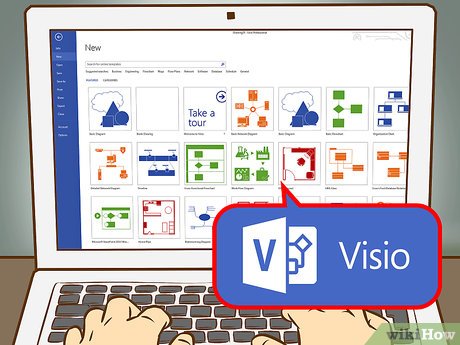 Learn at least onebrainstormingtechnique/method and a software that is used to implement that method. For example: brainstorming diagrams and MS Visio.
 Get familiar withwebsite structuring. This is creating conceptual web diagrams, site-maps, and navigation structures.
 Take a crash course on graphics design. Try to learn at least one graphics editing/manipulation software package (optional, but strongly recommended)
 Learn the basics of the internet infrastructure. This includes getting a basic idea about:
- Base Web services protocols (HTTP, FTP, SMTP, and POP3 or IMAP4)
- Web server software (preferably, one for the platform you will be working on mostly)
- Web browsing software.
- Email server and client software
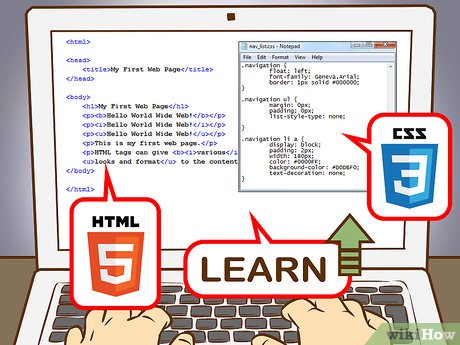 Learn the HTML and CSS languages. You might also want to get the "What You See Is What You Get (WYSIWYG)" software package for editing HTML.
 Learn XML and XML related technologies, such as XSL and XPath (optional but recommended).
 Create simple static websites until you are familiar with and comfortable aroundHTML.
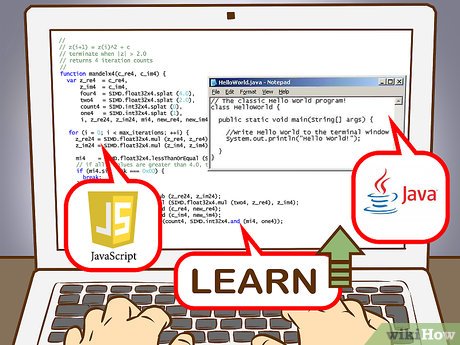 Learn a client-side scripting language. Most users learn JavaScript. Some learn VBScript, but this isn't compatible with most browsers.
 Familiarize yourself with the client-side scripting language you learned. Try to reach your potential using only that language. Only go to the next step after you've at least become familiar with your client-side scripting language.
 Learn at least one server-side programming language. If you choose to restrict yourself to one server software, learn one of the programming languages supported by that software. If not, learn at least one programming language on each server software.
 Create a pilot project for yourself after you finish learning the server-side programming language.
 Obtain your own websiteand start experimenting online within your own page.
Method 2
Desktop Application Programming
 Know what you're getting into with desktop application programming. Most desktop programmers write code for business solutions, so getting an idea about businesses, their organizational and financial structure will be a big time-saver.
 Learn about the different computer hardware architectures. An introductory level course in digital circuits design and another in computer architecture is useful; however, some see it as being advanced for a starting point, so reading two or three tutorial articles (such as this one and this one) might suffice. Then you can go back to this step later, after you learn your first programming language.
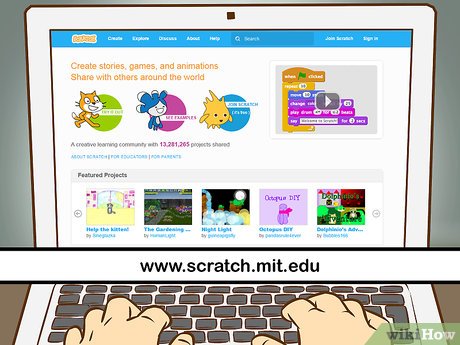 Learn an entry-level (kids')programming language. Don't be shy to learn such a language just because you're older than being called a "kid". An example of these programming languages can be Scratch. These programming languages can ease up the pain in learning your first programming language tremendously. However, this step is optional. It can also be done before the preceding step.
 Get an introduction to theprocedural,object oriented, andfunctionalprogramming paradigms.
 Take an introductory course in one of theprocedural programming languages. No matter what language you choose later to be your language of choice, it will require procedural programming at some level. Also, procedural programming is reported by most programmers to be the easiest to use as a starting point to get the idea of programming in general.
 Learn at least one advanced modeling technique such as UML or ORM.
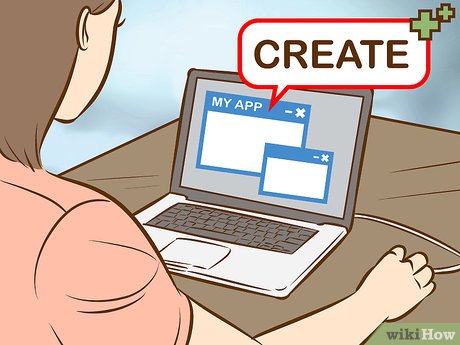 Start writing some small console or console-like applications. You can make use of common small exercises in programming languages books. For this, choose a tool for writing programs in the programming language you are writing in.
 Take a more advanced course in your chosen programming language. Make sure you understand the following concepts well and that you can apply them with relative ease before going forward:
- Inputting and outputting information to users of a program.
- The logical flow and the execution flow of programs in procedural languages.
- Declaring, assigning and comparing variables.
- Branching programming constructs such as if..then..else and select/switch..case.
- Looping constructs such as while..do, do..while/until, for..next.
- Your programming language syntax for creating and calling procedures and functions.
- Data types and manipulating them.
- User defined data types (records/structs/units) and their use.
- If your language supports overloading functions, understand it.
- The memory accessing methods of your language of choice (pointers, peeking, etc.)
- If your language supports operators overloading, understand it.
- If your language supports delegates/function pointers, understand it.
 Apply the advanced techniques you've learned.
 Take an introductory course in at least one moreprogramming languagein another programming paradigm. It is recommended to learn one programming language of each paradigm, and most advanced programmers do, however, you usually start with one, work for a while applying your knowledge and practicing it, then learn the other later on, after you already had a real-life experience in programming. Try one of the following language areas:
- Logic programming paradigm.
- Functional programming paradigm.
- Object-oriented paradigm.
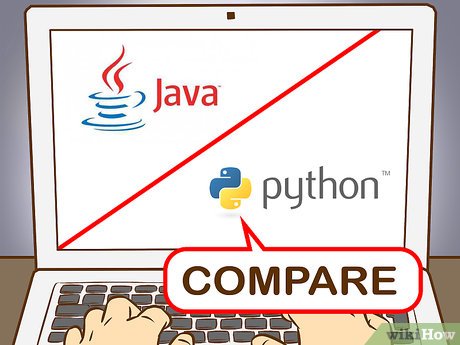 Try to compare the two programming languages you learned so far. Evaluate the strengths and weaknesses of each one. Usually this is done by:
- Taking simple samples of your early work in the first programming language and re-write it using the second programming language.
- Creating a new project and try implementing it using both languages. Sometimes, depending on your choice of project and languages, you might not be able to implement the project in one of the languages!
- Writing a cheat-sheet or summary-table comparisons between similar constructs in the two languages and features unique to each of the languages.
- Try finding ways to mimic features that is unique to one of the two languages using the other language.
 Learnvisualprogramming concepts using one of the languages you learned. Almost all programming languages have versions/libraries that support visual programming and others supporting console or console-like programming. This can be accomplished by:
- Get an introduction to event-driven programming. Most visual programming relies in some level on events and events handling (using the programming language you choose).
- Try as much desktop software as you can and understand what the software does. Most software development companies offer beta-testing versions of their products which you can use to test the software. Keep up-to-date on user interface advancements.
- Read some articles or tutorials on graphical user interfaces.
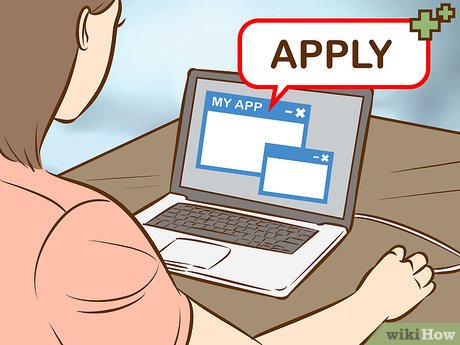 Start applying your knowledge on small software projects you design. Try applying your programming expertise on problems you face in your day-to-day life. For example, write programs that rename files in mass, compares text files visually, copies the names of files in a directory to memory/text file, and things like that. Keep it simple at first.
 Create a virtual graduation project . Complete this to the end, applying the techniques of visual programming you learned so far.
 Widen your understanding of the visual framework/library/package you learned before by taking advanced courses, paying extra attention to detail and learning more tips and tricks for your framework from online resources.
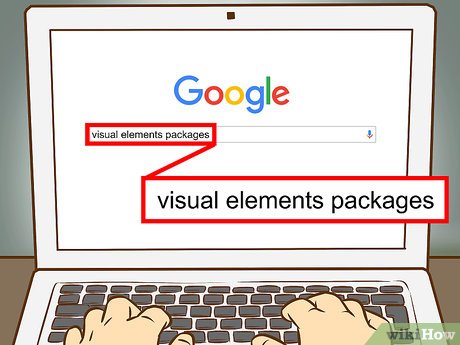 Search for other packages/libraries of visual elements for your programming languages and learn them.
 Take a course ingraphics(not graphics design). It will be very helpful for programmers wanting to write appealing user-interface elements.
 Consider becoming a games programmer (optional). Game programming is considered, in most of its parts, desktop programming. If you intend to become a games programmer, you will need to learn more about game programming after you finish these steps. A graphics course is a must for game programmers and the second language of choice in the preceding steps should be a logic/functional programming language (preferably Prolog or Lisp).
Method 3
Distributed Applications Programming
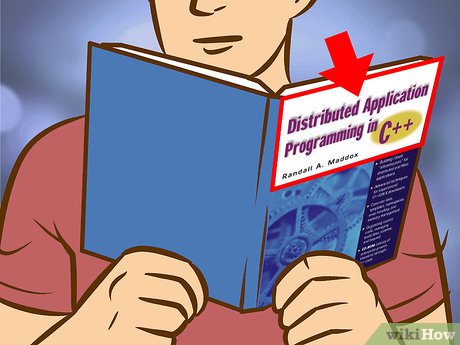 Tackle distributed applications programming. Distributed application programming is considered by many to be one of the hardest to learn and requires diverse knowledge in computer and communication technologies.
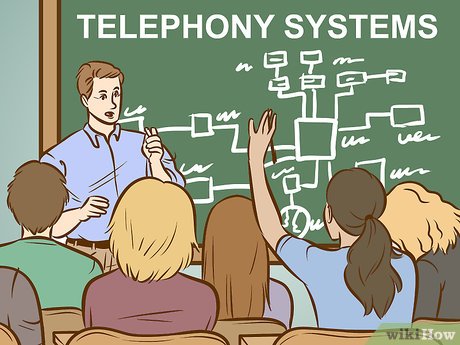 Take a speed introduction totelephonysystems and their hardware. This step is optional. However, it is very useful in understanding network topologies.
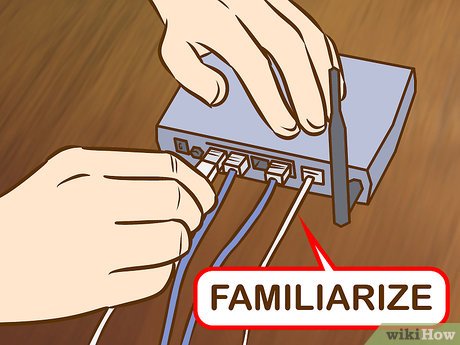 Familiarize yourself with networking hardware architectures and devices such as hubs, switches and routers.
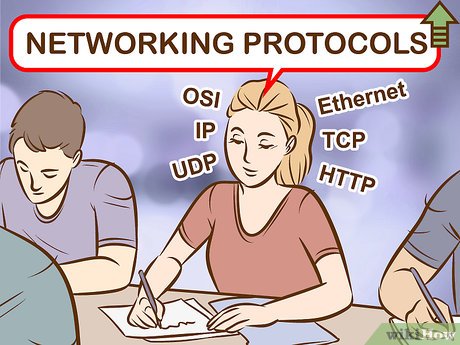 Take a course in networking protocols and essentials. You need a good understanding of the Open Systems Interconnection (OSI) model, Ethernet, IP, TCP, UDP and HTTP before you start programming distributed applications.
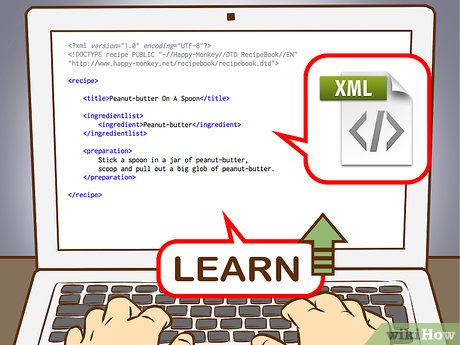 Learn the XML language and familiarize yourself with it.
 Start by learning a shell scripting language. For Windows-based programming, that would be any script that works with Windows Scripting Host. For Linux-based programming, Bash scripts and Perl will be sufficient. JavaScript is strongly recommended for this in both platforms for the following reasons:
- It is supported by almost any scripting host in any operating system (Windows Scripting Host supports JavaScript by default, most Linux distributions has a package for JavaScript scripting console support).
- It is considered to be easier to learn by many developers.
- It has an ALGOL derived syntax which familiarizes you with much more other programming languages when you need to choose a second programming language (C, C++, C#, Java and J# all have ALGOL derived syntax).
- By learning JavaScript, you familiarize yourself with client-side scripting of web pages which is a bonus side-effect!
 Apply only procedural programming using your scripting language of choice at first. Later, you can use more advanced programming techniques and paradigms according to your scripting language and what it supports. All scripting languages have some procedural programming aspects at some level.
 Use the scripting language you learned to write scripts that perform communications between machines. Learn what is necessary for doing that. Simple communications will suffice.
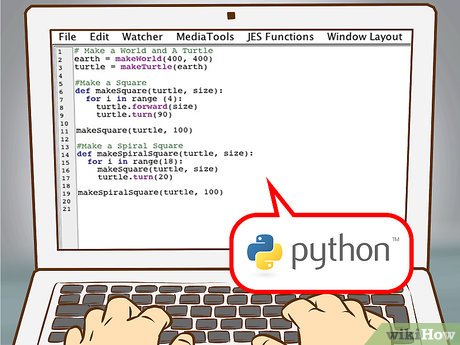 Make a transfer to a desktop scripting/programming language. Preferably, one that is a multi-paradigm language such as Python. Take a simple introduction to that second language. Java is considered by most programmers to be the language of choice for many reasons. However, C# is gaining momentum fast in this field. Java and C# are preferred for the following reasons:
- They are object oriented programming languages which shields programmers in large teams from implementation details as they both supports components (units of code, pre-compiled, that perform a certain task and can be used in other programs).
- They support event-driven programming, as well as OO and procedural programming at some level.
- The framework that the language is built upon is distributed by nature (in the case of Java).
- The availability of many ready-made packages that deal with networking, both as open-source code and framework built-in packages; this makes it easier for programmers to build upon the work of others.
 Concentratemore on the core features of the language, especially those supporting networking. Pay less attention to user-interface elements such as outputting, window design and techniques, and user-interface elements.
 Take a course on distributed applications design and architectures. This can be done using books, online tutorials or academic courses. However, understanding the architecture of distributed applications and its concepts is necessary.
 Learn about building serviced components andservicesusing your programming language of choice.
 Learn one or more of the following technologies. It is recommended that you get at least an introduction to all of them. Most distributed application programmers do not stop at one or two programming languages, but learn at least one programming language on each operating system. That is because if you want your application to be "distributed", you should provide a version of it at least for each major operating system.
- Common Object Request Broker Architecture (CORBA)
- Simple Object Access Protocol (SOAP)
- Asynchronous JavaScript and XML (AJAX)
- Distributed Component Object Model (DCOM)
- . NET Remoting
- XML Web Services
Method 4
Library/Platform/Framework/Core Programming
 Know what core programming is. Core programmers are merely advanced programmers who made the transfer from programming applications to programming code units to be used by other programmers.
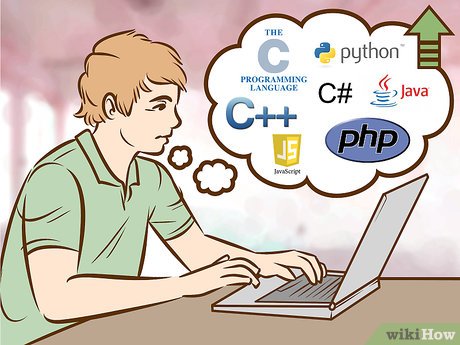 Learn a programming language that supports building reusable components/packages, if you have not done so already.
 Take an advanced course in UML and ORM. Most library developers use one or both of them.
 Take a course insoftware engineering.
 Learn at least modular, component-based, object-oriented, and event-driven programming techniques and concepts. The more programming paradigms and languages you cover, the more successful you become as a library/package programmer.
 Learn more about the differentoperating systemsand programming frameworks supported by these operating systems.
 Focus your learning efforts on platform-independent frameworks, programming languages and technologies.
 If the programming languages you learned so far haveANSI/ISO/IEEE/W3Cstandard versions, master the standards. Try to use standard code whenever possible.
 Try to mimic simple, already establishedlibraries, especially open-source ones. This is useful during the early phase of becoming a library/package programmer. Start with simple packages like units conversion and intermediate scientific calculations packages. If you are a college student, make use of your non-programming courses by trying to implement their equations and scientific core as libraries.
 Search for and try open-source packages in your field of programming. First download binaries/executables of the package. Try to use it and find its strong and weak points. After you've done that, download the source and try to figure out how it was done. Try to recreate those libraries or parts of them. At first, do that after you've seen the code and later before you see the code. At later phases, try improving those libraries.
 Learn the different approaches used to distribute and deploy components to programmers.
- Usually, library/package programmers tend to think recursively and/or iteratively of all problems they are presented with. Try to think of each problem as a collection of smaller problems (a sequence of simpler tasks) or as a repeated process of reducing the problem's scope to smaller scopes and then piling those scopes upon each other.
- Library/package programmers tend to generalize. That is, when presented with a simple specific problem, they usually think of a more general problem and try to solve that general problem which will automatically solve the smaller one.
Method 5
System Programming
 Understand what system programming entails. System Programmers deal with the science of programming not the specific implementations of it. Do not tie yourself to a specific platform.
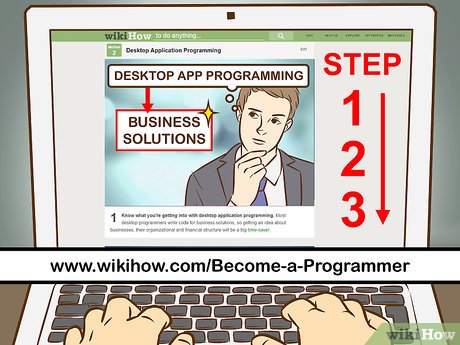 Follow the first three steps for Desktop Applications Programmers.
 Take an introductory course in Linear Algebra.
 Take a course inCalculus.
 Take a course in Logic and/or Discrete Mathematics.
 Introduce
FAQ
What is Programming: How to Become a Programmer about?
It provides a structured overview of programming, explains the main context, and highlights practical takeaways for readers.
Why does this topic matter?
Understanding the main concepts helps readers evaluate the issue, avoid common mistakes, and make better-informed decisions.
How should readers use this information?
Use the guidance as a practical starting point, confirm details that may have changed, and follow current product, safety, or security recommendations.
Related Articles
 How Much Money Do Programmers in the US Earn Each Year9 minutes read
 Congratulations to the Developers, Today, September 13 as Your Day!4 minutes read
 Should a Programmer Choose a Macbook or a Windows Laptop?5 minutes read
 Provide: How to Find a Good Programmer5 minutes read
 This Is the Amount of Money You Can Earn When Doing One of the 910 minutes read
 Job Skills: Form a Way of Thinking Like a Programmer16 minutes read
Reader Comments 0
Sign in with email or Google to join the discussion.