Table of Contents
This updated guide explores how assassin bugs control their prey with practical details, clear explanations, and useful takeaways. An insect that harvests and transforms plant sap to trap prey is growing evidence that we may be underestimating the ingenuity of invertebrates.
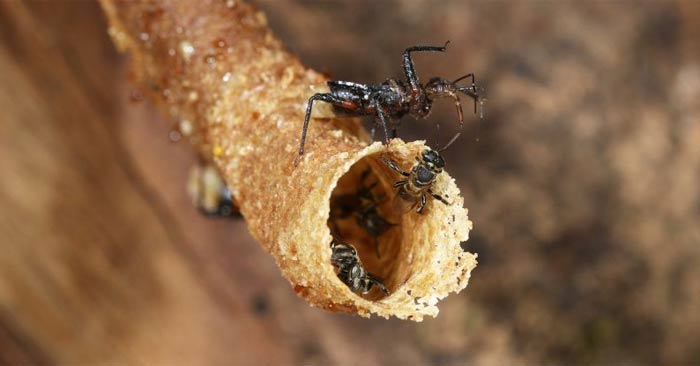
Assassin bugs (Pahabengkakia piliceps) , found throughout Thailand and China, smear tree sap on their legs, but not just for the reason you might think. The smell of the sap lures prey to the best attack location, greatly improving the assassin bug's chances of success during its hunt.
" We empirically demonstrate how invertebrate predators adapt to the social insect's swarm defense through tool-use behavior ," a research team led by entomologists Zhaoyang Chen and Li Tian of the top China Agricultural University writes in a new paper.
"Our findings provide a new paradigm for studying the adaptive functions and underlying mechanisms of tool use behavior in animals."
In recent years, we have discovered that tool use in non-human animals is probably more common than we once thought—and not limited to vertebrates.
Insects like bees and ants use tools to make their lives easier; and a 2023 study of assassin bugs in Australia found that these intrepid invertebrates use plastic to make themselves sticky, facilitating more successful prey capture.
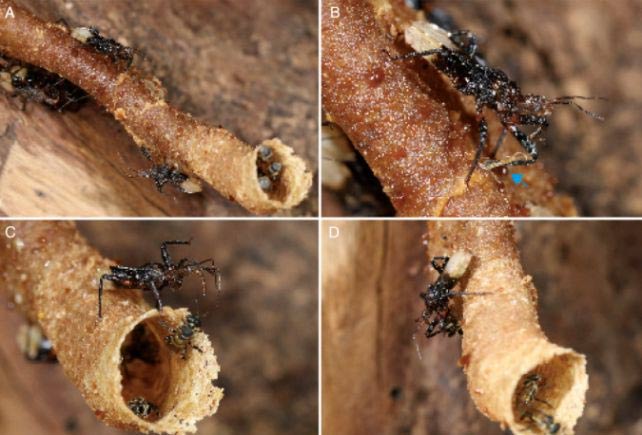
P. piliceps is a species from another part of the world. Its lifestyle is much more specialised than that of the Western Australian assassin bugs. It relies on very special prey: six species of stingless bees. The assassin bug builds its own nest not far from the stingless bee nests, and hangs around the entrances of the nests to hunt.
Bees possess only a degraded stinger, which means they have to get creative with their defenses. They coat the entrance to the hive with droplets of resin; when intruders try to enter the resin-covered hive, the guard bees rush out to attack and neutralize the threat.
Here's what P. piliceps does. It dips its legs into the resin left by worker bees, coating its front and middle legs evenly. It then sits at the entrance to the hive and lures a sentinel bee to come running to see what's going on. The assassin bug then retreats with its protected prey to a nearby safe location.
But things got even more interesting. Despite the pine resin all over the entrance to the hive, the guard bee flew straight for the waiting assassin bug. Something else seemed to be going on.
To investigate, the researchers conducted field experiments in which they tested the stickiness of the resin and what role it played. They applied bee resin to the hind legs and rumps of several assassin bugs and observed what happened.
Even assassin bugs with the resin on their rumps and hind legs – not the legs they use to catch prey – were more successful at hunting than assassin bugs without the resin, suggesting that stickiness plays only a partial role in hunting success, unlike their Australian relatives.
So the team conducted experiments to find out why. They hypothesized that as the resin dries, it releases volatile compounds at a lower rate, and that by applying the resin to the assassin bugs' legs, they would speed up the release of volatiles.
Chen and colleagues placed some resins in a ventilated environment and measured the emission rates before and after application. Indeed, the emission rates of volatile substances were higher after application.
This suggests that, by using the plastic, the beetles are signaling to the bees that they need to come and solve the problem.
The use of plastic – a foreign object – alters the physical properties of the assassin bug's body to achieve a specific goal. This fits the criteria. Interestingly, Still, the way this tool is used differs from the way a similar tool is used in Australian assassin bugs. The specialization of P. piliceps may play a role in this; but further research is needed.
" Although the role of food specialization in the evolution of plastic use warrants future cross-species comparative studies within a phylogenetic framework ," the researchers write, " this specialized assassin bug system of stingless bees provides a valuable model for studying adaptive evolution and tool use behavior, with fewer ethical constraints than studies based on vertebrates ."
The study was published in PNAS.
FAQ
What is the main takeaway about How Assassin Bugs Control Their Prey?
The key is to understand the core idea, compare the available options, and apply the practical guidance that matches your situation.
What should beginners know about How Assassin Bugs Control Their Prey?
Start with the essential steps and terminology. Avoid changing advanced settings until you understand how they affect performance, privacy, cost, or compatibility.
How can I use this information in practice?
Follow the relevant section in order, test one change at a time, and confirm the result before moving to the next step or recommendation.
Related Articles
 Viking Is Not an Assassin, So Is It Worth Looking Forward to8 minutes read
 Invite Assassin's Creed Brotherhood Download for $$ 19.99, Free3 minutes read
 Assassin's Creed Valhalla Is Big, But Northern Europe10 minutes read
 Assassin's Creed Valhalla - New Fascinating Revelations10 minutes read
 Download Assassin's Creed 2 Game Now for Free on Uplay3 minutes read
 Download Assassin's Creed Origins Gold Edition - How to Install and8 minutes read
Reader Comments 0
Sign in with email or Google to join the discussion.