Table of Contents
This guide provides a clear, practical overview of clean command in Windows, with useful context, important details, and straightforward takeaways for everyday readers.
Clean command syntax
clean [all]command parameter clean
ParameterDescriptionall Specifies that each and every sector on the drive is set to 0, this will completely erase all data present on the drive.
Note:
- On MBR (Master Boot Record) drives, only the MBR partition information and hidden sector information are overwritten.
- On a GPT (GUID Partition Table) volume, the gpt partition information, including the Protective MBR, is overwritten. No hidden sector information.
- A drive must be selected for this to be successful. Use the select disk command to select a drive and switch to it.
Example of how to erase the drive with the clean command via Command Prompt
1. To determine the drive number assigned to a 3TB+ MBR partitioned volume, follow the steps below.
- From the Start menu , right-clicking on Computer will provide a drop-down menu. (If you are using Windows 8 or 8.1, move your mouse to the bottom left corner of the desktop and right-click. Then select Disk Management ).
- Select Manage.
- Select Disk Management (listed under Storage ).
- Find the drive identified as a 3TB (2794GB) drive. The properties window shows that the partition table on the drive is MBR.
Important : Note the drive number (such as Disk 1 ).
2. Open a Command Prompt window with admin rights.
3. From Command Prompt, type diskpart and press Enter. The diskpart command prompt will open.

4. From the diskpart command prompt, type list disk and press Enter.

5. From the diskpart command prompt, you'll need to select the drive number (for example, if the 3TB+ drive is Disk 1 , you'd type select disk 1 ) and press Enter. A message appears indicating that the drive has been selected. You'll be back at the diskpart command prompt.
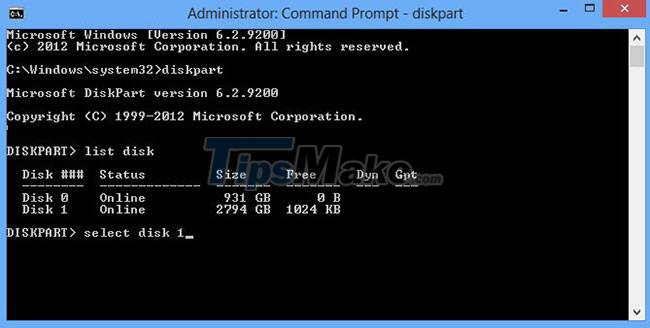
6. From the diskpart command prompt, type clean and press Enter. The drive's partition, data, and signature are now deleted. You'll be back at the diskpart command prompt.
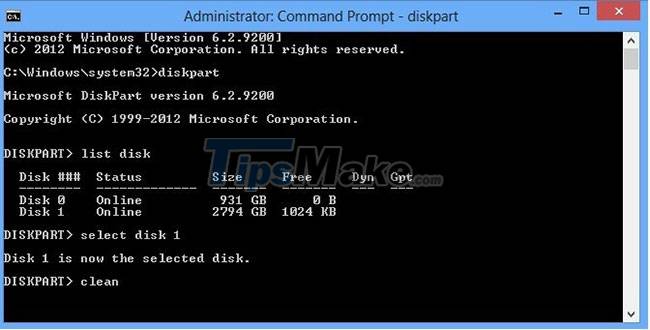
Warning : After you type clean and press Enter , the drive will be erased, no warning is provided so be careful to select the correct drive you want to erase.
7. The Command Prompt window will display the message "DiskPart succeeded in cleaning the disk" . Close the Command Prompt window by clicking the red X in the upper right corner.

8. 3TB+ drives can now be re-initialized, partitioned and formatted.
Key Takeaways
Use the information above as a practical reference for clean command in Windows. Review each step carefully, confirm any requirements, and choose the option that best fits your situation.
FAQ
What does this guide explain about Clean Command in Windows?
It explains the main concepts, practical considerations, and useful steps related to clean command in Windows without requiring advanced knowledge.
Who can benefit from learning about Clean Command in Windows?
This information is useful for readers who want a clear overview, practical guidance, and reliable steps related to clean command in Windows.
What should I check before applying this information?
Review the requirements, confirm that your device, software, or situation matches the instructions, and back up important data before making major changes.
Related Articles
 How to Clean Windows PC Using Command Prompt: Complete Guide12 minutes read
 How to Use Clean Master to Clean up, Speed up Windows6 minutes read
 How to Implement Clean Boot on Windows 10/8/74 minutes read
 Sub-commands in Nslookup Windows Command (Part 2)6 minutes read
 Sub-commands in the Nslookup Windows Command (Part 1)6 minutes read
 Sub-commands in Nslookup Windows Command (Part 3)9 minutes read
Reader Comments 0
Sign in with email or Google to join the discussion.