Table of Contents
This guide provides a practical overview of VARA - Function That Calculates Variance Based on a Sample, including its main features, benefits, limitations, and important considerations.

Description: The function performs a calculation of variance based on a sample, including logical and text values.
Syntax: VARA (value1, [value2]. )
Inside:
- VARA (value1, [value2]. : The arguments in the whole need to calculate the variance, where value1 is the required argument, the next arguments are optional and contain up to 254 value arguments .
Attention:
- The VARA function assumes that its arguments are a sample of the population.
- Arguments can be numbers, names or arrays that contain numbers.
- If the argument is an array or a reference, only values in that array are used.
- When typing logical values and presenting numeric values into function arguments -> these values are still calculated.
- True value is 1 default, false value is 0 default.
- Function error occurs when arguments are text or error values cannot be converted.
- If you do not want to calculate both logical values and text -> use the VAR function .
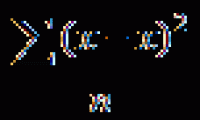
- The equation to calculate the VARA function is:
[frac {{sum {{{left ({x - overline x} right)} ^ 2}}}} {{left ({n - 1} right)}}]
Inside:
+ x is the sample mean AVERAGE (number1, number2. )
+ n is the sample size.
For example:
Calculate variance based on a sample of number values in the following data table:

- In the cell to calculate, enter the formula : = VARA (D6: D10)

- Press Enter -> variance based on a sample of number values is:

- Here the calculated logical values correspond to its default values.
- Where the value is text or logic -> the function still calculates and returns the result:

Above are instructions and some specific examples when using VARA function in Excel.
Good luck!
FAQ
What should I know about VARA - Function That Calculates Variance Based on a Sample?
Focus on the key features, requirements, limitations, and practical use cases explained in this guide.
How do I get the best results with VARA - Function That Calculates Variance Based on a Sample?
Follow the recommended steps, use current software or information, confirm compatibility, and review settings before major changes.
Are there any risks or limitations?
Potential limitations depend on compatibility, data quality, cost, privacy, support, and how the product or method is used.



Reader Comments 0
Sign in with email or Google to join the discussion.